U-M BME Team Wins $15,000 Prize for Accessible Eye-Drop Applicator
The team received the Technologies to Foster Healthy Aging Prize, funded by the National Institute on Aging, through the Design by Biomedical Undergraduate Teams Challenge, commonly known as the DEBUT Challenge.
A team of University of Michigan Biomedical Engineering graduates has won a $15,000 national prize for developing a simple, reusable device that helps patients with limited hand dexterity administer eye drops. The National Institutes of Health (NIH) and VentureWell annually announce winners of the Design by Biomedical Undergraduate Teams (DEBUT) Challenge. Two of the 14 winning projects included U-M teams.
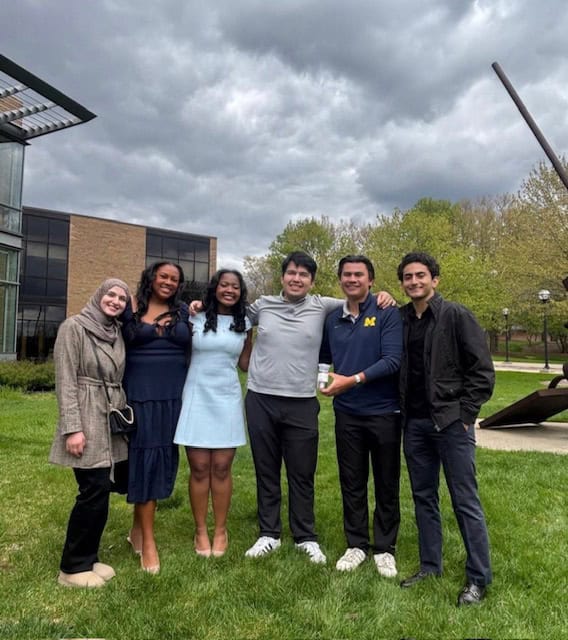
Team GlauCO received the Technologies to Foster Healthy Aging Prize, funded by the National Institute on Aging, through the Design by Biomedical Undergraduate Teams Challenge, commonly known as the DEBUT Challenge. Their project, GlauCO—A Palm-Press Eye Drop Applicator for Glaucoma Patients with Limited Hand Dexterity, was developed in U-M’s BME 450 senior design course.
The winning team members included Shahzad Sohail, Gonzalo Anyosa Galvez, Cham Alawer, Sheridan Balthazar, Karisma Edouard and Nathan Madlambayan. Dr. Melissa Wrobel, a U-M BME faculty member, served as the team’s faculty sponsor.
GlauCO is a low-cost, single-handed applicator that works with standard ophthalmic eye-drop bottles without requiring changes to the bottle or medication. Its design is intended to make it easier for people with arthritis, reduced grip strength, impaired vision or other challenges to administer their medication accurately and independently.
Finding a personal connection to an unmet need
The team began its project by brainstorming health challenges its members wanted to address. Balthazar proposed focusing on glaucoma because of her family’s experience with the condition.
“I have a family member who has glaucoma, so I had a personal connection to it,” Balthazar said. “I wanted to work on a project related to this topic, and everyone on the team was on board.”
Glaucoma is a group of eye diseases that can damage the optic nerve and cause irreversible vision loss. Open-angle glaucoma, the most common form, often requires patients to use prescription eye drops every day for the rest of their lives. Consistent treatment can lower pressure inside the eye and help prevent further damage, but administering the drops can be difficult.
Nearly 45% of patients cannot consistently administer their own eye drops, according to background information accompanying the team’s project. Older adults who also have rheumatoid arthritis or other conditions affecting hand strength and dexterity may face additional challenges, including difficulty squeezing a small bottle, positioning it above the eye and dispensing a single drop.
After connecting glaucoma with arthritis and mobility limitations, the students researched existing products and patents to determine where current approaches fell short.
“We examined products already on the market and tried to identify the problems that each one addressed,” Edouard said. “Some products focused on one issue, while others focused on something different. It was important to us to create something that could address several of those problems at the same time.”
The students also interviewed stakeholders, including pharmacists, physicians and potential users. Edouard’s conversation with a pharmacist highlighted the consequences of inaccurate administration. Patients may accidentally touch the bottle tip to their eye, potentially contaminating the medication, or dispense more medication than intended.
“I learned how many patients contaminate the bottle or their eyes while taking the medication, or lose a significant amount of their eye drops,” Edouard said. “That creates additional problems because they cannot continually obtain replacement bottles, so reducing contamination and wasted medication became a major focus for us.”
More than 30 prototypes
The team’s path to GlauCO was not linear. Early concepts explored several forms of drug delivery, including a contact lens that could release medication over time. Through research, stakeholder conversations and design reviews, the students determined that an eye-drop applicator represented a practical opportunity to address an immediate need.
“Our project went through many stages,” Madlambayan said. “At the beginning, we did not know that we wanted to target eye-drop medication. We considered different ways of delivering medication before gradually recognizing how important eye drops are for this patient population.”
Once the team selected its approach, members began an iterative process of building and testing prototypes.
“We went through more than 30 prototypes for the device,” Madlambayan said. “Each iteration included something different or something we had not considered before. One of the benefits of the way the class was structured was that we were continuously innovating and improving the project.”
Members divided responsibilities according to the project’s needs and their individual strengths. Anyosa Galvez took a leading role in computer-aided design, while other team members worked on physical prototypes, stakeholder analysis, testing and documentation. Regular team meetings ensured that everyone understood the full project rather than only one component.
“We divided the work into equal parts while making sure that everyone knew what was happening in each area,” Sohail said. “During our team meetings, we updated one another, discussed our next steps and made sure we were all on the same page.”
Edouard said the six team members’ different backgrounds and interests within biomedical engineering contributed to the design.
“We had a strong diversity of thought about where the product could go,” she said. “That was especially beneficial during the meetings when we sat together at a whiteboard and worked to determine the best next step.”
Making eye-drop delivery simpler
GlauCO is designed to fit into one hand. The patient inserts a standard eye-drop bottle into the bottom of the applicator without transferring or refilling the medication. An ocular cup at the top helps align the device around the eye, while a palm-press actuator dispenses the drop. In addition to ease of use, one of the goals of the device is to reduce product waste and cost for patients.
“As part of the class, I’m repeatedly asking teams to consider the environmental and economic impact of their designs,” said. Dr. Wrobel. “A lot of thought and analysis went into the materials selection for the students’ design, how much it would cost to manufacture, how long parts would be expected to last, and other considerations, which I think also made it competitive in the DEBUT competition with a focus on commercial viability/translation.”
The eye cup can be surrounded by a foam or silicone ring made from a material selected to avoid introducing contaminants near the eye. Different cup sizes and shapes can accommodate a range of users and facial anatomies.
“You insert the eye-drop bottle into the bottom of the applicator, position the cup around your eye and press once to dispense the drop,” Balthazar said. “Because the medication’s original bottle is placed directly into the applicator, the device can work with a variety of eye-drop medications.”
The applicator reduces the conventional eye-drop administration process from eight steps to six. In particular, it eliminates steps that depend heavily on fine motor control and vision. Its palm-press mechanism allows the user to apply force using the hand rather than pinching or squeezing a small bottle between the fingers.
The design grew in part from an everyday consumer product. A makeup applicator that dispensed cosmetic cream through a pressing mechanism inspired the team to explore a similar actuator for eye drops.
“I learned a great deal about reverse engineering,” Balthazar said. “The palm-press actuator built on an idea Karisma had from a makeup dispenser. Not every engineering solution has to begin with a completely new concept; many successful designs build on existing ideas in a new way.”
The resulting device is intentionally uncomplicated. Its components can be produced using accessible manufacturing methods, including 3D printing, and its modular design can accommodate different users.
“One of the strengths of the product is its simplicity,” Madlambayan said. “It is easy to manufacture, and that is by design. It is also easy for the user because it fits into the existing workflow while removing some of the most difficult steps in the drug-delivery process.”
Although the team designed GlauCO with glaucoma patients in mind, its use is not limited to one condition or age group. People who take eye drops for dry eye or other ocular conditions could also use the applicator.
“It is not only a glaucoma eye-drop delivery aid,” Edouard said. “A patient can place their prescribed eye-drop bottle into the device, so the design has the potential to be used for several different ocular conditions.”
Supporting independent treatment
Independence was an important consideration throughout the design process. While caregivers can assist some people with medication, many patients must administer their own drops—sometimes more than once per day.
“For many older adults, maintaining independence is very important, and not everyone has a caregiver,” Balthazar said. “This device can be used by one person. A patient could leave it on a bedside table and use it independently in the morning or at night.”
An eye doctor interviewed by the team confirmed that some patients struggle with alignment and dosing and that physicians already recommend assistive devices in certain cases. That conversation helped the students identify an opportunity to combine several helpful functions in a single product.
“I could see an eye doctor recommending this device, particularly for an older patient who has difficulty administering eye drops,” Sohail said. “The patient aligns it with the eye socket and presses down, making the process much simpler.”
Keeping the end user at the center of each decision also helped the team move away from more complicated ideas.
“We had to keep an open mind and focus on the user throughout the entire process,” Madlambayan said. “That helped us create something that could actually help patients, rather than simply creating something we thought would help.”
Because the team could manufacture and test its prototypes, members were also able to collect data on safety and drop-placement accuracy. That evidence strengthened the group’s DEBUT submission, Sohail said.
“The design was straightforward enough to test, so we could produce data on safety and drop accuracy and demonstrate that the device worked,” he said. “That was powerful because some of our earlier ideas, such as a drug-eluting contact lens, would have been much more difficult to evaluate within the course.”
“Ultimately, I’m proud of this team’s independence,” added Dr. Wrobel. “The project motivation and final design were truly their own. Often, my job is just to play devil’s advocate and challenge or pushback on all of their design decisions, making sure they can really defend their choices.”
Taking their next steps
Several team members described BME 450 and its structured design process as essential to the project’s success. Balthazar also credited Wrobel with encouraging the students to submit GlauCO to the DEBUT Challenge.
“The BME 450 teaching team was an amazing source of support,” Balthazar said. “They always made space to answer our questions and helped us work through challenges. We are also grateful to Dr. Wrobel for encouraging us to submit our application to DEBUT.”
“I want to acknowledge the other instructors in the course, particularly, Dr. Nabilah Khachab, a lecturer in the Program in Technical Communication, for supporting this team’s development of their written and oral communication, including how they presented their design work to outside audiences such as the DEBUT judges, and Mai Doan (UM Alum, MS in May 2026) a Grad Student Instructor who also mentored this team.
The team members themselves have begun pursuing careers and advanced study across biomedical engineering, biotechnology, pharmaceuticals, medicine and life-sciences consulting:
Nathan Madlambayan, who graduated in May, will join the biotechnology and medical technology company B. Braun in Europe. He is also considering pursuing a doctoral degree in the future.
Sheridan Balthazar, a May graduate, returned to U-M through the Sequential Undergraduate/Graduate Studies program in Biomedical Engineering, concentrating in biomaterials and regenerative medicine. She plans to enter industry, working at Boston Scientific as a Manufacturing Engineer after completing her master’s degree.
Karisma Edouard, who also graduated in May, began working as a Quality Assurance Representative at Eli Lilly and Company, supporting the frontline manufacturing of the active pharmaceutical ingredient used in two insulin medications.
Shahzad Sohail, a May graduate, has pursued work in life-sciences consulting and cell re-programming research and will begin medical school at the Icahn School of Medicine at Mt. Sinai in July.
Gonzalo Anyosa Galvez, a May graduate, started the doctoral program at the Biological Engineering program at the Massachusetts Institute of Technology, continuing his undergraduate work in tissue engineering and biomaterials research.
Cham Alawer, a May graduate, will begin work at a healthcare tech startup, supporting digital care management and patient coordination, and plans to take the Patent Bar to become a registered patent agent.
For the students, the project demonstrated that an effective biomedical device does not need to be technologically elaborate. It needs to respond to a clearly defined problem and work for the people expected to use it.
“Dr. Wrobel reminded us not to create the most extreme or complicated contraption,” Balthazar said. “The solution simply needed to be useful, and that is what we tried to keep in mind throughout the project.”