
Biomedical Engineering
Solving important challenges at the intersection of engineering, medicine, and the life sciences for the benefit of humanity

-

Keith Cook Named William and Valerie Hall Department Chair of U-M Biomedical Engineering
Dr. Cook identified U-M Biomedical Engineering’s breadth of research and strength in education as two of the department’s major assets.
-

Sean Chambers Receives 2026 U-M BME Alumni Merit Award
This award recognizes an alumnus who has demonstrated outstanding leadership, scientific achievement, and a lifelong commitment to translating engineering innovation into clinical impact.
-

Synthetic Immunological Niches Could Offer an Earlier Warning of Islet Transplant Rejection
Research from the Shea Lab uses implantable synthetic immunological niches to monitor immune activity, with the goal of identifying islet transplant rejection before conventional clinical measures can.
DOCTORAL PROGRAMS
Learn about research and funding opportunities
MASTER’S PROGRAMS
Explore BME pathways to earn your MS, MSE, or MEng degree
UNDERGRADUATE ADMISSIONS
The Michigan BME undergraduate degree program provides a strong foundation in the life sciences and engineering.
BME Innovations
Read BME highlights from the past year.
Core Faculty

Our 48 Core Faculty reflect the breadth and depth of research represented in BME.
By the Numbers
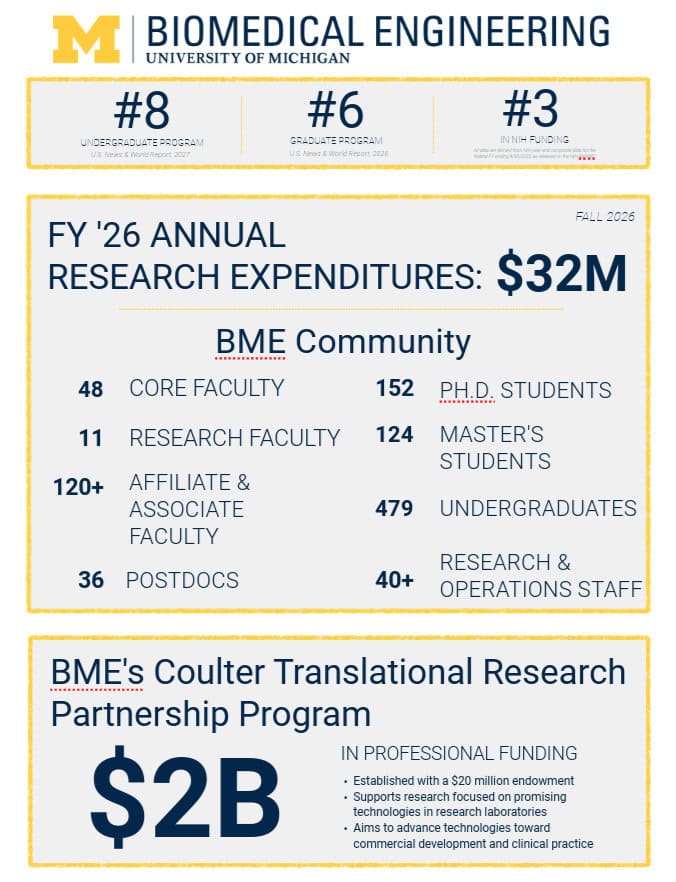
Michigan BME is one of the oldest and largest biomedical engineering programs in the country.
Doctoral Brochure
Learn details about our Ph.D. program.
Master’s Brochure

Read about options for our Master’s degrees.
Undergraduate Fact Sheet
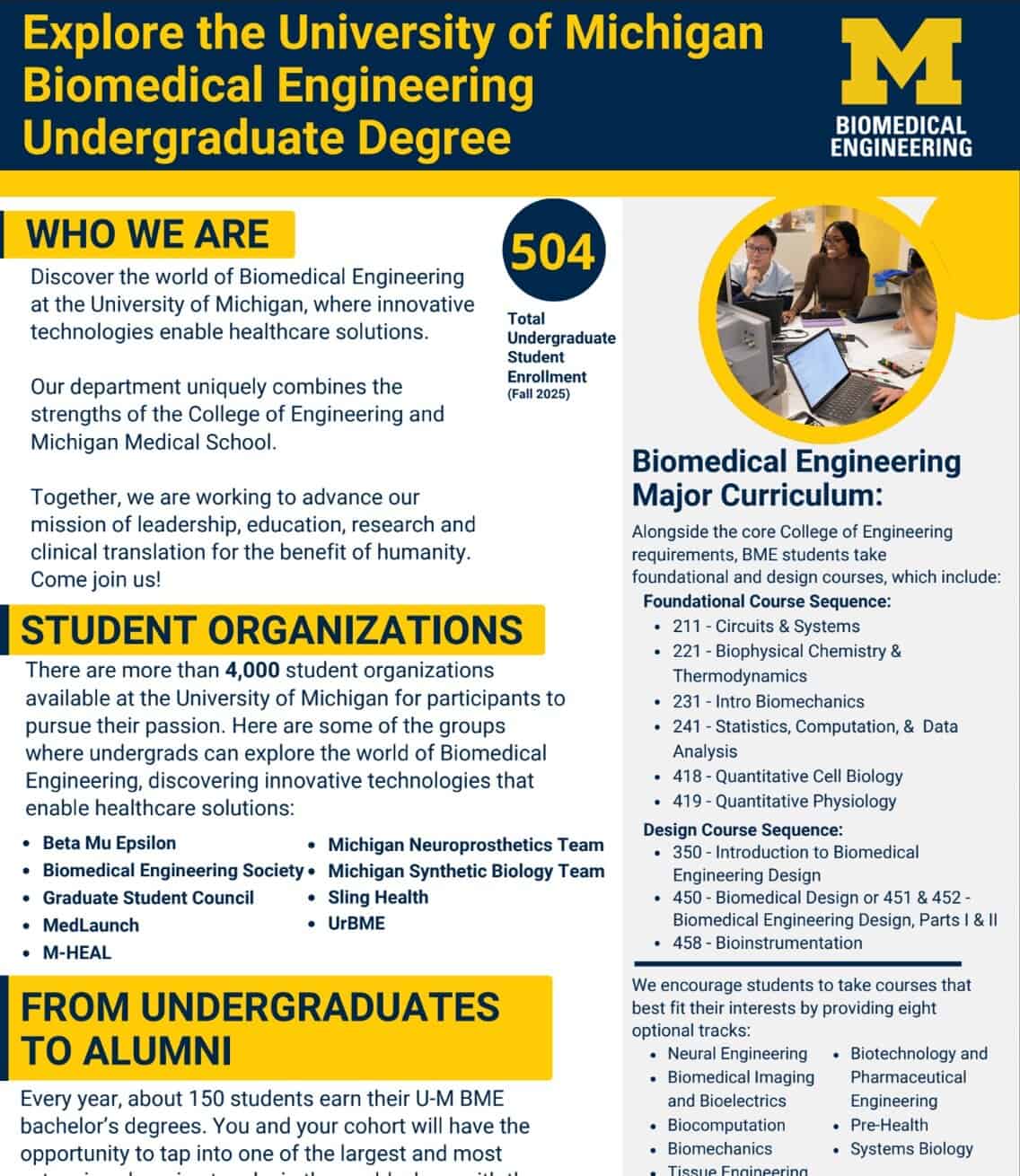
Learn about our undergraduate opportunities.
Select BME Videos:
Edge in Tech Athena Awards
The EDGE in Tech Athena Award for Early Career recognizes promising young STEM leaders in industry, academia, or the public sector. Nominated by Mark Saltzman, Celeste Nelson, and Taylor Feehley, the award was presented to Dr. Alexandra Piotrowski-Daspit, a distinguished figure in the fields of biomedical engineering and internal medicine. Her research, notably in three-dimensional cell culture models, has significantly advanced our understanding of tumor development and mechanics.
Engineering 100 Section 510
Course Description:
Interested in BME or the healthcare industry? This section could be for you! Join us for a deep dive into the high-stakes world of technology and human health. Biomedical engineers design, redesign, and test devices that improve the treatment, diagnosis, and monitoring of important health challenges facing humanity today. This section will let you experience this process hands-on with real medical devices. We will explore:
- Stakeholder analysis (e.g., interviewing clinicians and patients)
- Ethical, legal, social, environmental, and economic implications that underlie every decision a biomedical engineer makes
- Statistics, regulatory bodies (e.g., FDA), and patent law to understand bringing a new device into the world
Learn about Histotripsy, a process used to treat cancer that was pioneered at U-M BME, through this video produced by Reuters.