A team of recent University of Michigan Biomedical Engineering graduates has won a $15,000 prize for developing an internal applicator designed to improve radiation treatment for patients with inoperable endometrial cancer.
The team received the National Cancer Institute-funded Technologies for Cancer Prevention, Diagnosis, or Treatment Prize for Endura’s Chiral Uteri. Team members include Julia Sarrach, Caroline Dean, Joyce Kafi, Shlok Bhattad and Eeshan Khandelwal, with U-M BME faculty member Dr. Rachael Schmedlen serving as the team’s sponsor and advisor.
The project began in BME 451 and 452, U-M BME’s yearlong senior capstone design course sequence. Through the course, students work with clinical and engineering clients to identify an unmet need, research existing approaches and develop and test a potential solution.
“Our clients introduced us to a clinical problem they were facing,” Bhattad said. “We worked to understand the problem, develop a need statement and conduct additional research so we could determine how best to address it.”
“Much of our introduction to the problem came from conversations with our clients and physicians at Michigan Medicine, along with extensive literature research,” Sarrach added.
One of the team’s clients included a Michigan Medicine medical physicist, Dr. Choonik Lee, and biomedical engineer Rajiv Trivedi. The students also consulted radiation oncologists at Michigan Medicine and reviewed relevant scientific and patent literature.
“Working with such brilliant and dedicated students has been an absolute privilege and a true joy, said Dr. Lee, Director, Brachytherapy Physics, and Clinical Professor of Radiation Oncology, University of Michigan Medical School. “Being able to bridge clinical challenges with innovative engineering solutions through this kind of synergistic collaboration is a tremendous asset and a source of pride for the University of Michigan. Huge congratulations to the team on their well-deserved DEBUT award, and I look forward to continuing to foster these incredible opportunities for our students in the future.”
Addressing limitations in brachytherapy
Endometrial cancer develops in the lining of the uterus. While surgery to remove the uterus is a common treatment, surgery may not be possible for some patients because of the tumor’s characteristics, a patient’s overall health or other clinical considerations. In those cases, physicians may use brachytherapy, a form of radiation therapy in which a radioactive source is placed inside or near the area requiring treatment.
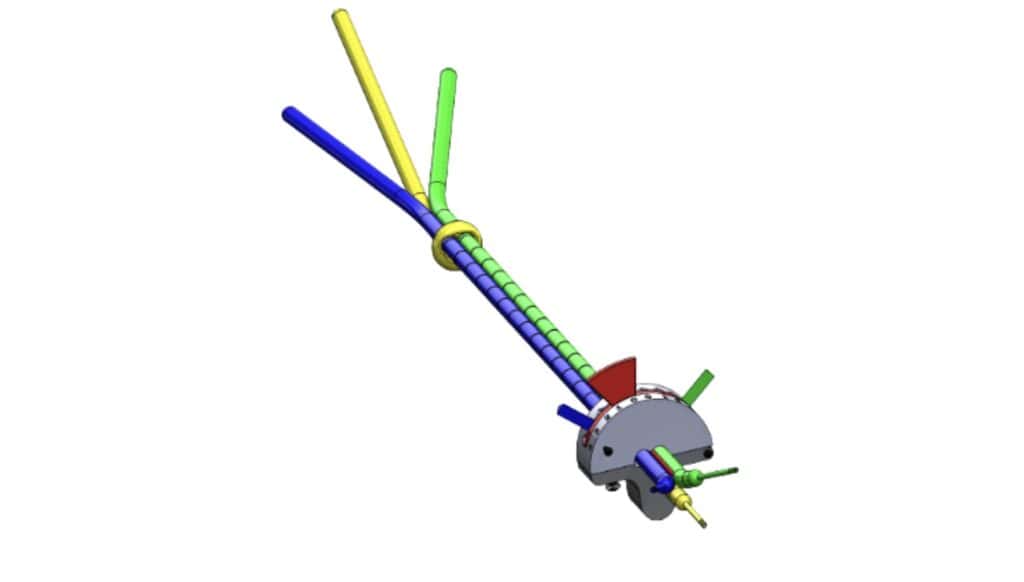
Endura’s Chiral Uteri is an internal applicator that guides a radioactive source during high-dose-rate brachytherapy. The device is intended to help physicians achieve appropriate radiation coverage inside the uterus while making insertion and positioning more efficient.
“The current devices have limitations in how deeply they can reach into the uterus and how widely they can angle outward,” Sarrach said. “If the applicator cannot reach the necessary depth or width, it may be more difficult to achieve optimal radiation coverage of the tumor.”
More complex cases may require multiple channels through which the radioactive source can travel. Existing three-channel applicators can require each component, known as a tandem, to be inserted sequentially through the patient’s dilated cervix. In addition to making the procedure more technically demanding, multiple insertions can increase the risk of uterine perforation.
“Our goal was to turn three sequential insertions into one insertion,” Sarrach said. “The physician could then splay the tandems within the uterus and lock everything into place.”
The team’s design features three stacked tandems that align into the profile of a single tandem during insertion. Once the device is inside the uterus, the physician can use external controls to rotate the tandems outward and customize their positions. A locking mechanism then holds the selected treatment geometry in place.
“Because the tandems are aligned, they can be inserted as one unit,” Bhattad said. “They can then be unlocked, rotated to the desired positions and relocked so they remain stable during the procedure.”
The rotation mechanism also gives clinicians greater control over the applicator’s configuration, allowing the treatment geometry to be adjusted to a patient’s uterine anatomy.
“We originally intended to solve the insertion problem, but the design also gave physicians another level of control because they can determine the amount of rotation on each side,” Bhattad said. “That became an important and novel aspect of the device.”
By combining the three tandems into a single insertion unit, the design is intended to maintain radiation coverage while reducing operating room time, procedural complexity, physician fatigue and the risk of uterine injury.
From capstone project to protected intellectual property
The students moved through multiple rounds of ideation, prototyping and feedback before arriving at their final design. Conversations with physicians were particularly important in identifying which design requirements should receive the greatest emphasis.
“The physicians are the people who use these products and understand what can create difficulty or increase the risk of error,” Bhattad said. “Their feedback helped us focus on factors such as ease of operation and treatment time.”
The team has filed a provisional patent covering the design. Additional development would be necessary before the device could be evaluated for clinical use, including precision fabrication in titanium, biocompatibility assessment and further safety and performance testing.
“We have the computer-aided design and a provisional patent, but the device would still need to be fabricated in titanium and undergo testing to confirm that it is safe for patients,” Sarrach said. “It is definitely possible to continue developing it, although the precision manufacturing involved would be expensive.”
Because the applicator consists of narrow, intricate components, producing a clinically suitable titanium version would require specialized machining beyond what the students could complete within the capstone course.
“Biocompatibility and precision machining were outside the short-term scope of the project,” Bhattad said. “However, the provisional patent protects the intellectual property and creates an opportunity for a company or other external partner to explore its market potential.”
A winning team experience
The award came as a surprise to the team. Dean was the first member to see the notification and initially wondered whether the message was legitimate.
“I thought it might be spam at first,” Dean said. “Then I read it and texted everyone. It was such a great team experience, and this was by far the best project team I worked on during my four years at Michigan. I was incredibly proud of everyone.”
Bhattad recalled Dean messaging the group that they appeared to have won $15,000.
“We were all really excited,” he said. “We were proud that the work we put into the project was recognized.”
All five team members graduated from U-M in May. Their next steps span industry, clinical research, graduate education and medicine:
Caroline Dean works in clinical research at Boston Children’s Hospital.
Julia Sarrach is a manufacturing engineer at Stryker.
Eeshan Khandelwal conducts electrophysiology clinical research at Allegheny General Hospital in Pittsburgh and is preparing for the MCAT, with plans to apply to medical school.
Shlok Bhattad returned to U-M to pursue a master’s degree through the Sequential Undergraduate/Graduate Studies program.
Joyce Kafi was also a member of the winning team.
Reflecting on the project, the team members emphasized the importance of beginning early and maintaining strong communication throughout the design process.
“My biggest piece of advice is to always be working on something and looking ahead,” Sarrach said. “Processes such as filing a provisional patent take time, so setting up meetings and getting started well before a competition deadline is extremely important.”
Bhattad added that the team’s close working relationship helped members use their individual strengths and manage complex tasks efficiently.
“Strong collaboration and communication made a major difference,” he said. “We could divide and conquer difficult tasks, ask for help when we needed it and keep moving the project forward.”