BMES at Michigan: Building skills and fostering community
U-M’s BMES chapter provides skill- and community-building opportunities for students seeking professional development and networking.
5–8 minutes

U-M’s BMES chapter provides skill- and community-building opportunities for students seeking professional development and networking.
The U-M Biomedical Engineering Society (BMES) student chapter has grown into a wide-reaching hub for professional development, technical training, outreach, and social connection among BME students.
“BMES is a rather large organization within U-M BME,” said Michael Fabian, who served as the chapter’s president in the 2025-2026 academic year. The chapter has about 250 registered members, with roughly 200 BME majors. Fabian estimates about 50–60 “involved members,” excluding board members, who regularly attend events, join committees, and help plan programming.
That core group is busy. The chapter aims to host three events per month, organized across four programming areas—technical workshops, professional development, outreach, and social activities—each led by a chair.
BMES’s most consistently popular programming centers on hands-on skill building—workshops designed to help students add practical tools to their coursework, labs, and resumes.
“In our surveys, BME students have consistently told us that the technical workshops have been the most useful,” Fabian said. This past year, the chapter hosted sessions on pipetting, 3D printing, and MATLAB, among other topics. A key feature of these workshops is that they are scaffolded: introductory sessions invite newer students, while follow-up workshops build upon more advanced concepts.
“We designed these sessions so that anyone who was interested—whether they were learning for the first time or looking to expand their skills—could get something out of them,” Fabian said. “We did an introductory-style session for the topic, and then the next session built off that.”
This structure supports one of the chapter’s priorities: creating on-ramps for first-year students while addressing the professional support needs of upper-level undergraduates and graduate students. Fabian noted that the chapter has seen different participation patterns from year to year. This year, with a younger board, the programming drew “a lot more younger students, especially in undergraduate representation,” though BMES has traditionally seen “more of an even split,” Fabian said.
As recruiting season ramps up, BMES shifts into career-readiness mode, with events that help students communicate their interests and navigate opportunities in industry, research, and medicine.
The chapter runs resume workshops and “pitch yourself” sessions timed around career fairs, and it has partnered with campus resources for targeted training. “We worked with the Engineering Career Resource Center for a Networking 101 event,” Fabian said.
BMES also hosted a BME Night that brought faculty into the conversation about real-world pathways. Faculty participated in a panel format and then broke into smaller discussions where students could ask questions aligned with their interests, including a focus on industry roles, Ph.D. training, and pre-health-career preparation.
“We wanted a panelist from each subfield,” Fabian said, “so students could talk one-on-one, learn more, and hear about each career path.”
To better tailor programming, the chapter also surveyed students on post-graduation goals. Fabian noted that those who expressed career interests in industry were the largest group (around 40%), followed closely by those interested in pursuing medical fields/medical school (around 30%), with the remainder interested in Ph.D. routes and other options, such as consulting. The results help BMES strike a balance: serving strong industry interest while making sure that research and clinical pathways are supported.
BMES’s outreach efforts have been growing, with the chapter building relationships with local schools and creating opportunities for younger students to learn what biomedical engineering is—and why it might matter to them. Recently, a group of students visited a local middle school to talk about BME, BMES, and life at U-M. Looking ahead, BMES hopes to do more school visits and, importantly, bring students to campus.
“Next year, the plan is to invite some students here,” Fabian said. “We have attend the kids-on-campus training, which the new board will be doing this summer.”
The motivation is simple: early exposure to biomedical engineering. “At that age, not a lot of people know what BME is,” Fabian said. “We want to explain what we do and share why this field could be something in which they might be interested.”
The chapter’s outreach also connects with other BMES programming areas and aligns with the chapter’s broader emphasis on service and community-building.
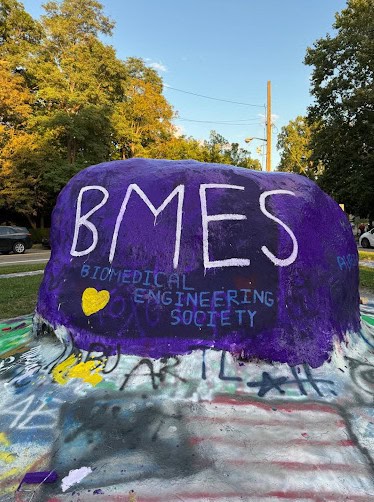
BMES is also intentional about making space for social activities to build an inclusive community. Social events range from drop-in study sessions to larger, volunteer-oriented gatherings. One of the year’s highlights was painting the rock on Central Campus, a classic Michigan tradition that drew strong participation. The chapter also partnered with Fleece & Thank You, a U-M student organization, to host a blanket-making event: students created tie blankets that were donated to C.S. Mott Children’s Hospital.
“That was really fun, and it was great to see so much participation because it had a positive impact in our broader community,” Fabian said.
BMES also hosts informal study sessions, often with food, and sometimes welcoming BME instructional aides so attendees can receive academic support while connecting with peers. When weather allows, the chapter organizes picnic-style gatherings to bring students together outside the classroom.
As a chapter affiliated with the national Biomedical Engineering Society, BMES at Michigan also helps students engage in the broader field. National conference participation can be expensive, so the chapter has sponsored some students to help offset conference attendance costs, especially for students who are presenting their research.
Locally, the chapter collaborates with other BME-focused organizations, including providing support for Beta Mu Epsilon’s backpacking event and other cross-organizational efforts to help students compare educational experiences and make informed academic choices.
For Fabian, BMES’s value is both practical and personal: The chance to gain skills, learn the landscape of BME pathways, and build relationships across class years. He offers BME students advice as they consider participating in the organization and encourages students to connect intentionally. “I’m always asking people for their LinkedIn,” Fabian said. “Before mass meetings, I encourage other students to do the same—get to know the person next to you socially, but also professionally.”
Fabian also views technical workshops as a strong entry point for new students aiming for research or internships. “I encourage freshmen to attend,” Fabian said, “so it’s something to add to their resume, especially to get into wet labs, which is usually the first step to landing an internship or summer research opportunity.”
A major selling point is access to the professional world. “Everything we do is free,” Fabian said. “It’s one of those things where students get out what they put in. If you’re one of the more involved members, you’re going to get more out of everything that BMES offers.”
For students who are unsure whether BMES is for them, Fabian’s advice is straightforward: Attend at least once, and see if the programming fits. “Go to something that seems interesting to you, such as a mass meeting, where there are a lot of people who bring different experiences to the table. Don’t be afraid to just try something new.”
As the chapter transitions to a new board this coming year, BMES plans to keep strengthening its programming, especially in the area of outreach, and will continue fostering community connections for students in biomedical engineering.