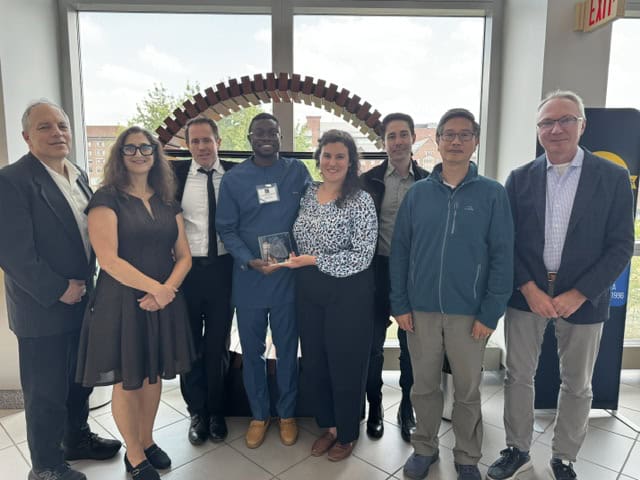
The Engineering in Cardiovascular Medicine Workshop, held August 6–7 in Ann Arbor, brought together researchers, clinicians, students, and trainees from across the cardiovascular engineering community to explore new approaches for understanding, treating, and improving outcomes for patients with cardiovascular disease.
The workshop was part of the annual BME Summer Workshops @ Michigan series and was co-sponsored by U-M Biomedical Engineering, the U-M Frankel Cardiovascular Center, and U-M Cardiac Surgery, with additional participation and support from the National Science Foundation Engineering Research Center for Cellular Metamaterials, or CELL-MET.
Featuring keynote presentations from nationally recognized experts Christopher Chen, M.D., Ph.D., Naomi Chesler, Ph.D., Elazer Edelman, M.D., Ph.D., and Igor Efimov, Ph.D., the two-day event focused on building connections across disciplines that are shaping the future of cardiovascular medicine.
“The goal of this year’s event was to bring together the cardiovascular device, computational, and tissue communities to share our research and examine where we can collaborate more to build bridges for greater understanding and advancement of our work,” said David Nordsletten, Professor, Biomedical Engineering and Cardiac Surgery. “This was a great forum for information sharing and networking, and a way for us to connect what we do as engineers to clinical settings where these discoveries make a difference in patients’ lives.”
“This workshop was a wonderful opportunity to present work from my newly established lab and to connect with colleagues across campus and at other institutions,” added Chima Maduka, Assistant Professor, Biomedical Engineering. “I had the chance to meet researchers whose work I might not have encountered otherwise, and I came away energized by the conversations, ideas, and opportunities for collaboration. I look forward to future workshops.” In addition to Dr. Nordsletten and Dr. Maduka, Brendon Baker, Associate Professor, Biomedical Engineering, and Alison Vander Roest, Assistant Professor, Biomedical Engineering, served on the faculty organizing committee.
Workshop sessions were organized around four central themes: cardiovascular tissue engineering, computational modeling and AI, engineering targeted therapies, and devices and technology. Across these areas, speakers and participants discussed advances ranging from engineered heart tissues and mechanobiology to predictive modeling, artificial intelligence, therapeutic delivery strategies, and next-generation cardiovascular devices.
The event also created opportunities for students and trainees to share their work with peers, faculty, clinicians, and visiting experts. More than 40 poster presentations showcased emerging research from institutions across the country, highlighting the breadth of innovation taking place at the intersection of engineering and cardiovascular health.
Poster awards recognized outstanding trainee research in two categories: Computation/AI and Tissue Engineering.
Poster Award Winners
Computation / AI
1st Place: Arnav Garcha, Carnegie Mellon University
A Multiscale Continuum-Discrete Solver for Platelet Adhesion, Activation, and Aggregation in Arterial Thrombosis
2nd Place: Brandon Hardy, University of Michigan
Noninvasive Measurement of TBAD Wall Mechanics for False Lumen Growth Prediction
3rd Place: Ehsan Naghavi, Michigan State University
Rapid Prediction of Cardiac Activation in the Left Ventricle with Geometric Deep Learning: A Step Towards CRT Planning
Tissue Engineering
1st Place: Miranda Wang, Boston University
Investigating the Impact of Mechanical Stress on Hypertrophic Cardiomyopathy
2nd Place: Yasaman Kargar, Washington University in St. Louis
Mechanical Forces Enable Human Stem Cell Modeling of Protein Aggregation Cardiomyopathy
3rd Place: Nathan French, University of Michigan
Effects of Myosin-Specific Pharmacologics on Cardiomyocyte Mechanical Behavior
By bringing together engineers, clinicians, and trainees working across complementary areas of cardiovascular research, the workshop underscored the importance of collaborative, translational approaches to biomedical innovation.