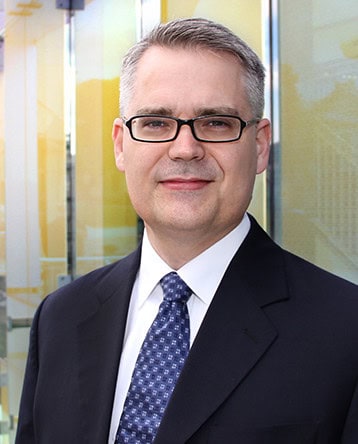
Keith Cook Named William and Valerie Hall Department Chair of U-M Biomedical Engineering
Dr. Cook identified U-M Biomedical Engineering’s breadth of research and strength in education as two of the department’s major assets.
6–9 minutes

Dr. Cook identified U-M Biomedical Engineering’s breadth of research and strength in education as two of the department’s major assets.
Keith Cook, the David Edward Schramm Professor and head of the Department of Biomedical Engineering at Carnegie Mellon University, has been named the next William and Valerie Hall Department Chair of Biomedical Engineering at the University of Michigan, effective January 1, 2027.
This appointment brings Dr. Cook back to the university where he earned two undergraduate degrees, began his research career and later served on the faculty. His relationship with Michigan runs deep, spanning almost five decades. He lived in Northwood V when his father was a Ph.D. student, and his mother worked at the University Hospital.
Dr. Cook earned Bachelor of Science in Engineering degrees in mechanical engineering and engineering science from U-M in 1993.
“When I was an undergraduate, there was no undergraduate biomedical engineering degree,” he said. “I worked hard on activities such as the Engineering in Medicine and Biology Society to provide undergraduates with opportunities to hear speakers discuss biomedical engineering. It is amazing to see how far the department has grown since then, and it will be an honor to lead it.”
Dr. Cook said his experience as a Michigan engineering student contributed to his development as a researcher and academic leader.
“I am an alumnus of the College of Engineering, and I had such a positive experience there,” Cook said. “My education at Michigan helped build me into the leader I am today. The opportunity to give back to the College and the department is very meaningful to me.”
Dr. Cook identified U-M Biomedical Engineering’s breadth of research and strength in education as two of the department’s major assets.
“The department’s strength is its diversity of research areas,” Cook said. “The major research areas in biomedical engineering are strongly represented by faculty with outstanding research programs. There is also a strong base of instructional faculty and strong leadership in the educational programs.”
As chair, Dr. Cook plans to build on that foundation by strengthening connections among U-M Biomedical Engineering, other engineering disciplines and Michigan Medicine. He said his experience working in both engineering and clinical environments will inform this effort.
“I look forward to further building bridges between the Medical School and the College of Engineering,” he said. “One of the things I have worked hard to do at Carnegie Mellon is build connections between clinicians and engineers that lead to research partnerships, and I hope to do the same at Michigan.”
Because engineering faculty and clinicians face substantial demands on their time, Dr. Cook said interdisciplinary partnerships must be developed intentionally. One approach is to create structured opportunities for clinicians to present unmet health care needs and for engineers to share the technologies, methods and expertise they could apply to those problems.
Trainees—including undergraduate and graduate students, postdoctoral researchers, medical students and clinical fellows—can also help connect research groups and sustain collaborations across engineering and medicine.
“Ideally, we can build bridges among departments and very busy people by using our trainees on both sides to help develop those connections,” he added.
Dr. Cook also wants to help establish interdisciplinary teams before major research opportunities are announced. Investigators who already have experience working together will be better positioned to pursue large, complex projects from organizations such as the Defense Advanced Research Projects Agency (DARPA) and the Advanced Research Projects Agency for Health (ARPA-H).
“I am very interested in fostering teams of investigators—whether engineers, clinicians or both—who have already started to collaborate on research projects,” Dr. Cook said. “Then, when calls come out for large research projects, those teams are ready, prepared and accustomed to working together.”
Dr. Cook sees artificial intelligence as a major area of opportunity for biomedical engineering research and education. He supports an approach that prepares students for different roles, rather than applying a single model across the curriculum.
“We need to adapt to the artificial intelligence age,” he said. “I have thought a great deal about enhancing the artificial intelligence curriculum specifically as it applies to biomedical engineering.”
Over time, he expects artificial intelligence to become a standard part of biomedical engineers’ training and practice. “Artificial intelligence should become another tool in our arsenal, much like mathematics is now, so that we are adept at using it throughout our research,” Dr. Cook said.
He also expects entrepreneurship to become more important as students seek to translate research and design projects into products and companies.
“Students are becoming much more entrepreneurial, and I think that will only increase,” he noted. “We are not only preparing students to enter industry; we are also preparing them to start their own successful companies.”
Dr. Cook identified neuroengineering, including noninvasive neural technologies, as another area likely to generate increased demand for research, education and hiring as technologies move from academic laboratories toward commercial use.
Dr. Cook’s research focus began at Michigan as an undergraduate, when he joined the laboratory of Robert Bartlett, professor emeritus of surgery, whose work helped establish extracorporeal membrane oxygenation, or ECMO, as a treatment for patients with severe heart or lung failure.
“I started working on this at Michigan as an undergraduate,” Dr. Cook said, “where we were testing the artificial-lung technology of the time.”
Dr. Cook conducted research there for several years, gaining early experience with respiratory-support systems. That work led to a position at Sarns, an Ann Arbor-area medical-device company, where he worked in research and development on devices for cardiopulmonary bypass.
Those experiences shaped Dr. Cook’s choice of graduate research and established the direction of his career. He earned a master’s degree in biomedical engineering from Northwestern University in 1996 and a doctorate in biomedical engineering from Northwestern in 2000.
“That combination of experiences ultimately led me to choose a graduate laboratory that worked on similar technologies,” Dr. Cook noted. “Since I was 19 years old, I have been working on this same topic. It has evolved over the years, but I have continued to take what I learned in medical-device development and bring in new areas, such as biomaterials and drug delivery, that can help us develop permanent artificial lungs.”
Dr. Cook’s current research applies mechanical engineering, chemical engineering and materials science principles to critical care medicine. His group works on artificial and biofabricated lungs, biomaterials designed to reduce coagulation at artificial surfaces, and long-acting contact-system inhibitors. One of his primary objectives is to develop artificial lungs that could provide years of respiratory support as a destination therapy.
His research interests also include ex vivo organ perfusion, hemodynamics, and organ transplantation.
After graduate school, Dr. Cook returned to U-M, where he became a research associate professor in Biomedical Engineering and Surgery. He developed collaborations with Michigan Medicine surgeons, some of which have continued for more than 20 years.
He left Michigan for Carnegie Mellon 13 years ago. In addition to serving as the David Edward Schramm Professor and head of Biomedical Engineering there, he is faculty director of Carnegie Mellon’s Bioengineered Organs Initiative and CMU-side director of the Mayo Clinic–Carnegie Mellon Transforming Transplant initiative.
This work has involved applying engineering methods to challenges in transplantation. At Michigan, Dr. Cook sees opportunities to extend related collaborations in biomaterials, immunoengineering and medicine.
“I have been involved in bringing engineering skills to transplantation for the past five or six years,” he said. “Michigan’s immunoengineering community could contribute to this work, including collaborations I have developed with Mayo Clinic and hope to expand with Michigan Medicine.”
Dr. Cook is a fellow of the American Institute for Medical and Biological Engineering and a member of the American Society for Artificial Internal Organs and the Biomedical Engineering Society.
Although Dr. Cook knows the university and many of its researchers, he said his initial priority will be to understand how the department has changed since his departure and gather input from faculty, staff and students.
“My biggest priorities are learning as much as I can about the department and its people,” he noted. “I may have ideas about programs or policies, but I would not want to implement them until I understand the department, its procedures and what faculty, staff and students believe is going well or may need to be adjusted.”
That process, he said, will be important for identifying the most effective decisions and developing broad support for them.
“That level of nuance is needed to make the best decisions possible and ensure buy-in from faculty, staff and students,” Dr. Cook said. “It has been 13 years, and ways of operating change and people change. I need to dig in and listen before I start to make changes.”
Dr. Cook said his appointment provides an opportunity to contribute to a department whose development he has followed since his years as a Michigan student. “The opportunity to give back to the College and the department is very meaningful to me,” Cook said. “It is amazing to see how much the department has grown.”