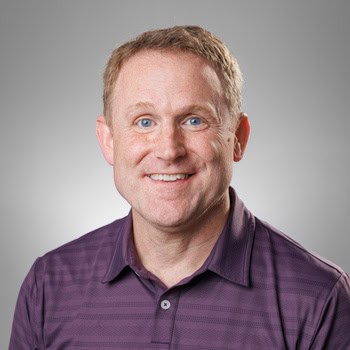
U-M BME is proud to announce Sean Chambers, Ph.D. ’98, as the recipient of the 2026 BME Alumni Merit Award. He is being honored along with other alumni by Michigan Engineering on Friday, October 16, as part of Homecoming Weekend activities.
This award recognizes an alumnus who has demonstrated outstanding leadership, scientific achievement, and a lifelong commitment to translating engineering innovation into clinical impact. Chambers, Director of Research & Development for the Interventional MRI division at Cook Medical, has spent nearly three decades building a career that reflects the Michigan BME spirit: collaboration across disciplines, rigorous engineering, and a focus on improving patient care.
For Chambers, the recognition is both meaningful and unexpected.
“I was very humbled,” Chambers said. “When I think about the caliber of peers I know who graduated from the University of Michigan and what they’re doing in their careers, it’s very humbling to think that I would be considered for this. I’m grateful to have this honor and to be able to represent the department in this way.”
A Michigan Connection, Rooted in Family and Opportunity
Chambers’ Michigan story began before he ever arrived in Ann Arbor. His mother was born and raised in Detroit, and Chambers and his sister were born in Warren, Michigan, before the family moved to Indiana. Although he grew up outside the state, southeastern Michigan remained familiar territory — and the University of Michigan held a special place.
“I’ve always been a fan of U-M,” Chambers said. “A friend of mine just sent me a picture from my senior year of high school, and I was wearing a University of Michigan sweatshirt. I remember watching the 1989 national championship basketball game with my mom. But I never thought of that being a university I could attend.”
As an undergraduate studying mechanical engineering at Rose-Hulman Institute of Technology, Chambers became increasingly interested in biomedical applications. At the time, biomedical engineering was still an emerging field, and he sought guidance from mentors about where to pursue graduate training. One mentor, Sam Hulbert, then president of Rose-Hulman and a biomaterials instructor, advised him to look for universities with both a top engineering school and a top medical school — and, importantly, a place where the two truly collaborated.
“University of Michigan had all that on one campus,” Chambers said. “A top-tier medical school, a top-tier engineering school, and people who actually functioned together. That was a big factor in my decision.”
A visit to campus confirmed the fit. Chambers recalled being struck by the depth of resources, the collaborative environment, and the people who helped him find his way into the program. He ultimately joined the lab of Dr. Robert Bartlett, the pioneering surgeon and ECMO innovator, with additional mentorship from BME alumni Scott Merz, engineering faculty Matt O’Donnell and David Kohn, and Steven Ceccio in Mechanical Engineering.
“I never envisioned, as an engineer, that I would have a surgeon be my direct advisor,” Chambers said. “But that seemed valuable for where I wanted to go. Dr. Bartlett would give me these clinical challenges — things that were needed clinically — and then I had to learn how to form the right engineering approach. That training was remarkable.”
Learning Collaboration at the Source
Chambers arrived at Michigan during a pivotal moment for biomedical engineering. At the time, U-M’s bioengineering program had already built a national reputation, but the field itself was still emerging. Chambers was a student during the Whitaker Foundation process that helped transform U-M’s program into a department and expand its educational mission.
“It was a very dynamic time at Michigan,” Chambers said. “The field was still forming, and I was able, as a student, to be part of the process Michigan went through to receive the funding that created the department. I remember the debates: Should we become a department? Should we offer undergraduate degrees? Would we lose what we are if we do that?”
Those conversations left a lasting impression.
“Michigan just provides so many experiences because of the different campuses and schools that are all there together, and they collaborate across each other,” he said. “As I look back at my career, I was able to use those experiences.”
That model of cross-disciplinary problem solving became a throughline in Chambers’ career. He credits Michigan with teaching him that engineering impact depends not only on technical excellence, but on the ability to assemble the right mix of people — clinicians, engineers, business experts, regulatory specialists, and others — to solve meaningful problems.
“One of the greatest things I learned at Michigan was that, yes, you’re an engineer, but your goal is to bring in the right people, the right experts, and help solve the problem,” Chambers said. “Michigan teaches that so well.”
Pioneering Interventional MRI at Cook Medical
Since joining Cook Medical in Bloomington, Indiana, Chambers has focused on applied research and product development, working closely with clinicians and university collaborators to advance new medical technologies toward commercialization.
Today, as Director of R&D for Cook Medical’s Interventional MRI division, Chambers is helping lead an emerging area of image-guided intervention. Interventional MRI, or iMRI, uses magnetic resonance imaging to guide minimally invasive procedures, offering an alternative to imaging modalities such as fluoroscopy, CT, or ultrasound.
Chambers has been involved in Cook’s iMRI efforts for more than a decade. What began as a research program eventually developed into a formal collaboration involving Siemens Healthineers and led to the creation of a dedicated iMRI division at Cook Medical. The division, established in 2024, is now advancing its first commercial products.
“We are taking and commercializing devices into interventional MRI,” Chambers said. “How do we do key interventional procedures using MRI to guide us, as opposed to fluoro, CT, or ultrasound? My role is the senior R&D role that owns both research and development and new product development.”
In 2026, Chambers and his team are focused on introducing the division’s first products and supporting the launch of an iMRI procedure suite with Siemens Healthineers.
“We launched the procedure suite this year with Siemens, which is the environment in which you can work, and now we’re bringing devices into that environment,” he said. “A big part of my role is university collaboration — helping form those collaborations and guide them — and using that work to direct early research and pre-development for future products.”
Among those collaborations is sponsored research with the University of Michigan, including work connected to the Department of Radiology.
For Chambers, the work represents the type of translational engineering he first learned to value in Ann Arbor: identifying a clinical need, building a multidisciplinary team, and developing technology that can move from concept to patient care.
From Ann Arbor Innovation to Global Markets
Chambers’ experience translating research into medical products began soon after he earned his Ph.D. in Bioengineering from U-M in 1998. After a year as a visiting lecturer in Mechanical Engineering at the National University of Ireland, Galway, he returned to Ann Arbor and joined MC3, Inc., a medical technology incubator founded by Scott Merz, Patrick Montoya, Ph.D., and Dr. Bartlett which was focused on bringing university-derived technologies to market.
At MC3, Chambers served as a research manager and principal investigator on seven NIH Small Business Innovation Research grants, securing approximately $2.5 million in funding. His work included the BioLung™ artificial lung technology, which contributed to the founding of Germany-based NovaLung GmbH in 2003. NovaLung later exited through a sale to Xenios in 2013.
The MC3 experience deepened Chambers’ understanding of the long, complex path from university invention to clinical and commercial impact.
“I’ve mostly been on the research side — applied research — trying to advance new concepts and new technologies into devices,” Chambers said. “That means working with clinicians, working with universities, and trying to move ideas into something that can ultimately be commercialized.”
The lessons from Michigan were never far away.
“U-M holds you to a very high bar,” Chambers said. “There was a lot of emphasis, even in technical classes, on writing, articulating your ideas, forming a scope, and supporting it with objective evidence. It’s easy to find strong technical people. It’s harder to find people who can work in a team, articulate their ideas, and listen.”
A Global Academic Foundation
Chambers’ year in Ireland also reflected the influence of his Michigan training. As a visiting lecturer at the National University of Ireland, Galway, from 1998 to 1999, he helped develop an early biomedical engineering curriculum and co-authored a multidisciplinary grant that contributed to the establishment of Ireland’s National Centre for Biomedical Engineering Science.
He said the collaborative model he experienced at U-M helped him communicate the value of bringing engineering and medicine together.
“I was able to look back at what I learned at U-M about cross-pollination and collaboration,” Chambers said. “I think that’s really why they chose me at that time.”
Chambers has continued to contribute to the profession through leadership and service. He is an AIMBE Fellow and a member of the American Society of Mechanical Engineers. He has also remained engaged with U-M BME through alumni and industry advisory roles, student mentoring, and involvement with translational programs, including Coulter-related initiatives.
He said those opportunities give him as much as he gives back.
“I have gotten to be part of the Industry Advisory Board and work with VP-level individuals at major corporations,” Chambers said. “The mentoring you receive from being involved like that is very impactful. And because there are so many Michigan people throughout the industry, those connections are significant.”
“Ann Arbor Feels Like Home”
Although Chambers has built much of his career in Indiana, he has remained closely connected to Ann Arbor — professionally, personally, and, naturally, athletically.
“Going back to Ann Arbor is always special,” he said. “It definitely feels like home.”
Advice for the Next Generation
For current U-M BME students and young alumni interested in medical device research, development, and translation, Chambers encourages embracing the breadth of the Michigan experience.
He emphasized that technical training matters deeply — but so do communication, collaboration, humility, and the ability to learn from people outside one’s own discipline.
“Michigan challenged us to think differently,” he said. “The way the program was structured required you to seek out medical input, engineering input, and other perspectives. It was daunting as a student, but I look back on it and realize that’s precisely what I do every day now.”
His advice: take advantage of the full university experience.
“Michigan is one of the greatest universities in the world because it is the sum of its parts,” Chambers said. “You have top engineering, medicine, business, law, liberal arts — all together. If you embrace that breadth, it can have a huge impact on you.”