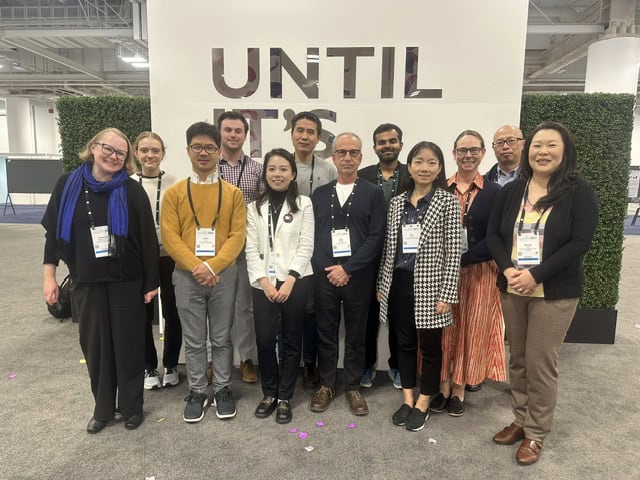
The Cystic Fibrosis Foundation has awarded a team of researchers $900,000 over two years to advance the Cystic Fibrosis Research Development Program at U-M. U-M Biomedical Engineering Assistant Professor Alex Piotrowski-Daspit, Ph.D., who also holds a joint appointment in Internal Medicine–Pulmonary and Critical Care Medicine, serves as the principal investigator.
The other members of the leadership team are Lindsay Caverly, M.D., Clinical Associate Professor of Pediatrics, Pulmonary Medicine; Michelle Hastings, Ph.D., Pfizer Upjohn Research Professor of Pharmacology and Director of RNA Therapeutics at the Center for RNA Biomedicine, and John LiPuma, M.D., James L. Wilson Research Professor Emeritus of Pediatrics.
The new funding builds on a two-year, $500,000 Program Development Award that the CF Foundation made to U-M in 2024. During that initial phase, investigators began establishing the scientific, administrative and educational infrastructure needed to bring together CF researchers from across the university.
“I believe the broader CF research community and the CF Foundation are excited by the work we’re doing here and the momentum we have generated,” Dr. Piotrowski-Daspit said. “We are grateful for the continued support from the CF Foundation as we continue to develop infrastructure and build a center focused on therapeutic development, delivery, and translational impact.”
In addition to developing research infrastructure, the program supports activities designed to strengthen U-M’s CF community. These include pilot project funding, a monthly seminar series, an annual retreat, and workshops that help investigators form interdisciplinary teams and develop collaborative proposals. The program has also established an educational core and provides six travel awards annually to support trainee participation in the North American Cystic Fibrosis Conference (NACFC).
“Our goal is to stimulate the community in multiple ways,” Dr. Piotrowski-Daspit said. “The seminar series, project development workshops, annual retreat, and pilot projects all create opportunities for people to find collaborators on campus and turn promising ideas into CF research programs.”
U-M’s Bold Challenges initiative also awarded the group Accelerate funding to help prepare a larger center proposal.
“It is immensely meaningful to have additional support from the University of Michigan,” Dr. Piotrowski-Daspit said. “The internal investment and project personnel are helping us build teams and prepare for the next stage of growth.”
Extending Michigan’s history of CF research
The program builds on a long history of cystic fibrosis research and care at U-M. In 1989, a team co-led by then U-M faculty member Dr. Francis Collins helped identify the gene responsible for CF. Today, Michigan investigators continue to conduct basic research into the disease, study respiratory infections, participate in clinical trials and pursue new treatments for rare forms of CF.
“It is a full-circle moment to bring an emphasis on basic CF research back to Michigan,” Dr. Piotrowski-Daspit said. “We have made significant progress in bringing the community together and engaging new investigators in CF research.”
CF is caused by mutations in the cystic fibrosis transmembrane conductance regulator (CFTR) gene, which encodes a chloride channel that helps regulate the movement of ions across epithelial tissues. Although CF is often associated with lung disease, it is systemic and can affect the gastrointestinal tract, pancreas, endocrine system, immune system and other organs.
Existing CFTR modulator drugs have transformed treatment for many people with CF. However, they do not benefit every patient or address every disease-causing mutation. Genetic therapies could provide new options—particularly for people with rare mutations who are not eligible for effective modulator treatments.
“There are many different mutations that cause CF and several types of genetic therapies are being developed to address them,” Dr. Piotrowski-Daspit said. “There is still a great deal to do, particularly in delivering those therapies to the right tissues and cells.”
Three interconnected research pillars
The CF@UM Research Development Program centers on novel therapeutic development and delivery across the systemic manifestations of cystic fibrosis and across the lifespan. Its scope encompasses genetic and other therapies, new delivery systems and effects beyond the lungs, including those involving the gastrointestinal, endocrine and immune systems.
The program is organized around three interconnected research pillars:
- Therapeutic development, focused on discovery of genetic and other treatments;
- Therapeutic delivery, focused on transporting treatments safely and effectively to target cells; and
- Therapeutic translational testing, focused on evaluating potential therapies in human-relevant experimental systems.
An administrative and educational core will support those scientific components. Internal and external advisory boards will provide guidance to the leadership team as it develops the program. Richard Simon, Ph.D., and Carey Lumeng, M.D., Ph.D., serve on the internal advisory board. The external advisory board includes Mitchell Drumm, Ph.D., of Case Western Reserve University; Marie Egan, M.D., of Yale University; and Amit Gaggar, M.D., Ph.D., of the University of Alabama at Birmingham.
The program’s design creates a two-way connection between research and patient care. Clinical samples from people with cystic fibrosis can inform laboratory studies and human-relevant models, while discoveries from research projects can move toward testing and, ultimately, clinical application.
“We are building core infrastructure, but we are also supporting pilot projects and helping research teams form around important questions,” Dr. Piotrowski-Daspit said. “The goal is to connect discoveries made in the laboratory with CF care teams and patients in Michigan Medicine’s adult and pediatric clinics.”
For Dr. Piotrowski-Daspit, whose laboratory specializes in delivering drugs and genetic therapies, the structure demonstrates why biomedical engineering is central to the program.
“There is a major emphasis on delivery, and that is an area in which U-M is very strong,” she said. “I’m hoping to bring more engineers into this effort because there is tremendous potential for synergy across the university.”
A university-wide research community
The Cystic Fibrosis Foundation’s Research Development Program is a national network of basic-science centers that brings together researchers from different disciplines to address challenges in understanding and treating CF. The network currently includes eight basic-science research hubs across the country.
Michigan’s program is being designed to connect laboratory discoveries with the adult and pediatric CF clinics at Michigan Medicine while pooling expertise from engineering, medicine, pharmacology, infectious diseases and RNA therapeutics.
“The idea is to bridge basic science and clinical research while bringing together people from different units across campus,” Dr. Piotrowski-Daspit said. “That collaborative environment is one of Michigan’s greatest strengths.”
“I am excited to be part of building this program at such an early stage in my career,” she added. “I have appreciated the opportunity to grow with this program. Our goal is to create an enduring community that brings together engineering, medicine and basic science to develop better therapies for people with CF.”