Maria Coronel Receives Five-Year NIH Award to Advance Sepsis Research
U-M Biomedical Engineering Assistant Professor Maria Coronel will develop a biomaterials-based platform to measure multiple immune signals near the patient bedside, study sepsis biology and guide new immunotherapies.
Sepsis can progress rapidly, leaving clinicians with limited time to determine why one patient responds to treatment while another continues to deteriorate. Complicating treatment decisions is the disease’s remarkable variability: Some patients experience severe inflammation, others develop severe immunosuppression, and some experience both simultaneously.
With support from a new five-year Maximizing Investigators’ Research Award (MIRA) from the National Institutes of Health, University of Michigan Biomedical Engineering Assistant Professor Maria Coronel will investigate these varied immune responses while developing technology that could help bring sophisticated cytokine measurements closer to the patient’s bedside.
“At a high level, the award aims to understand how complex immune responses and cytokine networks in the context of sepsis can be used to measure and understand the biology of the disease,” Dr. Coronel said. “It also aims to help generate new therapeutics that can improve patient outcomes.”
Sepsis is a life-threatening response to infection that can be caused by bacterial or viral infections. Although its initial presentation may vary based on the source of the infection, the cause alone does not reliably predict the severity of a patient’s condition or how the disease will progress.
“Sepsis is a very heterogeneous disease, and it is a very acute disease—it happens very, very fast,” Dr. Coronel added. “People can decompensate and experience terrible clinical outcomes very quickly. We are trying to interrogate the differences within that heterogeneity. Why do some patients experience severe inflammation, while others experience severe immunosuppression? Why do some patients experience both at the same time?”
Measuring multiple immune signals at once
Dr. Coronel’s team will investigate those differences through the lens of the immune system. The work will focus on cytokines, signaling proteins that allow immune cells to communicate with one another.
Patterns involving multiple cytokines may offer information about what is happening within a patient’s immune system, how severe the condition is and what may happen next. Existing proteomic and transcriptomic techniques can provide detailed information about these signals, but they are often expensive and require centralized laboratory facilities.
“The techniques we have now to dissect this—including many proteomic and transcriptomic techniques—are expensive and centralized,” Dr. Coronel said. “They are not something that can be brought near the bedside in an emergency room or intensive care unit to help make decisions for the patient.”
Because sepsis may progress so rapidly, clinicians need tools capable of providing useful information within a clinically relevant timeframe. Coronel’s laboratory will use biomaterials to develop a platform that can measure several cytokines at once, an approach known as multiplexing.
“What we are trying to do is develop an approach for multiplexing these signals that can be used near the patient’s bedside,” Dr. Coronel said. “We will use biomaterials to control that multiplexing and reduce much of the complexity associated with proteomic approaches.”
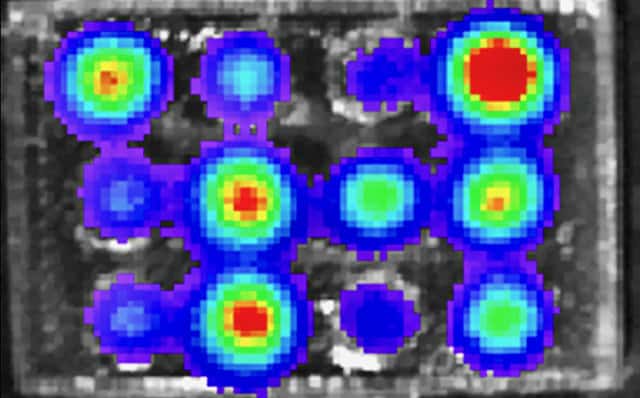
The platform will use a NanoLuc complementation system to produce light when a targeted cytokine is detected. For each cytokine, two antibodies will be paired with separate fragments of a split light-producing protein. While separated, the fragments do not emit light. When both antibodies bind to the cytokine, the fragments come together and generate a detectable signal.
“Because the protein is split, there is no light, but when the fragments come together, they begin emitting light,” Dr. Coronel noted.
The researchers will immobilize the antibodies on the surface of biomaterials. This will allow them to control how the components come together and ensure that the emitted light is sensitive to the cytokine they want to detect.
The biomaterials will be fabricated at the micron scale, allowing the researchers to arrange different cytokine sensors in separate locations. By using spatial organization and geometry, the platform could detect multiple cytokines through the same type of optical signal.
“Instead of looking at a single signal, which might not tell us much about the immune system, we can use the platform to examine multiple signals at the same time,” Dr. Coronel said. “We can use space and geometry with the same optical signal to detect multiple things.”
Building a broader sepsis research program
Unlike an NIH grant centered on a narrowly defined project, a MIRA supports a broader research program within an investigator’s laboratory. Dr. Coronel’s five-year program will address three interconnected questions spanning clinical measurement, fundamental disease biology and therapeutic development.
The first question is whether the platform can measure multiple immune signals near the bedside and use those measurements to assess sepsis severity and predict clinical outcomes. That information could help clinicians determine when an intervention is needed and identify patients whose conditions may progress more quickly.
The second question concerns the underlying biology of sepsis. Bacterial and viral infections activate different components of the immune system, but patients can nevertheless present with similar symptoms, yet experience widely different outcomes.
“Clearly, there is a difference in how sepsis begins to manifest depending on whether it is viral or bacterial, but the outcomes are all over the place,” Dr. Coronel said. “You cannot say that someone will have more complications because the infection is bacterial rather than viral.”
Even patients receiving similar treatment can respond differently, suggesting important variation in the host immune response.
“You can have one person who receives treatment and gets better, and another who receives treatment and does not,” Dr. Coronel said. “That means there are different host immune responses to the same disease. Why that is the case is not known.”
By monitoring several cytokines simultaneously, the team hopes to identify biological patterns that distinguish patients likely to progress rapidly from those with more time for treatment. The platform may also help explain why infections with different causes can appear clinically similar despite eliciting distinct internal immune responses.
The program’s third question is how the researchers can combine the platform with their biological findings to engineer more effective immunotherapies. Current approaches may rely on broad suppression of inflammation with potent anti-inflammatory medications. A better understanding of each patient’s immune response could point to more targeted treatment strategies.
“Can we use this not only for better clinical diagnosis, but also to understand the inherent differences in the disease?” Dr. Coronel said. “Can we determine who is a fast progressor, who may have more time for treatment, and what the targets for treatment are? If we can develop something that is more personalized, perhaps the outcomes could be better.”
Collaboration creates new research opportunities
The award marks the Coronel laboratory’s first major research program focused on sepsis. She credited U-M collaborators in internal medicine with providing critical disease expertise and recognizing how the biomaterials tools developed in her laboratory could address unmet clinical needs.
“We had support from collaborators at Michigan in internal medicine who understand more about the disease and saw an opportunity to use the tools we are building to answer many of these questions,” Dr. Coronel said. She added that the project demonstrates how U-M’s collaborative research environment can help investigators apply their expertise to new and complex health challenges.
“The environment at Michigan lends itself well to generating programs that can expand your research into other areas,” she noted.