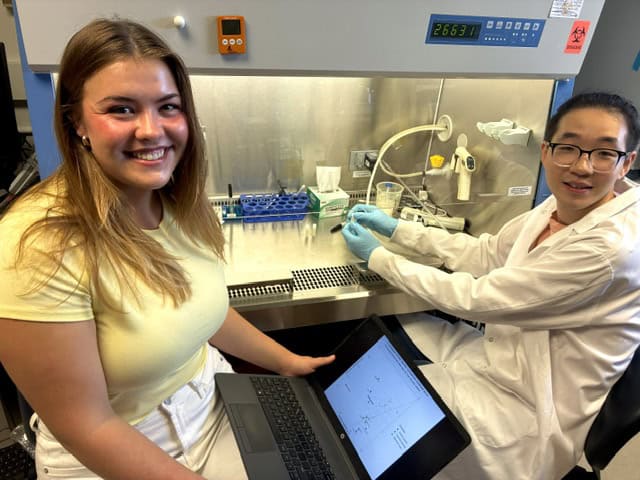
A new University of Michigan Biomedical Engineering study is helping researchers better understand a complex question in colon cancer treatment: What happens when cancer drugs, cancer cells and gastrointestinal bacteria all interact at once?
Led by Annie Badenoch, a U-M Bioinformatics Ph.D. student and first author on the study, and Sriram Chandrasekaran, Associate Professor, Biomedical Engineering, the research uses machine learning to predict whether drug combinations will be effective against colon cancer, and whether specific microbes in the GI tract may strengthen or weaken those treatments. The team collaborated with the lab of Jiahe Li, Associate Professor, Biomedical Engineering.
“We wanted to see whether we could predict if different combinations of drugs would be effective or ineffective in treating colon cancer,” Badenoch said. “Because colon cancer is so closely connected to the gut microenvironment, we also wanted to know whether microbes could influence how well those drug combinations worked.”
Why microbes matter in colon cancer
The colon is home to a dense and diverse microbial community, making colon cancer an especially important model for studying how bacteria may affect therapy. Tumors do not exist in isolation; they develop and respond to treatment within a broader microenvironment that includes immune cells, nutrients, oxygen levels and microbes. That complexity creates opportunities — and challenges — for cancer treatment.
“People are increasingly exploring bacteria as therapies, and asking whether certain bacteria are good or bad in particular disease contexts,” Dr. Chandrasekaran said. “The platform Annie developed allows us to look at different bacteria and ask how well they synergize with existing cancer therapies.”
The study began with a computational question: Could a model previously used to predict cancer drug combinations be extended to include bacteria as an additional biological variable? The team incorporated metabolic profiles — information about the biochemical activity of cancer cells, microbes and drug treatments — into a machine learning framework. The goal was to predict which drug-microbe combinations might be synergistic and useful, versus those that might be antagonistic and reduce treatment effectiveness.
One bacterium of particular interest in the study was Fusobacterium, which has often been associated with colon cancer progression and poorer responses to chemotherapy. But the team found a more nuanced picture.
“Fusobacterium is common in patients who do not respond well to chemotherapy,” Badenoch said. “Finding a therapy that could be effective in patients with high levels of it would be useful. We identified some drugs that are potentially synergistic with Fusobacterium, which was really exciting.”
Dr. Chandrasekaran said the finding highlights the need to understand context when studying the microbiome.
“Fusobacterium usually has a bad reputation because it is associated with promoting colon cancer,” he said. “But Annie found that when you add certain anti-cancer drugs, having Fusobacterium present can actually make those drugs more potent. It may have this dual role where it is harmful in one context, but under treatment conditions, it could help improve the response to specific therapies.”
From computational predictions to lab testing
One of the major challenges in studying cancer-microbe-drug interactions is that the experimental systems are difficult to build.
Bacteria found in the gut often require low-oxygen conditions, while human cancer cells typically need more oxygen to survive in the lab. Growing both together in a way that reflects the colon environment is technically demanding.
To test the model’s predictions, the team collaborated with Jiahe Li’s lab, which had developed a specialized co-culture system capable of growing bacteria and colon cancer cells together under different oxygen conditions. The setup allowed bacteria to remain in a lower-oxygen environment while cancer cells received the oxygen they needed.
“The experimental side required a very specialized setup,” Badenoch said. “You need an anaerobic chamber, oxygen pumps and a system that is carefully calibrated for both the colon cells and the microbe. That platform made it possible to test whether the drug and microbe combinations we predicted computationally were actually meaningful in the lab.”
Dr. Chandrasekaran said that experimental validation was essential, but also showed why computational screening is so valuable.
“Computationally, we can explore very complex combinations,” he said. “But doing those experiments in the lab is much harder. Because the system is so low-throughput, Annie could only test a few drug combinations with the bacteria and cancer cells. The computational model helped narrow what was most worth testing.”
Interpretable AI, not a black box
The team’s approach also differs from machine learning models that make predictions without offering insight into the underlying biology.
Dr. Chandrasekaran described the method as a form of mechanistic AI — a model that not only predicts outcomes, but also helps researchers understand why those predictions were made.
“The type of machine learning we used allows us to go back and explain why the predictions were made,” he said. “Annie was able to identify which pathways were associated with the drugs that worked well with Fusobacterium, and then test whether those pathways were actually important.”
Badenoch said that interpretability was a key strength of the project.
“It is not a total black box,” she noted. “Because the inputs to our model are metabolic, we can look at specific pathways associated with synergistic or antagonistic drug interactions. That helps us ask not only whether the model is predicting accurately, but also whether those pathways are biologically important.”
In follow-up experiments, the team used enzyme inhibitors to test whether specific pathways were involved in the drug responses predicted by the model. One pathway of interest involved redox biology — processes related to cellular oxidation and reduction — which can play an important role in cancer cell survival and drug sensitivity.
“That information can be useful beyond this particular study,” Badenoch said. “If we know which pathways matter, especially in patients with different microbiome profiles, that could help inform future drug development.”
Toward more personalized cancer therapies
Although the study focused on colon cancer, the researchers said the broader framework could eventually be applied to other diseases influenced by microbial communities.
“Colon cancer was a great model to start with because the cancer cells and microbes are so close together and can strongly affect one another,” Badenoch said. “But many other cancers, including skin cancer and pancreatic cancer, also interact with microbiomes. This approach could potentially be applied more broadly.”
The work may also help researchers think differently about precision medicine. In the future, a patient’s microbiome profile could potentially inform which therapies are most likely to work, which combinations should be avoided, or whether adding a beneficial microbe could improve treatment response.
“This could help us move toward more precise therapies for colon cancer,” Dr. Chandrasekaran said. “We may be able to identify treatments that match a patient’s microbiome, or determine whether a particular bacterium enhances or weakens a therapy.”
The platform could also be useful for researchers developing new cancer drugs.
“If someone is developing a colon cancer therapy, they could use this type of platform to ask how the microbiome might affect that therapy,” he added. “Will it enhance the drug’s effect, or will it make the therapy less effective? These are variables that are not always considered in drug discovery.”
Collaboration bridges computation and wet lab research
For Badenoch, one of the most rewarding parts of the project was the collaboration between computational modeling and experimental biology. “This paper is exciting because it brings together computational and wet lab work,” she said.
Chandrasekaran said the project demonstrates the value of combining AI-based prediction with biologically realistic experimental systems.
“This work shows why we need computational tools,” he said. “When the biology is this complex and the experiments are this challenging, computation can help us prioritize the most promising possibilities and then test them in meaningful ways.”
The research points toward a future in which cancer therapies are evaluated not only by their effects on tumor cells but also by their interactions with the microbial ecosystems surrounding them.
As Badenoch put it: “The microbiome is part of the treatment environment. If we can understand how it changes drug response, we may be able to design better therapies.”
This work was supported by grants from the National Institute of General Medical Sciences, U-M Research Scouts, and Michigan Drug Discovery to Dr. Chandrasekaran, and a National Science Foundation Graduate Research Fellowship to Ms. Badenoch. Other members of the Chandrasekaran and Li labs, including Zeyang Pang, Carolina Chung, Bretton Badenoch, Ritish Natesan, and Layth Kakish, also contributed to this research.