
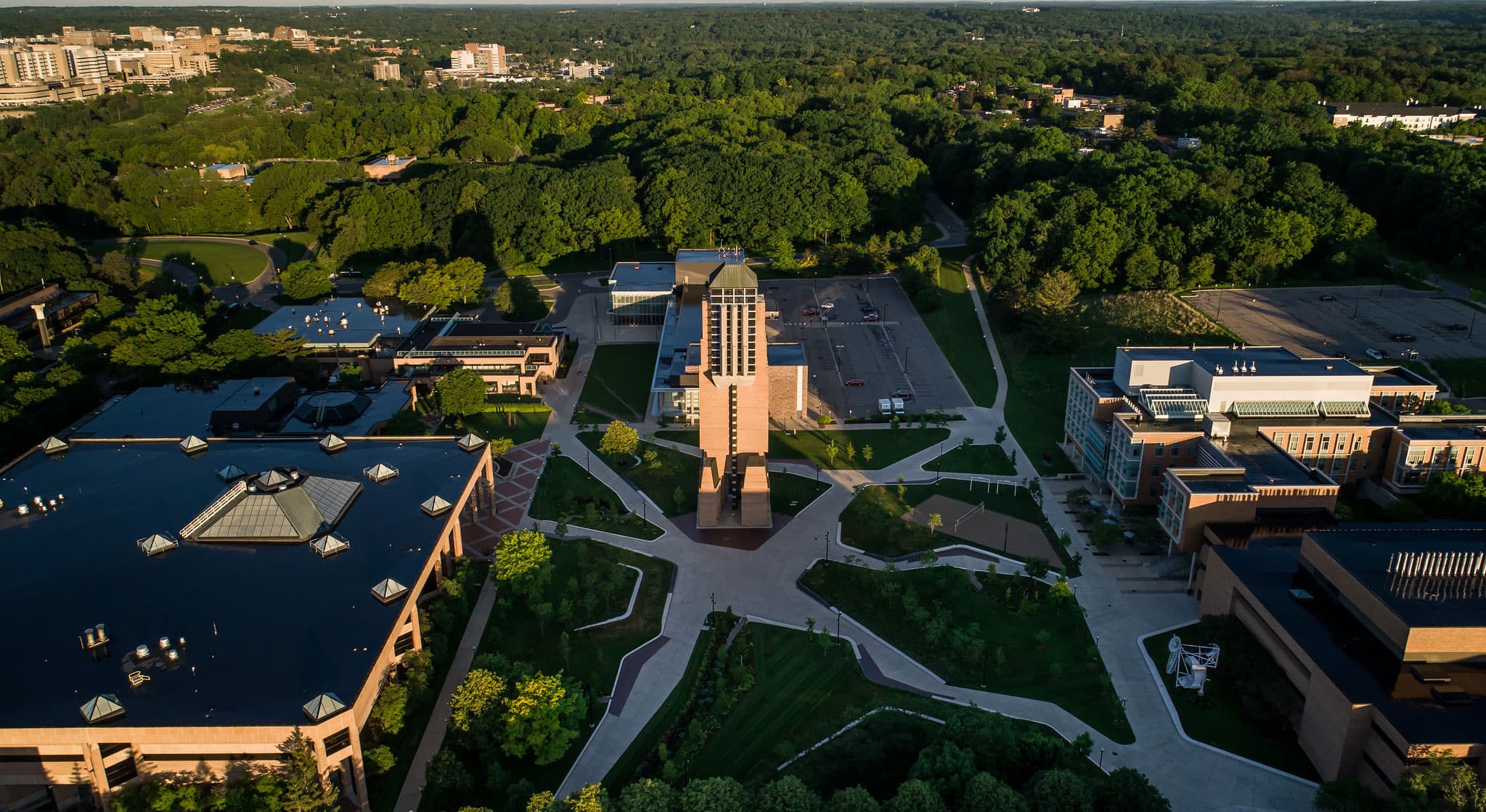
Celebrating 30 Years as a Department, Over a Half Century of Innovation
Michigan BME provides leadership in education, training, and innovative research by translating science and engineering to solve important challenges in medicine and life sciences for the benefit of humanity.
Ours is one of the oldest programs in the country, with a history that includes early work with lifesaving clinical devices like the Extracorporeal Membrane Oxygenation (ECMO) heart-lung bypass machine and implantable electrodes that stimulate or stabilize brain function.
The department has expanded its breadth and depth- from designing devices to engineering at fundamental biological levels, including tissue engineering, changing genes, and engineering artificial organs.
Department Mission
BME provides leadership in education, training, and innovative research by translating science and engineering to solve important challenges in medicine and life sciences for the benefit of humanity.
BME Timeline
- 1962: Biomedical Engineering Graduate program established
- 1996: Biomedical Engineering (BME) Department Founded
- 1997: Combined B.S.E./M.S.E. program established
- 2000: Undergraduate program established
- 2003: Carl A. Gerstacker Building opens
- 2005: Wallace H. Coulter Foundation Translational Research Partnership
- 2006: ABET accreditation
- 2006: Lurie Biomedical Engineering Building opens
- 2012: BME becomes a joint department in the College of Engineering and the Medical School
- 2021: LBME 1st floor renovated adding BME commons, ideation, hands-on lab, and fabrication spaces
- 2022: Inaugural Glenn V. Edmonson lecture and BME Symposium established
The University of Michigan’s Biomedical Engineering (BME) is marking its 30th anniversary as a department this year—celebrating a community shaped by decades of interdisciplinary collaboration, sustained investment in people and facilities, and a persistent drive to translate engineering breakthroughs into better health.
To commemorate this milestone, BME is introducing a special 30th anniversary logo, which will be made available to BME faculty and staff for use on slide decks and email signature lines. The logo also will appear in newsletters, social media and other communications through the end of 2026.
While BME’s history as an academic department spans 30 years, Michigan’s biomedical engineering story stretches back far earlier to the 1960s—beginning with a bold experiment in graduate education.
1962–1972: Launching a bioengineering graduate program
Michigan’s biomedical engineering roots trace to 1962, when U‑M established a Bioengineering Program as a degree‑granting, interdisciplinary graduate program under the Rackham School of Graduate Studies. The program’s first director was Glenn V. Edmonson, a mechanical engineering professor.
In 1964, the program developed its first course—quantitative physiology for bioengineers—followed in rapid succession by coursework in biomedical instrumentation, electrical biophysics and biomechanics. From the beginning, the curriculum blended engineering fundamentals with life science and medicine, drawing core courses from departments such as biochemistry, physical chemistry, thermodynamics and gross anatomy.
By 1967, the program awarded its first doctoral degrees to Spencer L. BeMent, John Campbell Jr. and Nelson E. Leatherman. And by 1972, enrollment had climbed to 53 students—22 master’s and 31 doctoral—a sign that the field’s promise was already attracting students eager to build careers at the interface of engineering and biology.
Stay tuned for more feature stories and highlights of BME’s history throughout the year.
1972–1989: The quest for identity—and the grassroots effort that sustained it
After 1972, bioengineering at Michigan—like bioengineering nationally—entered a period of uncertainty as the field wrestled with how it fit into traditional academic structures. Yet the program persisted as one of the largest in the country, typically supporting 40–60 graduate students annually, aided by champions across disciplines.
Key milestones from this era include:
- 1972: Peter H. Abbrecht (physiology) becomes program director.
- 1977: James L. Cockrell becomes interim director.
- 1979: Two junior faculty with Medical School appointments, David J. Anderson and Timothy J. Kriewall, catalyze a broad letter‑writing campaign to protect the program during a vulnerable period.
- 1979: David Anderson becomes program director and helps secure dedicated space and budget support.
- 1980: The program secures space on the fifth floor of the East Engineering Building on Central Campus—an imperfect but crucial home base.
- 1984: Steven A. Goldstein (surgery) becomes program director, working to rejuvenate bioengineering within the Medical School.
- 1985: A review by College of Engineering Dean James J. Duderstadt marks a turning point, concluding that U‑M should invest more seriously in bioengineering.
- 1986: The program moves with engineering to North Campus and receives space in the Electrical Engineering & Computer Science building.
These years also produced a steady stream of advances across biomechanics, imaging and instrumentation—work that helped define the department’s later strengths in ultrasonics, bioinstrumentation, mechanobiology and beyond.
1989–1999: Building the case—and establishing the Department of Biomedical Engineering
In 1989, U‑M alumnus and ultrasound expert Charles Cain became director following a national search. That same year, the program moved into the G.G. Brown Building, providing a stronger base and room for new hires.
In 1994, the program won the Whitaker Foundation’s Special Opportunity Award, described in the department’s history as the foundational entry‑level grant that helped propel Michigan toward the next step: creating a department.
That step arrived in 1996, when the Department of Biomedical Engineering was founded. The Whitaker Foundation provided a Development Award that included $3 million to help launch the new department, with Cain serving as the founding chair.
A year later, BME began expanding undergraduate pathways:
- 1997: Launch of a combined BS/MS program—now known as Sequential Undergraduate/Graduate Study (SUGS)—linking undergraduate engineering training with graduate study in biomedical engineering.
By the time the department was established, the earlier bioengineering program had granted close to 135 PhDs and engaged 70–80 faculty across campus, setting the stage for BME’s hallmark: collaboration at scale.
1999–2006: Scaling education, facilities—and translation
In 1999, Matthew O’Donnell became chair and helped chart a growth plan for facilities, faculty hiring, student support and undergraduate enrollment.
- 2000: The department’s undergraduate curriculum is approved (first students enroll in 2001).
- 2004: The undergraduate program receives ABET accreditation.
- 2001: A $10 million Whitaker Leadership Award supports continued growth.
- 2003: The NASA Bioscience & Engineering Institute is founded under James Grotberg, making U‑M the biomedical engineering department for NASA.
- 2003: The Carl A. Gerstacker Building is completed, providing purpose-built BME space.
- 2005: U‑M becomes one of nine universities to receive a Coulter Translational Research Partnership Award in Biomedical Engineering, supporting clinician‑engineer teams working to move promising technologies toward the clinic and marketplace.
- 2006: The Ann and Robert H. Lurie Biomedical Engineering Building is dedicated, creating interactive research and instructional space designed to facilitate collaboration.
Together, these investments cemented a defining Michigan BME idea: engineering impact is amplified when discovery and clinical translation are built into the same ecosystem.
2006–2013: Faculty growth and a translational engine takes hold
In 2006, MRI expert Douglas Noll became chair. During his chairmanship, the faculty doubled from 11 to 22, expanding depth across tissue engineering, neural engineering, imaging, drug delivery, systems biology and biosensors—broadening BME’s research “footprint” while also strengthening the sense of community for students through more department-led courses.
The department also expanded design and innovation training:
- 2007: Launch of BME 599, a year‑long graduate design course, integrating commercialization planning into the design process.
- 2008: Introduction of a year‑long senior capstone design sequence (BME 451/452).
- 2011: Launch of clinical needs finding (BME 499) and computational modeling and design (BME 350).
In 2011, based on the success of Coulter‑funded projects, U‑M became one of only six universities to receive an endowment through the U‑M Coulter Partnership for Translational Biomedical Engineering Research—a $10 million Coulter Foundation award matched by $10 million from the College of Engineering and Medical School.
In 2012, BME became a joint department of the College of Engineering and the Medical School, institutionalizing the cross-campus model that has been central since the earliest days of bioengineering at Michigan.
2014–present: Expanding partnerships—and defining impact through translation
In 2014, regenerative medicine expert Lonnie Shea became chair. The department’s history highlights a period of accelerated hiring and partnership-building, including a reported 60% increase in faculty research funding from 2014–2017.
Today, BME’s scale reflects both its growth and its continued interdisciplinarity focus. The department’s national ranking is #6 (undergraduate) and #6 (graduate) in U.S. News & World Report, and #3 in NIH funding.
Coulter today: funding teams, moving discoveries
BME’s Coulter Translational Research Partnership Program remains a signature driver of bench‑to‑bedside work. In September 2025, the program awarded $1.4M in funding to 13 multidisciplinary teams, supporting projects intended to advance promising technologies toward clinical and commercial adoption.
Histotripsy: Michigan ultrasonics to patient impact
Few examples illustrate Michigan BME’s translational arc as clearly as histotripsy—a noninvasive focused ultrasound technology that mechanically destroys targeted tissue using acoustic cavitation.
Histotripsy was invented at U‑M by a team including Zhen Xu, Li Ka Shing Endowed Professor of Biomedical Engineering, and Professor, Radiology and Neurosurgery. In a 2025 Q&A published by Michigan Engineering News, Xu described histotripsy as a way to destroy tumors without incisions by using ultrasound to generate bubble activity that breaks tissue apart, with the body clearing the debris over time. In 2026, Michigan Engineering News reported that Xu was named one of TIME’s 100 Most Influential People in Health, recognizing the broader impact of histotripsy and its path from laboratory invention to clinical use.
Histotripsy also appears in the department’s own historical record as a flagship Coulter-era success: HistoSonics, commercializing histotripsy, is listed among ventures supported through Michigan’s translational ecosystem, alongside U‑M inventors and collaborators including Charles Cain, Zhen Xu, Brian Fowlkes, Timothy Hall, and William Roberts.
An anniversary that carries a longer story
At 30 years old as a department, Michigan BME is still animated by the same idea that launched the bioengineering graduate program in 1962: the most important health challenges don’t respect disciplinary boundaries.
From early coursework in quantitative physiology, to the founding of a department built to bridge engineering and medicine, to translational engines like the Coulter Program and breakthroughs such as histotripsy, the throughline is clear—build the tools, train the people, and carry discoveries forward to make a difference in the world.
And this year, whether it appears on a seminar slide, a signature line, a newsletter header or a social post, BME’s anniversary logo will mark more than a date. It will mark a legacy of collaboration—recognizing the contributions of those who came before and the dedication of the next chapter of Michigan engineers working in service of human health.
Strengthening research, community, and visibility
The department’s growth over the last decade has also been shaped by leadership focused on both excellence and culture. In 2025, Professor Mary-Ann Mycek recently reflected on her time as department chair as a transformative era for BME, marked by strategic faculty hiring and growth areas, an expansion of research programs and centers, along with an emphasis on the student experience, advising, curriculum, and community-building.
During her tenure, the department also increased research expenditures and its NIH presence, rose in prominence in national rankings, received major awards, and redesigned facilities and space to accommodate the growing program, helping position Michigan BME to capitalize on major translational opportunities such as the Coulter partnership and to continue advancing signature strengths in imaging and ultrasonics.
Those efforts helped set the stage for the department’s current scale and impact—supporting the faculty’s expanding research portfolio and preparing students to thrive in a field increasingly defined by convergence across engineering, medicine, and computation.
2026 and Beyond
In this transitional time, Michigan BME is positioned to lead with its breadth and depth of research. From establishing the new Histotripsy Center to continuing with clinical advances in addressing cancer, cardiac care, neurology, immunology and other medical challenges, Michigan BME is ready to meet the moment.