Traumatic spinal cord injuries often lead to a permanent loss of motor and sensory function below the site of the injury. Historically, clinical options have been limited; standard treatments like the steroid methylprednisolone carry an unbalanced risk-benefit ratio, frequently doing too little to halt the cascade of secondary damage caused by the body’s own intense inflammatory response.
Now, an article in the Journal of Neuroscience highlights research led by University of Michigan Department of Biomedical Engineering Professor Lonnie Shea, with Kate Griffin and Sarah Hocevar. This study is flipping the script on how to treat spinal cord trauma. By deploying targeted therapeutic nanoparticles, the research team has successfully reprogrammed immune cells at the injury—not just halting damage, but actively driving a pro-regenerative response that prevented scar formation and stimulated nerve regrowth.
Reprogramming the Immune Response
When the spinal cord suffers trauma, the body rushes immune cells—specifically monocytes and neutrophils—to the site. While meant to help, this massive inflammatory influx triggers a wave of secondary damage that can destroy surrounding healthy tissue.
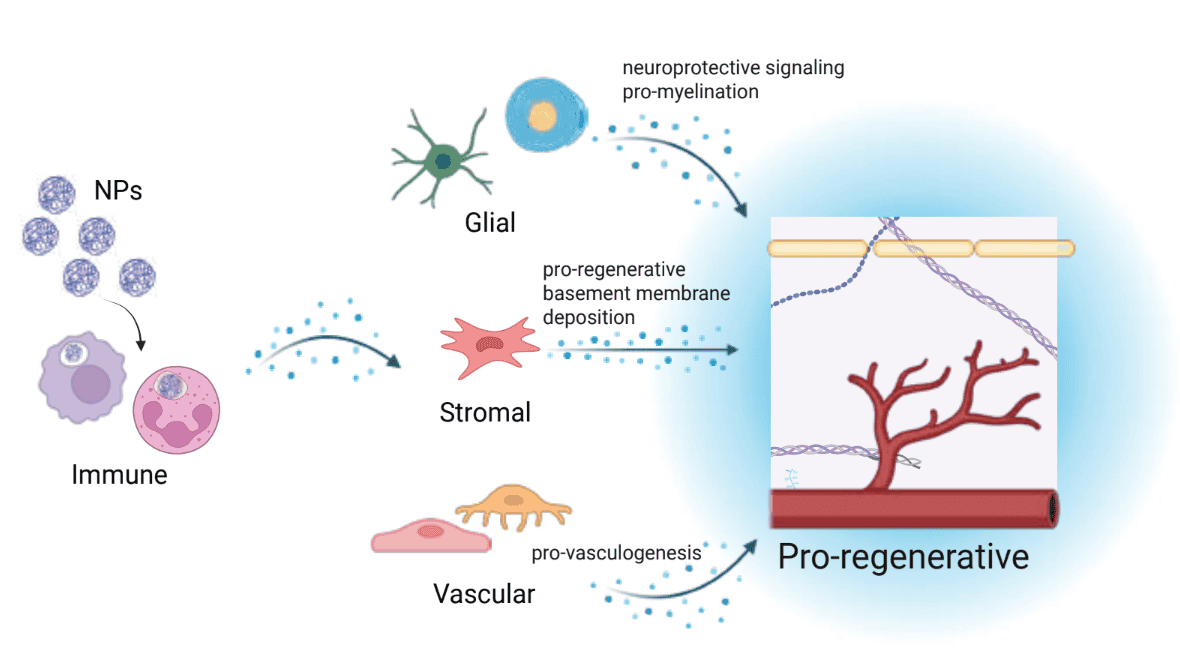
Dr. Shea’s team developed polymeric nanoparticles designed to intercept these circulating immune cells. Instead of merely blocking them, the nanoparticles interact with the cells to fundamentally shift their behavior.
Using advanced single-cell sequencing and computational modeling, the researchers cataloged the complex communication network within the injury microenvironment.
“Most traditional treatments aim to block inflammation,” says Dr. Shea. “Our nanoparticles fundamentally shift the function of the immune cells. We are reprogramming these cells to actively reduce inflammation and become pro-regenerative, essentially instructing the body’s own defense system to repair the damage rather than cause more of it.”
A Breakthrough Discovery: Preventing the Scar
One of the most striking findings of the study, which evaluated the therapy in a mouse model of cervical spinal cord injury, was the absence of typical scar tissue.
Normally, the body creates a dense glial scar around a spinal injury. While this scar walls off the damage, it also acts as a permanent physical and chemical barrier that prevents nerves from regrowing. When Dr. Shea and his team deployed the nanoparticle therapy, they observed a radical change.
- Reduced Scar Formation: The treatment successfully prevented the debilitating scar tissue from forming in the first place.
- Angiogenesis: The reprogrammed immune cells sent signals that promoted the growth of new blood vessels (angiogenesis), restoring vital blood supply to the healing tissue that may also guide axon growth.
- Nerve Regeneration: With the physical barrier gone and a supportive environment established, the therapy promoted axon outgrowth and neuroprotection, paving the way for nerve regeneration.
The sequencing data revealed that the nanoparticles triggered a massive chain reaction of positive cellular signaling. The reprogrammed monocytes and neutrophils sent outgoing signals that favorably influenced a wide matrix of neighboring cells, turning the injury zone into an environment for recovery.
Reviewers evaluating the research commented favorably on the characterization of multiple processes that are influenced by the nanoparticles. Dr. Shea is collaborating with neurosurgeons at Michigan Medicine, alongside an industry partner, towards translating the findings into a clinical trial.