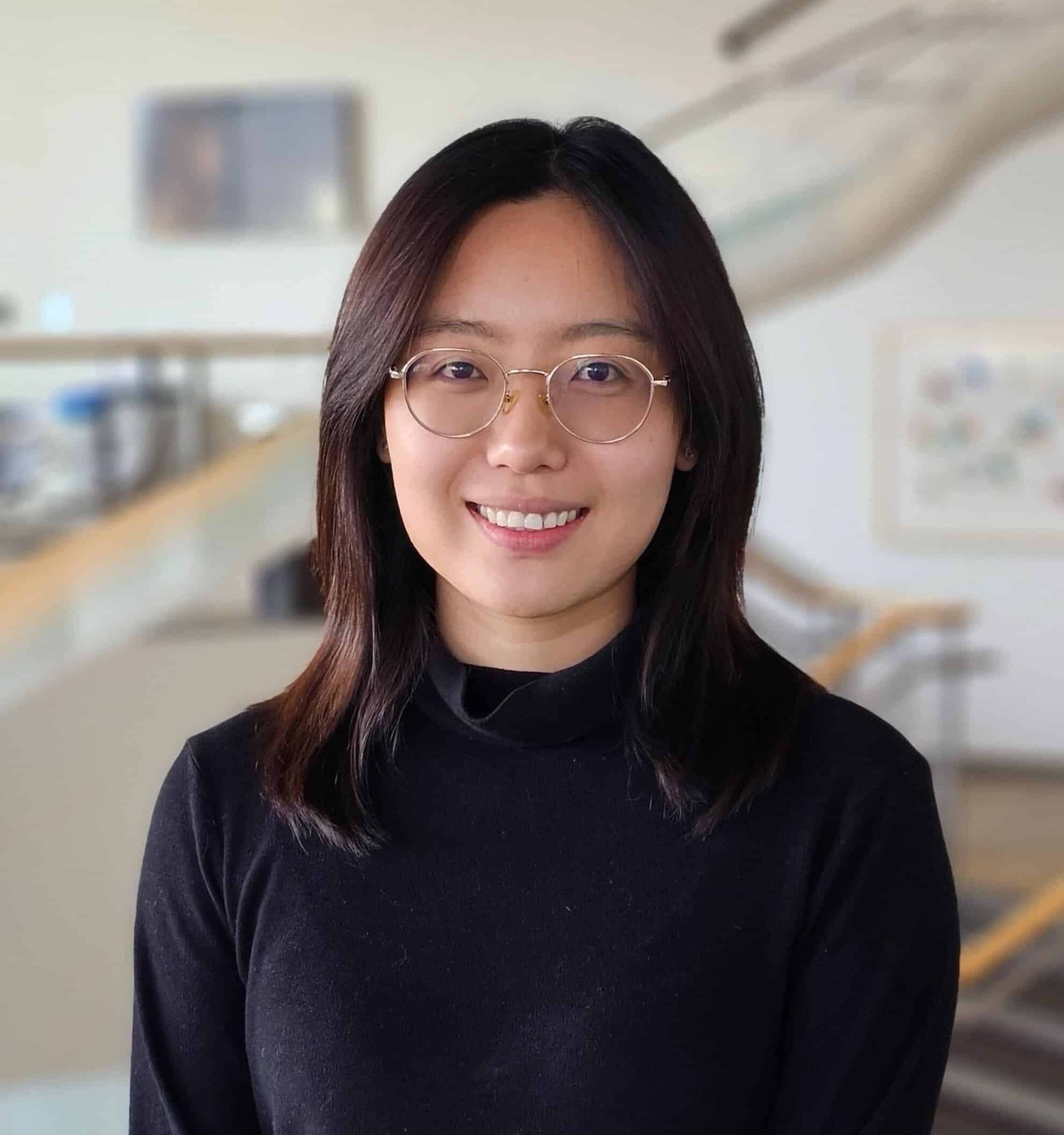
Xiaokai Wang Earns NIH Award to Advance MRI-based Research on GI Disorders
The National Institutes of Health’s (NIH) Pathway to Independence Award (K99/R00) will support Xiaokai Wang’s transition toward an independent research career.
3–5 minutes

The National Institutes of Health’s (NIH) Pathway to Independence Award (K99/R00) will support Xiaokai Wang’s transition toward an independent research career.
Xiaokai Wang, a U-M BME postdoctoral researcher and a former doctoral student of Zhongming Liu, Professor, Biomedical Engineering, and Electrical Engineering and Computer Science, has earned a National Institutes of Health (NIH) Pathway to Independence Award to investigate how magnetic resonance imaging (MRI) could help distinguish different forms of gastroparesis and assess their responses to bioelectrical treatment.
Dr. Wang’s long-term goal is to move beyond identifying delayed stomach emptying to understanding the specific dysfunctions that cause it — information that could eventually help guide more individualized patient care.
“Our goal is to develop an MRI-based approach so that we can capture different aspects of stomach function and dysfunction, especially how the stomach contracts, how it accommodates food and how it pushes food to the small intestine,” Dr. Wang said.
The NIH Pathway to Independence Award, known as the K99/R00, supports promising postdoctoral scientists as they complete mentored research training and transition to independent, tenure-track or equivalent faculty positions. It provides five years of support: two years of mentored postdoctoral research through the K99 phase, followed by up to three years of independent research support through the R00 phase, contingent on securing a qualifying position as a principal investigator.
Dr. Wang plans to complete the first two years at Michigan.
Gastroparesis is characterized by delayed gastric emptying, with food remaining in the stomach longer than it should, potentially causing nausea, vomiting and other discomfort.
According to Dr. Wang, gastric scintigraphy, a test used to evaluate stomach emptying, can identify that a delay exists, but offers limited insight into the different functional problems that may contribute to it. The test also exposes patients to radiation.
Dr. Wang is developing an alternative approach that combines dynamic MRI with computational modeling to measure several aspects of stomach function. MRI does not use ionizing radiation and can capture detailed images of the stomach over time.
Those measurements could help researchers and physicians distinguish among problems involving stomach contractions, food movement and the stomach’s ability to accommodate a meal.
“Each patient of gastroparesis is different. If we can use MRI to precisely identify where, how, and when stomach function goes wrong, it can help physicians use the right treatment specific to each patient,” Dr. Wang said. This vision is articulated in her recent paper, Gastroparesis Phenotyping: Current Methods and Emerging Opportunities With Magnetic Resonance Imaging.
During her doctoral studies at Michigan, Dr. Wang developed imaging, modeling and quantitative analysis methods to characterize stomach function in healthy animal models and human participants.
“For my Ph.D. work, I focused more closely on tool development,” she said. “We developed the imaging tool, the modeling tool and the quantification approaches for both animal models and human subjects.”
Dr. Wang’s postdoctoral research builds on that foundation by applying the tools to disease, with a particular focus on gastroparesis associated with diabetes.
She is also incorporating immunohistochemistry, a laboratory technique used to examine biological markers in tissue, to investigate disease-related changes. By comparing tissue findings with the functional measurements obtained through MRI, she hopes to better understand how underlying biological changes affect stomach performance.
The K99-supported portion of her work will focus on animal models. She plans to investigate whether MRI can distinguish disease subtypes and help assess whether a particular treatment works better for some subtypes than others.
“This K99 focuses on animal models, not patients,” Dr. Wang said. “The general idea is that we want to use MRI to differentiate subtypes of gastroparesis and characterize the efficacy of a specific bioelectric treatment — whether it is effective in different subtypes or which subtype would benefit more.”
Although gastroparesis is her current focus, Dr. Wang envisions potential applications for the imaging and modeling approach in other stomach disorders, including functional dyspepsia. She emphasized that her team has not yet applied the tools to that condition.
“The tool is more universal,” Dr. Wang said. “It is not restricted to one functional disorder but can be used more broadly.”
Dr. Wang is also pursuing collaborations involving brain imaging, with an interest in understanding how the brain senses signals from within the body — a process known as interoception.
Her award brings together a mentoring team, Dr. Zhongming Liu, Dr. Tim Bruns, and Dr. Doug Noll from Michigan, and Dr. John Furness from the University of Melbourne and Dr. Michael Camilleri from Mayo Clinic to support her research training and professional development.
As Dr. Wang works toward an independent research career, her central aim remains connecting detailed measurements of stomach function with a clearer understanding of disease — and, ultimately, more targeted treatment.