Building a Community to Advance Genetic Therapies for Cystic Fibrosis
CF @ UM’s second-annual retreat highlighted shared research resources, emerging discoveries and collaborations aimed at expanding treatment options.
5–8 minutes

CF @ UM’s second-annual retreat highlighted shared research resources, emerging discoveries and collaborations aimed at expanding treatment options.
Developing genetic therapies for cystic fibrosis requires expertise in therapeutic design, delivery, and translational models, as well as a vibrant research community that can connect those pieces.
At U-M, Alex Piotrowski-Daspit, Assistant Professor, Biomedical Engineering, and Internal Medicine – Pulmonary and Critical Care Medicine Division, is helping build that community through CF @ UM, a university-wide initiative focused on advancing cystic fibrosis research. Leadership team members also include Lindsay Caverly, M.D., Clinical Associate Professor of Pediatrics, Pulmonary Medicine; Michelle Hastings, Ph.D., Pfizer Upjohn Research Professor of Pharmacology and Director of RNA Therapeutics at the Center for RNA Biomedicine, and John LiPuma, M.D., James L. Wilson Research Professor Emeritus of Pediatrics.
On November 2, the initiative’s second annual retreat brought faculty, trainees, research staff, External Advisory Board members and Cystic Fibrosis Foundation (CFF) leaders together for an all-day conference, providing an opportunity to share research, assess progress and strengthen connections across disciplines.
“We have a special coalition of people here at the University of Michigan with unique but complementary expertise,” Dr. Piotrowski-Daspit said.
The retreat marked another step toward establishing a CFF-supported basic research center focused on genetic therapy development for cystic fibrosis. Following a kickoff event in September 2023 and a large round of initial financial support in 2024, the initiative renewed and expanded its funding in 2026.
The initiative’s mission includes developing therapeutic strategies for people with CF whose disease-causing mutations make them ineligible for existing small molecule modulator therapies. Although those treatments have substantially improved life for many people with CF, they are not a cure, and some patients cannot benefit from them.
“The ultimate goal is to find a cure for all people with CF,” Dr. Piotrowski-Daspit added.
Dr. Piotrowski-Daspit opened the retreat with an overview of CF @ UM and leadership updates. The program also included introductions to the initiative’s external advisory board in attendance: Mitchell Drumm of Case Western Reserve University, Amit Gaggar of the University of Alabama at Birmingham and Marie Egan of Yale University.
CFF representatives Patrick Thibodeau, Vice President of Discovery and Translational Research, and Christopher Penland, Vice President of BioPharma Programs, also participated and shared positive remarks about U-M’s research community and CF @ UM’s progress over the past few years.
According to Dr. Piotrowski-Daspit, feedback from the advisory board and foundation leadership has been very encouraging. The U-M team is working toward an application for foundation-supported center status in 2028.
That growth spans disciplinary boundaries. Dr. Piotrowski-Daspit estimates that the community includes at least 30 U-M faculty members, along with a comparable number of trainees and research staff. Participants represent several College of Engineering disciplines, multiple Medical School departments, as well as units from the College of Literature, Science, and the Arts (LSA). Undergraduate students are also beginning to engage through a CF interest group.
“It’s been exciting to connect all of these people and resources because Michigan is so vast and offers many opportunities to support our efforts,” she said.
The proposed center infrastructure includes three thematic cores focused on developing nucleic acid therapies, delivering those therapies to their intended targets, and evaluating their effects using clinically relevant samples and models.
“The idea is that everyone in the community would have access to these cores,” Dr. Piotrowski-Daspit said.
The retreat reflected this emphasis on shared infrastructure. Michelle Hastings, Pfizer Upjohn Research Professor of Pharmacology, Professor of Pharmacology, Medical School, Professor of Medicinal Chemistry, College of Pharmacy, presented updates on nucleic acid therapeutics. Jason Spence, H Marvin Pollard Professor of Gastrointestinal Sciences, Professor of Internal Medicine, Professor of Cell and Developmental Biology, Medical School, Professor of Biomedical Engineering, College of Engineering and Medical School, addressed cell culture model systems, and Lindsay Caverly, Clinical Associate Professor of Pediatrics, Medical School discussed translational resources.
Together, these areas support a critical progression: designing a potential treatment, finding ways to deliver it and testing whether it works in models relevant to human disease.
Dr. Piotrowski-Daspit’s laboratory collaborates with Dr. Spence on human airway models, including airway organoids and air-liquid interface cultures. Her lab also uses precision-cut lung slices to study therapeutic delivery in human tissue.
Through Gift of Life Michigan, researchers have access to donated lungs that are unsuitable for transplantation but available for research. Culturing samples from those lungs helps the team evaluate approaches designed for human tissues.
Although genetic therapies are the initiative’s primary focus, the community also welcomes complementary research on topics such as antimicrobial approaches, bacterial burden, and the immune system’s role in CF.
The retreat paired infrastructure updates with presentations illustrating the breadth of CF research at Michigan.
A morning Lightning Talk session featured six recipients of CF @ UM travel awards to attend the 2026 North American Cystic Fibrosis Conference. The initiative sponsors six competitive travel awards annually, providing researchers opportunities to share their work with the broader CF community.
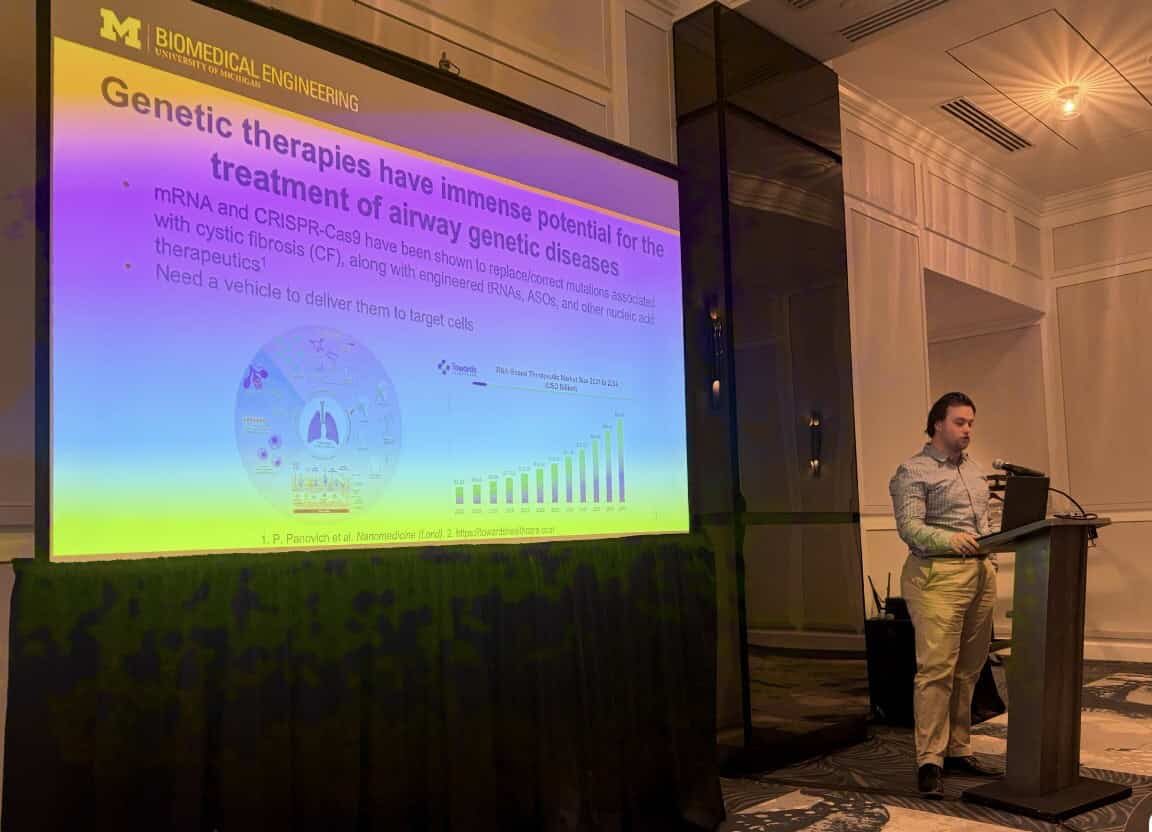
Biomedical engineering doctoral student Owen Kelly, whose project examined engineered, surface-functionalized nanoparticles for targeting airway epithelial cells in physiologically relevant human lung models was one of the featured presenters.
The session also included doctoral students Rachel Dziekan, Kate Desrochers and Ben Pockrass; clinical assistant professor Lidong Zhai; and postdoctoral research fellow Yang Liu. Topics included potential therapeutic targets, transfer RNA modifications, regulation of CFTR messenger RNA (CFTR is the gene implicated in cystic fibrosis), serum amino acid signatures associated with hepatobiliary involvement, and lipid-related gene changes in organoids modeling bile duct cells. .
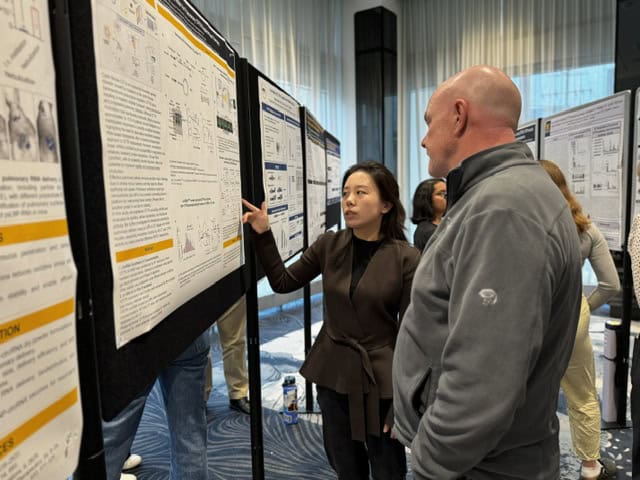
An open poster session during lunch provided another opportunity for participants to exchange ideas and learn about ongoing projects.
“We want to be as welcoming as possible to bring more people into the CF research community,” Dr. Piotrowski-Daspit said.
The afternoon research showcase, which included CF @ UM seed funding projects, further demonstrated the initiative’s range. Presentations explored approaches to increasing CFTR expression, restoring its expression through RNA modifications, understanding metabolic and immune effects, and characterizing CF lung disease through quantitative computed tomography.
The program concluded with a discussion led by John LiPuma, followed by an executive session involving the external advisory board, foundation leaders and CF @ UM leadership.
The initiative’s community-building efforts extend beyond the retreat and its monthly seminars.
Drs. Piotrowski-Daspit and Caverly, who are envisioned as co-directors of the proposed center, have participated in outreach intended to connect basic scientists with people with CF and their families. Those activities include presentations at an annual CF family night and a recorded episode for an upcoming Michigan Medicine podcast series.
“I’m grateful to be able to have served in this role,” Dr. Piotrowski-Daspit noted. “It means a lot, especially as an early-career researcher, to have a voice in how this center and our research come together, because my hope is that this initiative will be something that continues to grow and provide tangible benefits to people with CF and their families within my lifetime.”
Dr. Piotrowski-Daspit is also expanding her connections within the therapeutic delivery community. She recently received a £5,000 career development grant from the United Kingdom-based Aerosol Society to help initiate a project focused on delivering therapeutic agents to specific lung cell types—work related to the project graduate student Owen Kelly presented at the retreat.
She also served as a drug delivery track chair for the Biomedical Engineering Society annual meeting, helping shape sessions, select presentations and recruit session chairs. She and her co-chairs intentionally created opportunities for junior faculty and postdoctoral researchers across institutions.