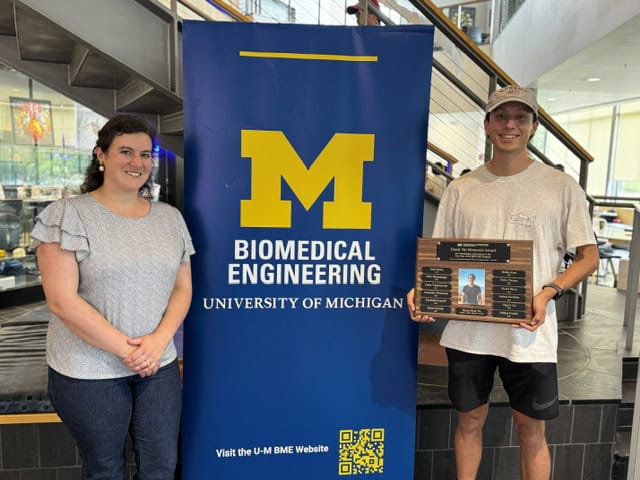
Nathan French Receives 2026 Derek Tat Memorial Award
The U-M BME Ph.D. student was recognized for academic excellence, innovative cardiovascular research and an exceptional commitment to mentoring others.
2–3 minutes

The U-M BME Ph.D. student was recognized for academic excellence, innovative cardiovascular research and an exceptional commitment to mentoring others.
University of Michigan Biomedical Engineering Ph.D. student Nathan French has received the 2026 Derek Tat Memorial Award, honoring his accomplishments as a researcher, educator and mentor.
The award recognizes second-year BME Ph.D. students who demonstrate two qualities that defined Derek Tat’s time at Michigan: academic excellence and a commitment to mentoring others.
Tat, a promising researcher with a bright future ahead of him, passed away in an accident in 2014. Cindy Chestek, Professor, Biomedical Engineering, Electrical Engineering and Computer Science, Robotics, and Neurosurgery, established the award to honor his memory and recognize students who carry forward the spirit he brought to research and the broader academic community.
“Derek had an exuberant happiness, and he was eager to assist in mentoring students whenever he could,” Dr. Chestek said. “I think it’s important to know that it’s never too early in one’s career to mentor whenever possible.”
French was nominated by his principal investigator, Alison Vander Roest, Assistant Professor, Biomedical Engineering
“Nathan joined my lab as a master’s student in my first year as an independent faculty member, and he has consistently been the most dedicated, enthusiastic and selfless member of my group,” Dr. Vander Roest said. “He brings a truly special level of intelligence, humility and humor to every lab meeting and informal discussion, and I am so thankful to have him as a member of my lab and our Michigan BME community.”
French’s primary research seeks to build a quantitative understanding of how cardiac muscle contraction is generated and propagated—and how changes in forces at the cellular scale influence cytoskeletal remodeling.
“Nathan is often the first one in the doors and the last to leave,” Dr. Vander Roest added. “He spends the time in between not only planning and executing his own impressive list of experiments, but also pouring hours into helping other students with new assay development, experimental planning and live-cell imaging.”
French’s mentorship has supported students both inside and outside the laboratory. He has guided U-M undergraduate researchers as well as visiting students participating in a research program through Michigan’s cardiovascular center.
Many student evaluations identified French’s instruction as a central part of their success in the course, with some students describing him as the best graduate student instructor they had encountered at Michigan.
French’s work illustrates the principle at the heart of the Derek Tat Memorial Award: mentorship does not have to wait until someone reaches a senior position. It can begin early and take many forms, from troubleshooting an experiment with a labmate to helping an undergraduate researcher gain confidence or making a difficult course more accessible.
“Derek was eager to assist in mentoring students whenever he could,” Dr. Chestek said. “That is why commitment to mentoring others is such an important part of this award.”
By advancing cardiovascular research, creating tools that enable new studies, strengthening undergraduate education and consistently investing in the success of others, French has made contributions felt throughout the Vander Roest laboratory and the U-M BME community.