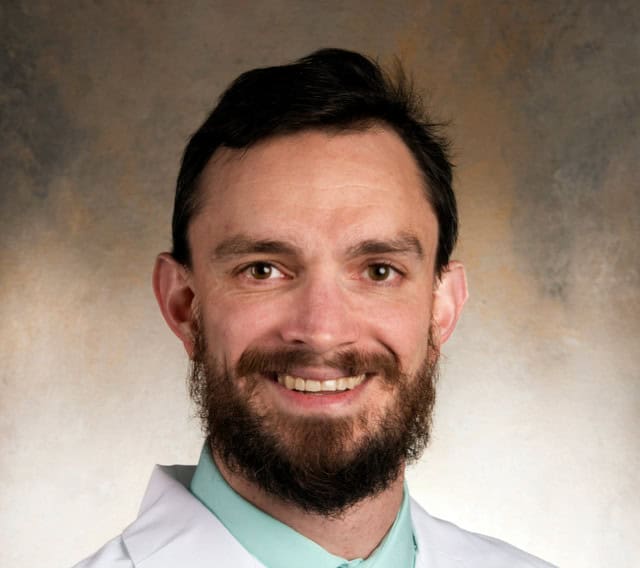
University of Michigan Department of Biomedical Engineering (U-M BME) welcomes Kenneth Bader, Ph.D. to our faculty. His research program is rooted in physics, driven by biomedical needs, and closely aligned with one of U-M’s signature areas of innovation: histotripsy.
Dr. Bader has focused his career on therapeutic ultrasound, acoustic cavitation and the development of non- and minimally invasive approaches to treating diseases that remain difficult to address with standard interventions. At U-M, he will become part of the growing Histotripsy Center, where he plans to continue advancing applications of histotripsy while asking deeper questions about the biological effects of treatment.
“I’m really excited to come to U-M,” Dr. Bader said. “It’s a great environment. I’ve known the folks in the Histotripsy Center for a number of years, and they’ve been good colleagues. I’m looking forward to working with them, and the department in general seems very open, with a lot of dialogue between people.”
Histotripsy is a focused ultrasound technology that uses acoustic cavitation — the formation and collapse of microscopic bubbles — to mechanically break down targeted tissue without incisions or toxic medications. Dr. Bader’s career path began with a longstanding interest in STEM and graduate research involving bubbles in a very different context.
“My degrees are all in physics,” Dr. Bader said. “When I was in graduate school, I worked in a field using bubbles to try to do inertial confinement fusion reactions. As it turned out, there were not a lot of opportunities to do that outside of where we were doing it, so the natural transition was toward biomedical applications.”
That transition eventually led him to histotripsy, in part through conversations with researchers and regulators at the U.S. Food and Drug Administration (FDA) who recognized the technology’s increasing importance. Dr. Bader became interested not only in how histotripsy could be developed as a platform, but also in where it could meet urgent clinical needs.
Prior to joining U-M BME, his laboratory at the University of Chicago, the Biomedical Acoustics Development and Engineering Research Laboratory — the BADER Lab — focused on translating therapeutic ultrasound for non- or minimally invasive treatment of cardiovascular and cancerous diseases.
“In terms of applications, we have focused on areas such as venous thrombosis and neuroblastoma,” Dr. Bader said. “These are pathologies that do not have good treatment options, and histotripsy seemed like an obvious potential solution.”
Dr. Bader’s work also includes developing improved methods for image guidance and treatment feedback. His group uses ultrasound imaging and magnetic resonance imaging to assess bubble activity and changes in tissue structure during and after treatment. These tools can help researchers understand whether therapy is being delivered effectively and efficiently.
“We have worked on methods to improve image guidance and use that information for feedback,” Dr. Bader said. “The goal is to vary the exposure in a way that provides effective and efficient treatment.”
At U-M, Dr. Bader plans to continue research in venous thrombosis, neuroblastoma, imaging and quantitative assessment of the mechanical effects that histotripsy induces in tissue. His group is also collaborating with researchers at the FDA and the National Institute of Standards and Technology (NIST) to develop methods for quantifying histotripsy systems, including the stresses and strains generated during treatment.
A major area of growth, Dr. Bader said, will be moving beyond technology development alone and toward a more nuanced understanding of tissue response.
“The questions I have been asking in recent years have been less technology-driven and more focused on the biology of what is happening,” he noted. “We have great tools now, such as single-cell sequencing, that can help us understand the response. What happens not only to what we treat, but also distally to where we are treating?”
That biological perspective is increasingly important as histotripsy moves further into clinical use. Dr. Bader sees the next phase of the field as one that requires collaboration across disciplines — from imaging and mechanics to chemistry, cancer biology and systems-level analysis.
“The technology is now at a point where we understand some of the fundamentals,” he said. “The more nuanced aspects of what is going on will require coming at this from different perspectives. Approaches such as photoacoustic imaging, MRI, click chemistry and sequencing will be increasingly relevant. Even as patients are being treated, the goal is to continue advancing the technology in a way that reinforces what is being done in the clinic and drives new scientific questions.”
Dr. Bader will bring members of his research group with him to Ann Arbor, including a graduate student, as well as several postdoctoral researchers.
Before joining U-M, Dr. Bader served as an associate professor of radiology at the University of Chicago, with affiliations in cancer biology and medical physics. He earned his Ph.D. in physics from the University of Mississippi, and his B.S. in physics from Grand Valley State University.
Outside the lab, Dr. Bader and his family are also looking forward to the move. He and his wife have two young children and a dog, all of whom are preparing to make Michigan home.
For U-M BME, Dr. Bader’s arrival strengthens an already vibrant histotripsy ecosystem and adds new expertise at the intersection of therapeutic ultrasound, imaging, cavitation physics and translational medicine. His work will help expand the field’s reach — not only by advancing new treatments, but also by uncovering the mechanisms that make them possible.