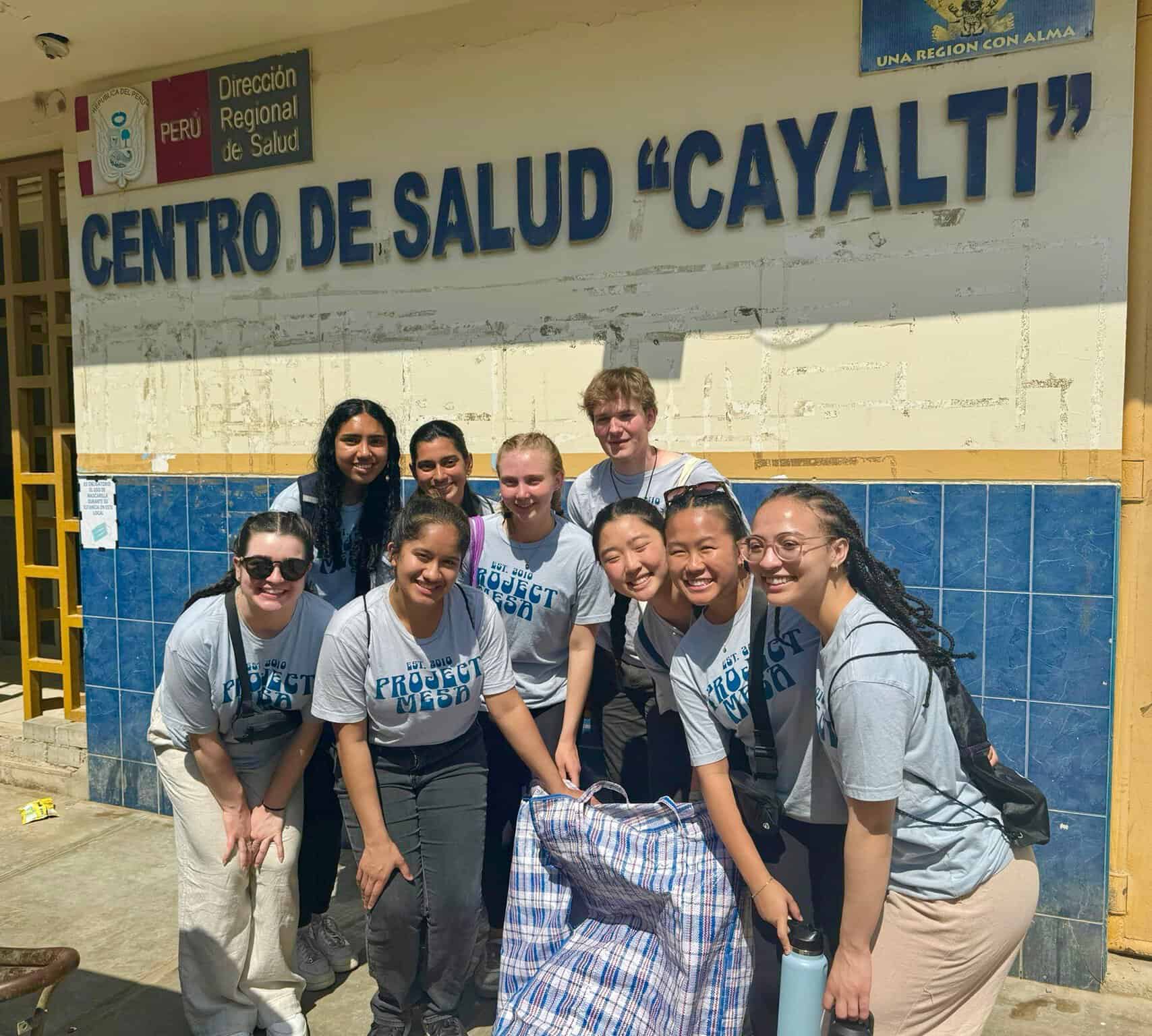
A student-led team in the University of Michigan’s M-HEAL (Michigan Health Engineered for All Lives) umbrella organization is working to make gynecological exams safer, more comfortable, and more accessible for patients in rural communities around the world. Project MESA (Making Exams Safe and Accessible) designs and delivers portable gynecological exam tables that can be transported to health posts and used in low-resource settings—supporting clinicians as they screen for conditions like cervical cancer.
“Our main focus is to help reduce the mortality rate of cervical cancer in low-income and rural regions,” said Emma Arnhols, a junior majoring in biomedical engineering and minoring in physics and computer science, and a current project co-lead. “We primarily work with our community partners in Peru and Kenya.”
From a needs assessment to an evolving global health technology
Project MESA began in August 2010 as a U-M engineering student effort within M-HEAL, a student organization focused on improving access to healthcare in underserved settings. The team’s earliest work included a needs assessment trip to Nicaragua, where members visited clinics centered on maternal health and education. Over the years, MESA has evolved into a multidisciplinary project team that builds and refines its portable exam table through repeated partner feedback and iteration. The team has expanded its reach beyond Nicaragua, focusing on various communities in Latin America with the potential to scale to rural regions globally.
That sustained process of iteration and partnership has provided tangible results: MESA reports 1,000+ exams administered, 9+ prototype iterations, and 47+ communities reached.
A table built for how care is actually delivered
For the students, the project’s urgency is grounded in the realities of rural care workflows—and in the fact that the product is already in use.
“Our table is currently being used in Peru,” said Hadil El-Geneidy, a sophomore studying biomedical engineering with a minor in entrepreneurship and a co-lead of the table engineering subteam. “Clinicians will take this table into rural areas and then conduct their gynecological exams, so it is actively being used for patients right now.”
The team partners closely with FNE International, working with local stakeholders to ensure the device fits the needs of both clinicians and patients. FNE International focuses on sustainability in all aspects of life, including housing, health, and education. One facet in which FNE creates a more sustainable form of health is through the advancement of women’s health by creating and maintaining partnerships with a variety of stakeholders, including urgent care centers. Such partnerships aim to introduce cervical cancer screening and treatment measures, as well as health education programs, to women in need of healthcare access. Over years of collaboration, this relationship has become the foundation for MESA’s implementation model: listen closely, iterate quickly, and return to validate improvements in the field.
Designing in collaboration with patients and clinicians
The upcoming trip to Peru, planned for May 2026, is an extension of that feedback loop. 10 students will travel for 10 days to visit communities in Zaña, Peru, where MESA tables are already in-use, and to evaluate the newest prototype iteration with local clinicians and patients.
For Divya Narne, a sophomore majoring in biomedical engineering and a co-lead of the table engineering subteam, insights from the team’s past visits have shown how engineering work can be refined to respond to real healthcare needs.
“The team was able to gain feedback directly from the local clinicians and the patients themselves,” Narne said, describing Project MESA’s previous Peru trip in 2024. “Some of the feedback we received was how the stirrups could be more comfortable.” She added that affordability remains central to each redesign: “We’re also researching ways to reduce the cost to manufacture so the table is more affordable.”
Clinician and patient feedback has already shaped the current prototype. “In this newest iteration, we have a completely new stirrup design based on user feedback,” Arnhols said. The design and dimension changes aim to improve both patient comfort and clinician usability—two factors that can determine whether an exam is feasible in a small health post or on an outreach visit.
The visit in Peru: focus groups, site visits, and possible in-depth research
While the team will bring technical updates, the upcoming trip is structured around learning directly from community members and healthcare providers.
“For our trip, we’re planning to host focus groups with local patients and clinicians,” said Amy Li, a junior studying neuroscience and data science and co-project lead with Arnhols. “With the focus groups, we hope to gain more feedback from community users, highlighting aspects of the table that they think could be improved upon or expanded.”
MESA also plans to visit multiple health posts where their tables are currently used and, pending IRB regulatory approval, collect formal data about user experience and perceived impact.
“One of our hopes is to collect detailed survey data from the clinicians and patients there,” Li said. “We’ve started an IRB application, and we have high hopes that it will be approved by the time we travel.” If approved, she added, the team has questionnaires prepared for both groups and intends to use the survey results they gather to guide future iterations and document longer-term outcomes.
The motivation for this data collection is practical: While the team knows the tables are helping, it can be difficult to quantify impact without structured measurement. Li also pointed to the stark contrast between the table and what may otherwise be available. In conversations with partners, she said, an alternative can be using everyday items such as a “bucket that is turned upside down,” underscoring how basic infrastructure gaps can shape women’s health access in rural settings.
Sustainability: reducing costs through in-country manufacturing
Beyond user feedback, the Peru trip is also designed to support long-term sustainability. A major goal is to explore whether tables can be made locally, reducing both cost and logistical barriers.
“We’re exploring the potential of working with a manufacturer located in Peru so that we can produce the tables locally to reduce transportation costs,” Li said. On the trip, the team plans to meet with at least one in-country manufacturer to discuss feasibility and next steps.
A growing footprint: exploring a domestic partnership in California
As Project MESA strengthens its international collaborations, the team is also beginning to explore how a portable gynecological exam table could support underserved patients closer to home. Arnhols said the team has started communicating with USC Street Medicine in California—an outreach-focused program that brings care directly to people experiencing unsheltered homelessness and other barriers to traditional clinic access. The conversations are early, but the potential partnership reflects a broader direction for MESA: adapting a proven, field-tested design to meet gaps in women’s health access wherever they exist, whether in rural Latin America or in U.S. communities where mobility, privacy, and equipment availability can still determine whether preventive care happens at all.
Learning by building—and building with purpose
For many team members, Project MESA offers an engineering education that can’t be replicated in a classroom: designing a tangible product, testing it in the real world, and refining it in collaboration with the people it is meant to serve.
“I wanted a way to apply engineering concepts and skills that I’m learning in the classroom to a real-world project,” Arnhols said. “It’s really rewarding to see that my work with Project MESA makes a tangible impact on so many communities.”
El-Geneidy said she was drawn to MESA because it aligns technical work with a health equity focus. “I wanted to be able to apply the skills that we learned to something that actually makes an impact on people,” she said. “But specifically, I was really interested in women’s health and addressing underserved communities with issues that might not receive as much attention in current research.”
For Narne, the motivation was the chance to work on something concrete—and to know it could matter beyond campus. “I think it’s exciting to be able to work on something tangible, an actual product that you can see transforming into an impactful device,” she said. She added that the team’s opportunities to hear directly from partners reinforce why she chose the field: “Talking to different gynecologists, our community partners, and hearing that what we’re working on is actually making a difference in women’s lives and access to health care has been meaningful.”
Li traced her interest to earlier academic work and long-term career goals. “Freshman year of college, I was doing a cervical cancer research project through a class,” she said. “But I’ve always been very interested in women’s health, and so when I heard about Project MESA, it really aligned with my interest.” She also pointed to the unusual leadership opportunities student teams can provide: “We don’t get many opportunities to really lead research work and prototypes as a student,” she said, adding that this experience has influenced how she thinks about healthcare as she plans for a future in medicine.
Together, the students describe Project MESA’s team culture that pairs mission-driven work with sustained mentorship. “I think we’re a really collaborative team,” Arnhols said. “We’re always looking for the next step.” For Project MESA, that includes refining comfort and usability based on field feedback, lowering cost through local manufacturing conversations, expanding potential domestic impact, and returning to Peru in May ready to listen—so that the next exam table iteration continues to evolve to reflect the needs of the communities it is built to serve.