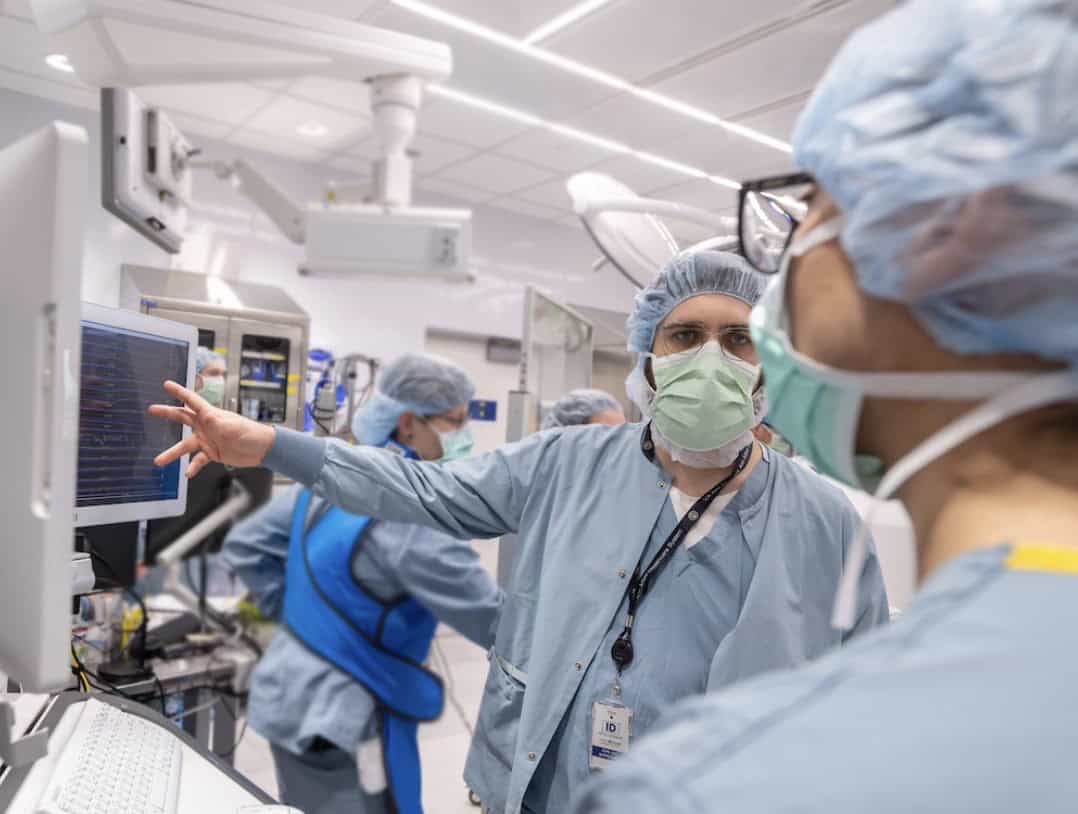
Enrico Opri, Assistant Professor, Biomedical Engineering and Neurology, was recently awarded a Frankel Innovation Initiative grant for his project, “Developing Next Generation Real-Time Directional Mapping for Deep Brain Stimulation (DBS) Therapy,” which aims to revolutionize brain surgery for patients with movement disorders such as Parkinson’s disease and dystonia.
Dr. Opri explained the significance of the award and the challenge his research tackles. “The number of patients affected by movement disorders such as Parkinson’s and dystonia is increasing, and these conditions result in long-term disability and loss of quality of life,” he said. “DBS, while successful as a late-stage therapy, often requires repositioning of electrodes in an estimated 15–34 percent of cases … because the surgery relies on implanting precisely-placed electrodes to deliver targeted stimulation.”
Currently, DBS procedures either keep patients awake for intraoperative mapping (“the classic way,” Dr. Opri noted, “is awake surgery, with a neurologist listening to brain activity to validate placement”), or surgery is performed while the patient is asleep based solely on imaging—limited to facilities with specialized intraoperative MRI suites. “Not many hospitals have that available, and you lose direct feedback on brain activity,” added Dr. Opri. The lack of intraoperative feedback during sleep surgeries is a barrier for expanding access to DBS therapies.
With support from the Frankel Initiative, Dr. Opri and his collaborators are proposing a methodology that leverages a new biomarker, called “DBS local field potentials—evoked by stimulation—that tells us whether we are at the optimal brain location,” Dr. Opri said. “This could allow us to provide real-time direction for electrode placement, reducing the number of surgical penetrations and making the procedure safer and more comfortable for patients.”
Crucially, the team’s innovation would enable functional mapping during both awake and asleep procedures, providing neurologists and neurosurgeons with real-time, automated feedback akin to what is currently only possible with highly specialized expertise.
“Our goal is to improve the patient experience during surgery, make it possible to perform sophisticated functional mapping even when the patient is asleep, and eventually develop a prototype that can be used in the clinic,” Dr. Opri added.
The Frankel Innovation Initiative is a $20-million fund dedicated to supporting the research and development of life-saving therapies and breakthrough technologies at Michigan Medicine. Thanks to the generosity of the Maxine and Stuart Frankel Foundation, this initiative offers up to $300,000 per year for promising research projects, coupled with guidance from an expert advisory committee of world-class scientists and technology developers. The program is committed to driving rapid patient impact by empowering U-M faculty at all stages of discovery.
The Frankel Initiative award provides one year of funding for clinical validation and prototype development. While the project officially launched in January, Dr. Opri’s group has also established intellectual property in this space, working closely with clinical faculty and the neuromodulation group—an alliance he sees as key for translating these technologies to patient care. “My lab focuses on both exploratory neuroscience and direct clinical applications,” he said. “A major focus for us is how to bring our research from the bench to the bedside. This award is an opportunity to support our efforts towards that.”
Looking to the future, Dr. Opri is optimistic about broader patient access that additional DBS might one day offer patients. “DBS as a therapy is only accessible in a small number of centers,” he said. “Many patients need to travel long distances for care. We hope our system will make DBS feasible in more hospitals and diverse care settings.”
For more details on the Frankel Innovation Initiative, visit Frankel Innovation Initiative at Michigan Medicine.