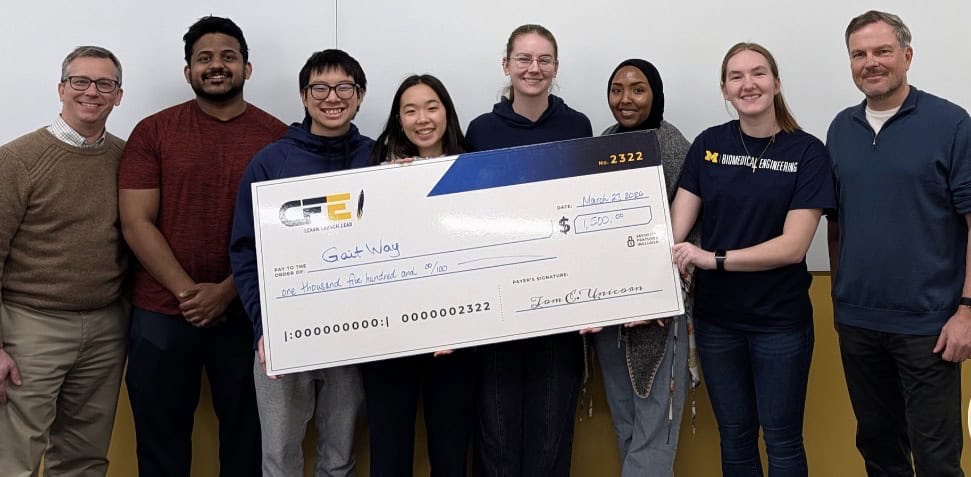
At a recent MTank pitch competition hosted by the University of Michigan’s Center for Entrepreneurship (CFE), a team of U-M biomedical engineering students–GaitWay–earned first place for its entry of a wearable system designed to detect and mitigate Freezing of Gait (FoG) in people living with Parkinson’s disease.
MTank is a project similar to the reality TV show Shark Tank, where startups come to pitch their ideas, receive live feedback and guidance from judges, and compete for capital from Venture Capitalists. This event is presented by MPowered and changes the game of pitch competition. MTank adds entertainment to the playing field, drawing in a crowd and resulting in huge exposure for the startups.
“I’m beyond thrilled to share that our team took home first place,” said Shinyeong (Kayla) Lee, who developed the project alongside Pom Pinitchan, Daniela Scagnetti, Karan Kaimal, and Sarah Horst. “Our goal is simple: to help people step with confidence and regain their mobility and independence. It was incredibly rewarding to see that mission resonate with the judges.”
FoG—often described as feeling like one’s feet are “glued to the floor”—can interrupt walking unexpectedly and increase fall risk. Lee said the team focused on improving both timing and usability compared with existing cueing approaches.
“People with Parkinson’s can experience freezing of gait, when it feels like their feet are stuck to the floor and it becomes difficult for them to move,” Lee said. “Many current solutions rely on manual cueing, and sometimes people don’t even realize an episode is happening. We wanted to build something that can detect a freezing episode automatically and then deliver a cue immediately—without requiring the user to activate anything.”
The team also designed GaitWay with discretion in mind.
“Some cueing tools can be very noticeable, and that can add stigma to a condition people are already struggling to manage,” Lee said. “We’re working toward a wearable approach that can provide cues in a more direct, discreet way, rather than loud metronomes or highly visible laser lines.”
“The more we build community with people who live with Parkinson’s, the more we hear about how their visible symptoms make them feel like a target for attention,” added Scagnetti. “We didn’t want a solution that adds another thing for people to see first. We are passionate about helping people with Parkinson’s re-engage with the lifestyle they enjoy leading, without having a device in the way.”
In addition to the wearable device, the team is exploring a companion app that could help users and clinicians better understand FoG patterns over time.
“We’re also developing an app to track when these episodes occur and potentially monitor disease progression over time, so future care and treatment decisions can be better informed,” Lee said.
“We have talked with many clinicians at Michigan Medicine who have a passion for innovation and also see patients on a daily basis,” Scagnetti added. “We want to also create data that are not only helpful, but informative.” The team’s victory reflects months of iteration and teamwork—often under tight schedules as graduation approaches.
“I’m incredibly proud of the hard work, the technical iterations, and the late nights our team put into bringing GaitWay to life,” Lee said. “We really couldn’t have done it without the structure AMPED provided,” added Scagnetti.
That work was shaped through U-M’s Advanced Medical Product Engineering and Development (AMPED) program, which emphasizes product development and real-world translation.
“AMPED is focused on the full medical product development cycle—from concept through end of life,” Lee said. “It helped us learn how medical products are developed in industry and how to apply engineering in real-world settings, not just in theory.”
Scagnetti added that AMPED provides real-world experience in product development. “What I like about AMPED and continue to highlight to others is that it is an engineering program, but we go way beyond engineering,” she said. “We receive experience with developing a business case for our product, learning the regulatory bodies involved in approving the device and how they operate, learning what good and bad documentation looks like, how to build a good quality assurance system, and more. The program really gives you a broadband scope of the industry as a whole, beyond just the research and development aspect of engineering.”
The team also credited mentorship from its professors for strengthening both the device development and the quality of their business pitch.
“Jan Stegemann (Professor, Biomedical Engineering) and Jonathan Fay (Clinical Associate Professor of Practice, Biomedical Engineering, Associate Chair for Translational Research, and Hub Director, NSF I-Corps Hub: Great Lakes Region) supported us throughout the process, sat in on our early pitch practices, and gave us critical feedback,” Lee said. “Their mentorship played a major role in our success. Honestly, we couldn’t have done it without them—or without AMPED.”
With MTank concluded, the team is looking ahead to additional entrepreneurship pathways at Michigan.
“Winning MTank opened doors to other opportunities through CFE, including the new M Combinator pathway,” Lee said. “We’re exploring how to keep moving the project forward even after graduation.”
Finally, Lee highlighted what the process taught the team about collaboration.
“We faced a lot of learning curves because we come from different backgrounds,” Lee said. “But we shared the same passion to take this to the next level, and that’s what brought us together.” Team members noted that their collaboration has extended beyond their interactions at U-M and will continue to provide networking opportunities in the world of product development.
The Center For Entrepreneurship’s Programs are open to any students from all schools and colleges – undergraduate level through PhD.
Read more about GaitWay’s success at MTank.