Undergraduate Innovation in High-Throughput Screening Earns SLAS Poster Award
The award highlights the exceptional caliber of research and presentation skills exhibited by BME undergraduate student Christian Reinhardt, whose work drew considerable interest from conference attendees.
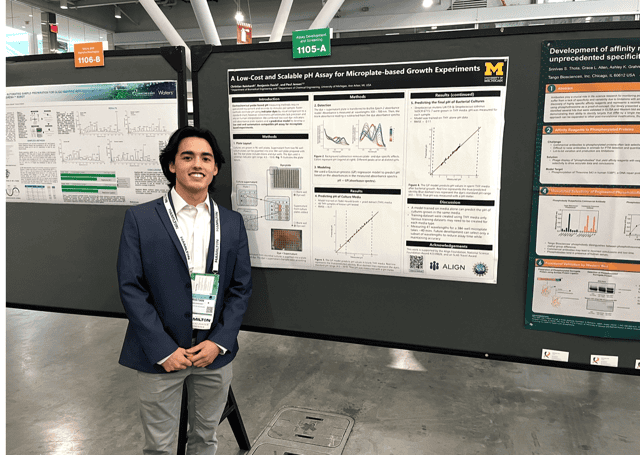
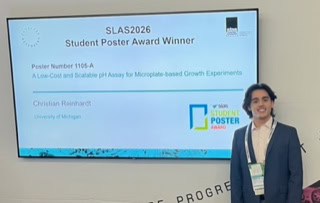
BME undergraduate student Christian Reinhardt received top honors from the Society for Laboratory Automation & Screening (SLAS) International Conference held in Boston last month. Reinhardt’s poster, co-authored by mentor Benjamin David, Assistant Research Scientist, Biomedical Engineering, and supervised by Paul Jensen, Associate Professor, Biomedical Engineering and Chemical Engineering, was selected as one of only three award winners among hundreds of submissions, making him the only undergraduate recipient in a competition that typically recognizes graduate students, postdocs, and junior faculty. The award highlights the exceptional caliber of research and presentation skills exhibited by Reinhardt, whose work drew considerable interest from conference attendees.
Impactful Undergraduate Research
The project, conducted in partnership with the Align Foundation, tackled a common bottleneck in laboratory workflows: efficiently measuring pH across tens of thousands of reactions. Dr. Jensen noted, “We need to measure pH, but the usual ways take a long time or are quite expensive. Christian worked with Ben David to figure out a way to measure pH at high throughput and low cost, so the assay scales to thousands of reactions.”
Reinhardt’s innovative assay utilized standard lab equipment—a spectrophotometer—and inexpensive pH indicator dyes (the same type used to check swimming pool water) to deliver high-function results that are accessible and scalable for labs worldwide.
“Taking small resources and doing big things with them—that ultimately will allow for open science,” Reinhardt said. “This is an accessible assay that pretty much any lab can replicate.”
Rewarding Experience
“I’m obviously very excited. It’s very rewarding,” Reinhardt said of winning the award. “My mentors, Ben and Paul, have really helped guide the project, and I attribute a lot of our success to our teamwork.”
The experience at SLAS was not without its challenges, however. “The judging was kind of stressful—it was in the big convention center, next to other students presenting,” Reinhardt described. “A group of six judges came up to my poster, gave their overview, and asked questions. It was a fun opportunity. Especially sometimes I doubt my abilities and my knowledge of the project, so it’s exciting to present the research and highlight the work that you’ve done.”
From Prototype to Production
What makes Reinhardt’s journey especially noteworthy is the full arc from innovation to real-world impact. Dr. Jensen said, “It’s rare for an undergraduate student to develop a new assay or process, and then also be here to put it into production. Next summer, we will run thousands of these assays every week. This is a great experience for an engineering student to guide something from design to deployment over the course of two years.”
Reinhardt added, “This is the first time I feel like I’ve created something from an idea to something tangible—and not just as a prototype, but to see it go into production for large-scale purposes. I even got to help industry partners who saw my poster and wanted advice for their own labs.”
Collaboration at the Core
When asked about the lab environment that fostered his growth, Reinhardt praised the collaborative spirit: “Paul creates a culture of collaboration,” Reinhardt said. “Even though people have their own projects, everyone helps each other. Here, it’s very rewarding and supportive.”
Dr. Jensen agreed: “Christian needed knowledge of biochemistry, chemistry, microbiology, modeling, statistics, and production engineering. All those things have to come together to get a project like this to work. I think that’s indicative of an interdisciplinary field like biomedical engineering.”
Looking Forward
With one year left after this as an undergraduate, Reinhardt is considering medical school—but his time in the Jensen Lab has opened new possibilities. “I never considered doing a master’s program more than I had after I joined his lab. It’s tempting.”
Reinhardt’s research will be featured on an SLAS podcast.
This work was supported by the National Science Foundation and the Align Foundation.