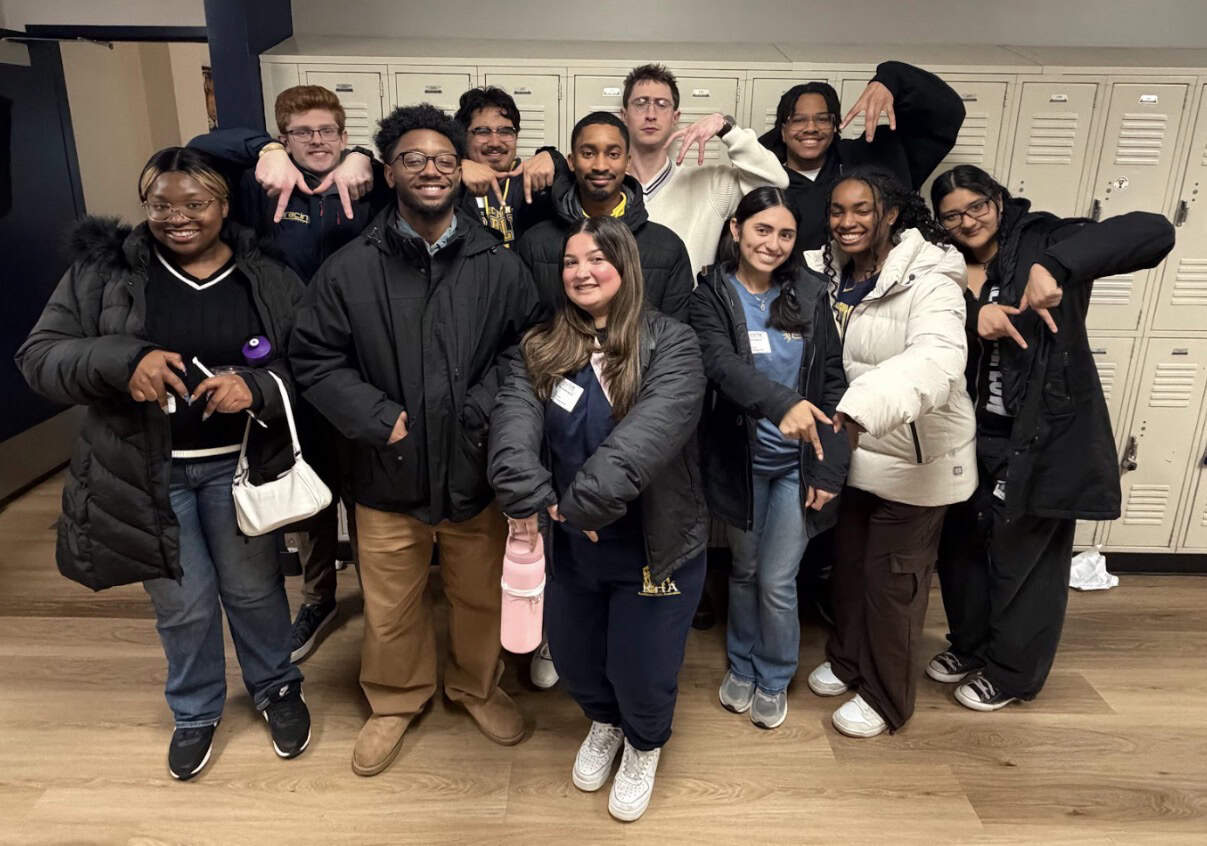
During Spring Break 2026, a team of University of Michigan Engineering students included lesson plans with travel plans—and visited Chicago to lead hands-on STEM workshops and talk candidly with high schoolers about college pathways, engineering majors, and what it’s really like to study biomedical engineering.
The outreach was led in part by the student organization Underrepresented Biomedical Engineers (UrBME) in collaboration with the Society of Hispanic Professional Engineers (SHPE) and the Alternative Spring Break – Chicago (ASB‑C) program, a College of Engineering effort that began in 2011. Through ASB‑C, Michigan Engineering students partner with Chicago-area schools and community organizations to introduce teens to engineering concepts, model successful college pathways, and represent U‑M’s commitment to broadening access to STEM education.
This year, 10 U‑M students traveled to Chicago, including five students from UrBME, with additional participants affiliated with SHPE and ASB‑C. The group spent two days at Noble Street College Prep, rotating through classes and leading interactive activities designed to make engineering approachable, collaborative, and fun. UrBME President Bocar Soumare and Vice President Morghan Allen shared their recent experiences from the trip.
Engineering principles—marshmallows, foil, and robotics
At Noble Street, the outreach team visited 10 class periods over two days, reaching an estimated 200 students. “We led workshops in five class periods each day, so about 10 classes total,” said Bocar Soumare, a BME senior. “On average, every class had at least 20 or so students.”
Day one focused on engineering design and problem-solving in biology classrooms, including an earthquake-inspired tower challenge. Students built structures from dry spaghetti noodles and marshmallows, and then tested their designs using a vibrating tool to simulate shaking. “The students were building a tower and making sure it could withstand an earthquake,” Allen explained, helping students explore engineering principles behind what makes a strong structure.
Students also participated in a classic foil boat challenge—reimagined as an engineering competition. Students designed small boats out of foil and tested which design could hold the most coins, using the activity to discuss buoyancy and iterative design.
Day two shifted into computer science and robotics. Students used calculator-style coding tools to program small robots that would physically draw geometric shapes.
Learning to teach—and seeing future engineers in action
Both student leaders emphasized that the trip strengthened skills that matter in engineering, but aren’t always taught in a lecture hall—skills like communication, audience awareness, and engagement. “How to keep students engaged and how to communicate with them effectively and really show them what it’s like to be an engineer,” Soumare said. “That was a big learning curve for me.”
Allen agreed, especially as an upperclassman reflecting on what resonates with younger students. “As a senior, I’ve come a long way since being in high school,” she said. Returning to that mindset helped her think about how to answer questions about Michigan, engineering, and career options. “It was inspiring to me to be able to give them different resources, and teach them about opportunities at Michigan that they maybe didn’t know about before our visit.”
One of the biggest surprises for the team: how enthusiastically students participated. “Every student was very engaged,” Allen said. “They were asking really good questions. It was surprising to know how much of an impact I could have on a high schooler.”
Soumare also noticed that many students already display the traits engineers rely on every day, noting the teamwork that emerged during the spaghetti tower activity. “I saw some students holding the items in place, with others passing the materials. It’s like supply chain and procurement along with building the structure.”
For Soumare, the trip also carried personal significance. A Chicago native, he said the outreach mattered because access to STEM exposure and mentorship is uneven. “Some communities don’t have access to the resources of knowing what it’s like to be a STEM student,” he said. “Just having us in their space, and showing them what it’s like to be an engineering student, felt really great.”
UrBME’s broader focus on growth
UrBME leaders say one goal moving forward is to increase student participation and ensure biomedical engineering is included in outreach that introduces students to the breadth of engineering options.
Biomedical engineering, Allen and Soumare noted, can be an especially challenging field for students to picture themselves in—both because it’s interdisciplinary and because many students only hear about more “traditional” healthcare routes. By bringing BME students into K–12 classrooms, UrBME aims to offer specific, real-world explanations of what biomedical engineers do and the different directions the major can take.
The team also highlighted that effective outreach takes planning into account well before anyone steps into a classroom. “One surprise that I didn’t realize beforehand was the sheer amount of logistics that go into planning the event itself,” Soumare said, pointing to coordinating with teachers and ensuring workshops fit into curriculum schedules.
Looking ahead for UrBME: bigger trips, broader collaborations
Allen hopes the Chicago outreach continues to grow. “I hope that next year, we can bring even more people and collaborate with other student organizations,” she said. “It was a great opportunity and it reconfirmed why I chose engineering as a profession.”
On campus, UrBME supports students through biweekly general body meetings and professional development programming, including presentations from industry speakers and office hours for underclassmen seeking guidance on resumes, internships, and navigating the major. The organization also collaborates with other groups—recently partnering with the National Society of Black Engineers on a CAD workshop where students designed a take-home spirometer model.
Looking toward the next academic year, UrBME leaders say they want to expand technical workshops, including circuits/electronics, and build a mentorship program connecting undergraduates with upperclassmen and graduate students. “We would like to collaborate with more BME-affiliated orgs,” Soumare added, naming groups such as BMES, Beta Mu Epsilon, and project teams.
UrBME currently has about 30–35 active students, with a broader community network that includes alumni who stay connected virtually and occasionally return to share career insights.
And in Chicago classrooms, the impact may already be taking shape. Allen recalled that one student has been admitted to Michigan, and many others expressed interest in engineering. “A good amount of the students indicated an interest in engineering,” she said—exactly the kind of early spark the program hopes to ignite.