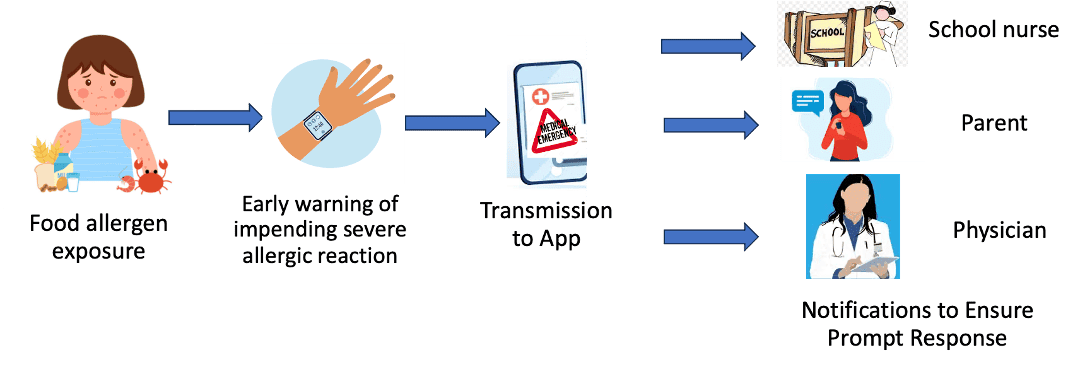
Early Detector of Severe Food Allergy Reactions – Knowing When to Reach for an Epi-Pen
U-M Team Leverages Collaboration, Innovation, and Coulter Support in the Development of a New Wearable Device for Food Allergy Anaphylaxis Detection
5–8 minutes

U-M Team Leverages Collaboration, Innovation, and Coulter Support in the Development of a New Wearable Device for Food Allergy Anaphylaxis Detection
“The story of our collaboration is the most ‘University of Michigan story’ ever: Two teams, one campus, and a shared drive to solve a rising medical crisis. Our story is about proximity, opportunity, and a lot of engineering elbow grease.” – Chase Schuler, MD, FAAAAI, Assistant Professor of Internal Medicine, Clinical Assistant Professor of Mary H. Weiser Food Allergy
As the Coulter Translational Research Partnership Program at U-M celebrates its 20th anniversary, this story features one of the projects that embodies the collaborative ethos of Michigan BME. Xudong (Sherman) Fan, Richard A. Auhll Endowed Professor of Engineering and Professor, Biomedical Engineering, and Dr. Schuler, a faculty allergist, are spearheading the development of a wearable device designed to detect the earliest signs of anaphylaxis—potentially revolutionizing care for millions living with food allergies.
Their partnership, forged through Michigan’s uniquely close clinical and engineering communities, exemplifies how proximity and teamwork can transform serendipitous discoveries into life-changing technology.
A Fortunate Discovery and an Urgent Need
Dr. Schuler’s research began with a fundamental clinical challenge: detecting anaphylaxis before it reaches a critical point. “There are no predictors—no monitors, no alarms,” he said. “Diagnosis is entirely clinical, and often inconsistent,” Dr. Schuler added. With food allergies affecting up to 10 percent of the U.S. population, the stakes are enormous and growing.
Initially, Dr. Schuler’s team measured transepidermal water loss (TWL) using a commercial device with the aim of studying skin changes during allergy events. By chance, they discovered a sharp and immediate spike in skin water loss during the earliest stages of anaphylaxis—a biological “fire alarm” that sounded before symptoms appeared, offering a potential window for intervention. Realizing the importance of their discovery, they published their findings, worked with Innovation Partnerships to file a patent application, and initiated a pilot trial focused on very small children—often too young to verbalize specific symptoms—making early detection especially critical.
However, Dr. Schuler quickly encountered barriers with the commercial device itself. It was too bulky, expensive, and unsuited for pediatric use. The solution would require more than just clinical insight—it would need targeted engineering expertise.
Where Engineering Innovation Meets Clinical Insight
That’s where Dr. Fan and his team entered, approaching the problem from the engineering side. Fan’s lab, supported by NIH, had been developing technologies to measure body odor for disease diagnosis, which required accurate and affordable TWL measurement tools. The devices available on the market, he found, were cost-prohibitive, unwieldy, and far too sensitive to motion and environmental factors, such as humidity.
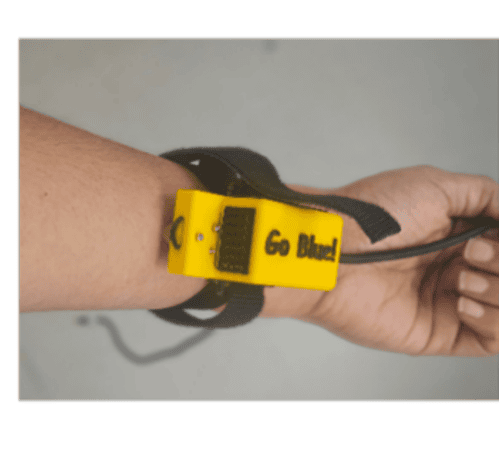
Motivated by both necessity and scientific curiosity, Dr. Fan’s group developed their own wearable TWL monitoring device prototype using miniaturized components to enable a device small enough for on a person’s wrist. As Dr. Fan recounted, the breakthrough came when they discovered Dr. Schuler’s published study on food allergen challenges and recognized both the clinical potential and the need for robust engineering solutions. Rather than being separated by thousands of miles or academic silos, the two teams were able to initiate collaboration minutes away from each other on the Michigan campus—an opportunity that would be much harder to realize elsewhere.
“Instead of one of us being in London and the other in San Francisco, both of us were in Ann Arbor,” Dr. Schuler said. The convenience of proximity, as Dr. Fan added, also simplified administrative challenges such as IP management and accelerated iterative problem-solving.
From Serendipity to Tailored Devices: The Michigan Advantage
From this point, the project moved rapidly, fueled by synergy and Michigan’s collaborative environment. As Drs. Schuler and Fan began working together, they focused on refining the device to meet the unique needs of pediatric patients. Dr. Fan’s lab adjusted its prototype, making it smaller, lighter, and increasingly tailored—eventually working toward a wireless, Bluetooth-enabled version. In addition to technical refinement, the team dramatically reduced costs, slashing the price from more than $500 to around $100, opening the door to future mass deployment.
This engineering progress dovetailed with clinical development. As Dr. Schuler continued his pilot studies and further validated the physiological phenomena, the team also moved forward with patent applications and new grant proposals. What began as an accidental finding quickly matured into a scientifically robust, clinically-sensitive technology, ready for broader testing and commercialization.
Coulter’s Strategic Boost and the Power of Guided Collaboration
A crucial part of their journey was the involvement of the U-M BME’s Coulter Translational Research Partnership Program. As Thomas Marten, Director, Coulter Program, describes, the program was designed not only to provide funding, but also to offer strategic guidance, de-risking, and essential market validation. “Coulter doesn’t give you unlimited time or funding,” Marten noted, “but we can help provide the support that teams need to reach the next stage to continue new product planning and development —whether that’s further grants, commercial partnerships in the form of licensing deals to startups or existing companies, or conducting human clinical trials while still a university project.”
For Dr. Fan, this guidance was transformative. “It’s the difference between pausing a project and refining it for real-world impact.” He emphasized how the Coulter process encouraged the team to prioritize market orientation, customer validation, and usability, rather than just technical achievement. Dr. Schuler echoed this sentiment, highlighting the value of education and hands-on experience that the Coulter mentorship and proposal review process provided—practical insights that don’t come from textbooks or isolated grant writing. “Coulter’s strategic guidance and market research were pivotal—these lessons will stick with me for the rest of my career,” said Dr. Schuler.
Building Momentum and Planning for the Future
As the project matured, the team began thinking beyond the immediate device. Their work with Coulter not only catalyzed technical improvements, but also built a foundation for the next steps: expanded clinical validation, commercial strategy development, and broader impact on public health.
With interest from organizations such as the Keep Smiling for Abby Foundation and involvement in a nationwide food allergy consortium’s study, the team is poised for larger validation trials. Simultaneously, they are leveraging Michigan’s Accelerate Blue Foundry and programs such as Michigan Translational Research and Commercialization (MTRAC) and Advance to maximize non-dilutive funding and cultivate entrepreneurial support. Alongside potential mentor and CEO candidates, they’re seeking commercial advisors and building out an advisory board to guide future business development.
Drs. Fan and Schuler are continuing their collaboration—to carry development as far as possible within Michigan’s unique ecosystem, maximizing support and minimizing capital needs and dilution until their device is commercially ready for the market.
The Michigan Difference: Collaboration and Forward Momentum
Ultimately, the device’s journey from accidental observation to near-market readiness were made possible because of the multitude of resources at Michigan. As Marten noted, “Our structure—bringing engineering and medicine together under one umbrella with funding, commercialization and translational research support—makes it possible for teams to move quickly and learn collaboratively.
Dr. Schuler summarized the transformation enabled by Coulter: “Going from a large, corded device that introduced a new measurement technique, to a small, cordless, market and clinically validated tool—that’s the process Coulter supports. And that’s exactly what we needed.”
As Michigan continues to celebrate two decades of the Coulter Translational Research Partnership Program, this project stands as a testament to the power of campus proximity, interdisciplinary collaboration, and strategic support in driving medical innovation forward.