From Concept to Clinic: How a Coulter Collaboration Delivered Innovation in Administering Anesthesia to Eyes
Michigan’s co-located Medical School and College of Engineering, along with a culture of innovation and entrepreneurship, makes projects like this possible.
BME’s Coulter Translational Research Partnership Program has played a foundational role in launching landmark innovations through collaboration. This story is another in a series of several spotlighting the Coulter Program’s impact during its 20th anniversary year.
Nearly 11 years ago, in the clinics of U-M’s Kellogg Eye Center, a persistent challenge inspired a team to rethink the future of eye care. Retina specialists, treating patients with sight-saving intravitreal injections for addressing conditions such as wet age-related macular degeneration (AMD), wondered if they could improve the way the doctors anesthetized the eye, making this frequent clinic procedure more comfortable for their patients.
The answer would require collaboration, invention, and a journey spanning continents, specialties, and entrepreneurial opportunities. This journey has culminated in two companies, more than $50 million in capital raised, a first-in-class FDA De Novo-granted medical device, and learnings that led to the development of a new drug to replace a commonly used eye antiseptic administered before intravitreal injections that often creates problems for patients.
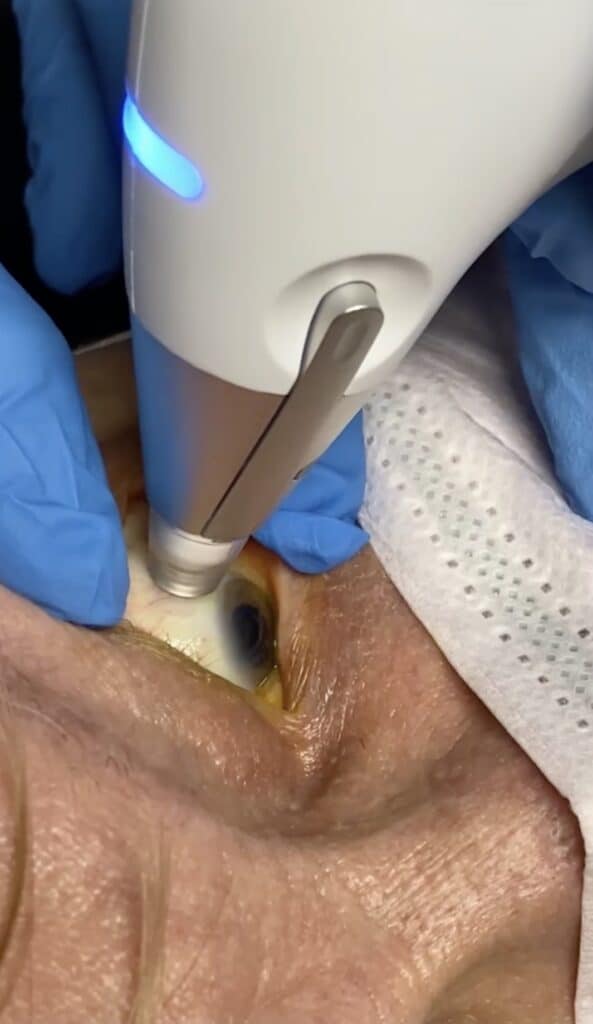
For background, cryoanesthesia, or numbing of the eyes using precision cold temperature, can decrease the discomfort patients experience during intravitreal injections (injection of drugs directly into the eye) and eliminate the need for lidocaine anesthetic injection prior to receiving intravitreal injections of therapeutics for conditions such as wet AMD (age-related macular degeneration). Cryoanesthesia is also an alternative to lidocaine for a small group of people with lidocaine allergies. For patients who require intravitreal injections—vision-saving treatments for conditions like wet AMD—this is a regular reality. Traditionally, doctors use anesthetic eye drops or numbing injections, which can be slow, uncomfortable, and sometimes only partly effective.
But what if, instead of chemicals, cold itself could block pain?
Cryoanesthesia takes advantage of neurobiology: cold temperatures can stop nerves from sending pain signals, like when you put an ice pack on a sprained ankle or bite into ice cream and your tongue goes numb. The challenge was translating this natural phenomenon into a safe, fast, and reliable method for medical use—specifically, for safely numbing the eye.
A Spark of Inspiration and the Power of Collaboration
“We asked ourselves if there was a faster, better way to numb the eye,” recalled Cagri Besirli, MD, Associate Professor, Ophthalmology, who first conceptualized the project with his then-resident Stephen Smith, MD, in 2014. “Traditional anesthetic drops and injections took time, sometimes didn’t fully relieve pain, and weren’t ideal for our workflow. Could cold, rather than chemicals, disrupt nerve conduction and bring relief?”
The idea of cryoanesthesia developed from Dr. Besirli and Dr. Smith’s direct experience with patients and a willingness to question traditional assumptions surrounding this procedure.
They noticed, anecdotally, that cold led to numbing in other situations. “We went to the literature,” Dr. Besirli said. “We examined how pain sensation works, which pain receptors exist on the surface of the eye, and how temperature changes could impact sensation.” Instead of trying yet another drug, they considered using direct cooling.
This clinical insight sparked partnership with engineers Kevin Pipe, Professor, Mechanical Engineering, Applied Physics Program, Electrical Engineering and Computer Science, and Associate Dean for Undergraduate Education, College of Engineering, and postdoctoral fellow, Gun-Ho Kim. The goal: To create a portable device that could deliver rapid, safe, localized cooling. What began as a cross-disciplinary conversation soon became a project emblematic of U-M’s collaborative spirit, drawing in the funding, support and structure of the Coulter Translational Research Partnership Program.
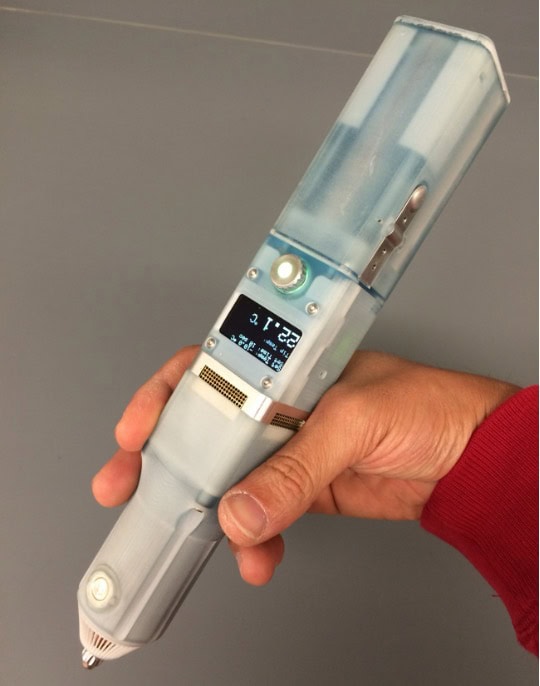
Early iterations began with simple prototypes—a classic story of academic resourcefulness and teamwork. The early result was a portable, battery-powered device that delivered cold to the eye just before injection.
This wasn’t simply “icing the eye.” Precise control over temperature and timing was critical: too cold, and you risked tissue damage; too little, and pain signals slipped through.
The Clinical Journey: Safety First
Their proof of concept began in the lab—rabbit studies—to ensure safety. Then, at Kellogg Eye Center, they moved to the human stage, testing the device on 22 patients in a carefully-regulated dose-response trial. The device’s effectiveness depended on finding the ideal zone for temperature and exposure time.
“We ran our first-in-human, proof-of-concept study at the University of Michigan … we had different groups to test the temperature as well as time of exposure to come up with the best combination to anesthetize the ocular surface,” Dr. Besirli said.
A Decade of Discoveries and Pivots
As Coulter funding and weekly project meetings began in 2015, the team quickly realized that moving from concept to clinic would turn an engineering project into a new product development project focused on meeting user needs. “Coulter enabled me to see my work through a new lens,” Pipe reflected. “My lab had always focused on scientific knowledge and technical performance. Suddenly, with Coulter’s mentorship, I had to broaden the scope to think about user workflow, cost, manufacturability, and value creation. It changed the way I approach engineering and teaching.”
The group’s early prototypes extended beyond the engineering ingenuity of creating a device concept with a cooling tip, and also included feedback from clinicians during market research interviews and input from a medical device design and manufacturing company to ensure both clinical utility and manufacturability. Together, all of the team members grappled with regulatory hurdles, intellectual property filings, and the all-important, often underappreciated, challenge of integrating innovation into busy medical practices. “We interviewed 20 different retina specialists—and found 20 different workflows,” recalled Tom Marten, Director, Coulter Program. “Only by understanding their daily retina medical practice realities could we ensure the design of the device would truly meet their needs.”
For Dr. Smith, those early years were a crash course in entrepreneurship. “Coulter was a springboard. I learned things that are not taught in medical school: how to write business plans, develop target product profiles, handle IP, and predict reimbursement challenges. It positioned me for a new career, where failure became a learning experience, not a setback.”
Learning to Fail Gracefully and Correct Course
The development process was not always smooth. Each team member noted both unexpected victories and the need to adapt as the project evolved. The team celebrated breakthroughs—such as the first proof-of-concept device and the prototype that finally achieved clinical-grade cooling speeds. But they also wrestled with real-world challenges: including differences in strategic vision amongst team members, and perceptions of future market needs.
“Our initial idea was promising,” added Dr. Smith. “But as we advanced, we realized the economics and regulatory realities made commercialization complex,” added Smith. “Learning to ‘fail fast’ and pivot—rather than push forward blindly—was the most valuable lesson.” Dr. Smith eventually went on to co-found iRenix Medical with Dr Besirli, a biotechnology company in the San Francisco Bay Area.
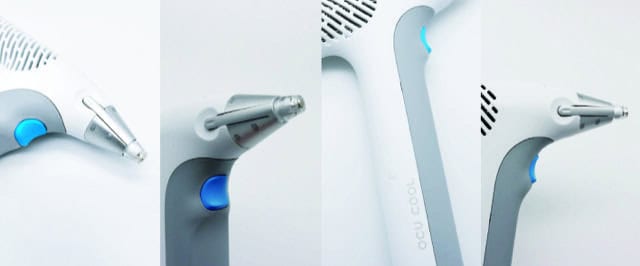
“Further engineering breakthroughs have been key to overcoming the regulatory and commercialization challenges of the original concept” said Gun-Ho Kim, who returned to Korea to found RecensMedical and drive the continuous development of the original concept. “Coulter taught me how to lead R&D, navigate the FDA and business creation, and—most importantly—work across borders and cultures,” Kim said. “The original concept has eventually evolved to a commercial grade device, OcuCool®. We’ve now become the first medical device company in Korea receiving De Novo FDA approval, the first of its kind medical technology, expanding our business to dermatology and veterinary care. With commercialization the real challenge has been integrating with every unique clinical workflow.”
The Coulter Ecosystem—and Lasting Impact
Marten summarized the diverse paths this project took: “This effort started when clinicians and engineers coalesced around a problem,” he said. “Coulter’s job was to push everyone beyond their silos, move towards a product development and solutions focused mindset, and emphasize both de-risking and value creation. Our proximity at Michigan—having colocated medical and engineering schools, and a culture of innovation and entrepreneurship—makes projects like cryoanesthesia possible.”
In the decade since its inception, the project has spun off companies and launched careers and new product innovations, all rooted in lessons learned through challenges, adaptation, and teamwork. As Dr. Smith noted, “Even when our original team diverged, I’m proud that our Michigan collaboration eventually led to an FDA-cleared device. The best validation is seeing an idea come to fruition to improve patient care.” Dr. Smith and his team evolved their focus to highlight drug development and have moved away from devices.
Kim is equally reflective: “From my earliest experiments in Ann Arbor, to clinical trials and regulatory reviews, to eventual manufacturing in Korea, I gained more knowledge than I ever expected. The technology has since evolved far beyond its origins in ophthalmology; numerous dermatologists and veterinarians worldwide now leverage the benefits of precision cooling for various procedures to improve patient experience. Today, we are revisiting the original goal we envisioned in Ann Arbor with OcuCool.”
Looking Forward
As the Coulter Program marks its 20th anniversary, the story of cryoanesthesia offers both inspiration and a blueprint: start with real-world problems, embrace collaborative learning, expect pivots, and be prepared for success to take unexpected forms. The bonds forged through long hours, open minds, and sometimes unexpected results are what propel Michigan innovation beyond university walls—changing lives for patients around the world.
“None of this work happens without capital,” said Dr. Besirli. “Coulter provided scientific, strategic, and financial expertise. These ideas don’t become reality without that type of support.”
“A decade of collaboration and Coulter mentorship didn’t just create a device—it reshaped how each of us approaches innovation, teamwork, and the real meaning of impact,” concluded Pipe.
About Irenix Medical
iRenix Medical is a biotechnology company developing innovative ophthalmic therapies to address unmet needs in large, underserved markets. The company’s lead asset, IRX-101, is currently in late-stage clinical development. IRX-101 is a novel, minimally toxic topical antiseptic designed as an alternative to povidone-iodine (Betadine) for use prior to intravitreal injections, addressing a critical unmet need for safer and more effective ocular antisepsis in intraocular procedures.
About RecensMedical
RecensMedical is a leading technology company for rapid precision medical cooling that seeks to be the world-leading company which discovers and provides optimal cooling treatments. In late 2024, RecensMedical was granted FDA De Novo approval for OcuCool® . OcuCool® is intended for the temporary reduction of pain associated with intravitreal injections. The company is moving forward with the goal of providing not only the best clinical results to its medical staff, but also a safe medical experience for its patients.