Collaboration, Innovation Lead to Success at iGEM for the Michigan Synthetic Biology Team
MSBT has been making significant strides in bringing synthetic biology solutions to pressing environmental and health issues.
5–7 minutes

MSBT has been making significant strides in bringing synthetic biology solutions to pressing environmental and health issues.
From researching the effects of dioxane on Ann Arbor’s water supply to developing targeted pharmaceutical delivery methods to enhance drug efficacy, the Michigan Synthetic Biology Team (MSBT) is a student organization that collaborates on complex research to introduce participants to biomedical engineering’s real-world challenges.
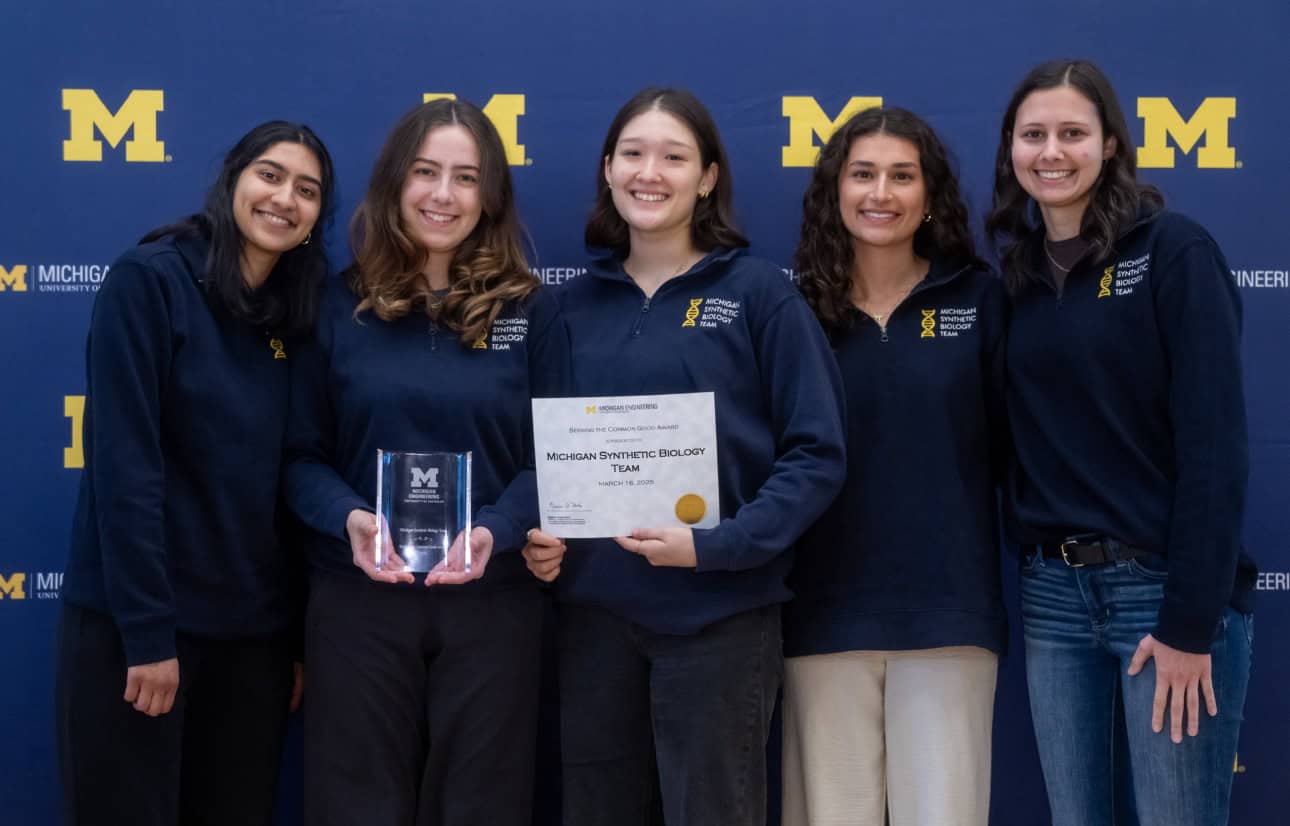
MSBT has been making significant strides in bringing synthetic biology solutions to pressing environmental and health issues. Last October, their hard work was recognized on the international stage at the prestigious International Genetically Engineered Machine (iGEM) competition, where the team earned nominations for the Best Sustainable Development Project out of over 400 global submissions and secured a silver prize for their groundbreaking research. The team also received the Serving the Common Good Award from the College of Engineering.
Led by a team of undergraduate students, the MSBT focused on a project to address 1,4-dioxane contamination, an urgent environmental concern affecting Ann Arbor’s water supply. “We competed at iGEM in October and were nominated for the Best Sustainable Development Project,” Aditi Ganesan, who co-led the human practices component of the project with Grace Lombardo, said.
Lombardo emphasized the importance of community engagement. “One thing we excelled at was human practices—reaching out to the community and gathering feedback on how our project could impact people around us,” she explained. This process included surveys and interviews with local residents and consultations with experts, such as leaders at the Coalition for Action on Remediation of Dioxane, to ensure the team’s approach resonated with real-world needs.
Integral to the project’s success was the innovative use of computational modeling, significantly boosting the team’s project, as explained by modeling lead Noah Black. He highlighted the importance of creating a resource upon which others could build. “We compiled a list of different pollutants and enzymes used to break them down, all available on our iGEM wiki,” he said, emphasizing the value of the team’s openly accessible database. “Future researchers can view our efforts in terms of the kind of bioengineering we did, and they can take a very similar approach to try to emulate our biodegradation results.”
Black added: “We also used tree-based models, which is a form of traditional machine learning, as well as more statistical-based machine learning through something called Bayesian algorithms, and a variety of deep learning approaches. “One of our studies took a form of neural networks called graph neural networks, which are really well suited for working with molecules, and we did some work there. I think our results were right on par with some of the best models published in the literature.”
The MSBT has been moving forward on its next challenge by focusing on healthcare for the 2025 competition. “One interesting feature of our team is that we try to expose students to a broad range of applications of synthetic biology, so every January, we start a new project, and we work on that project until our competition in October,” Ganesan said. “This year’s project revolves around developing a magnetotactic bacteria-based therapeutic system for solid tumors. We’ve started doing wet lab experiments, and Noah’s team has been working on simulations and models to complement our work, so we’re very happy with our results thus far. You can literally direct these bacteria with magnets, because they travel along magnetic field lines.”
The team directs the bacteria toward the solid tumor, and then once they aggregate enough, they can release a therapy, which the team will engineer them to be able to produce. “This makes cancer therapy way more targeted than it typically is,” Lombardo added.
The team prides itself on being an entirely student-run organization, composed of undergraduate students with two PhD student advisors. This autonomy allows team members to explore synthetic biology across a wide spectrum of applications. This approach not only enriches their educational experience but also helps them cultivate a broader understanding of what they might pursue in future careers. “I think this club does a great job introducing students to science in a low-stakes environment,” Ganesan added. In addition to providing a strong research experience, MSBT fosters a rich environment for collaborative learning, networking and mentorship, drawing students from a variety of disciplines.
Lombardo described the cross-functional nature of the team’s work. “Our team is interdisciplinary, so we have subgroups within the team, like computational modeling, human practices, wet lab, and even a finance team,” she said. Such an environment not only introduces members to diverse areas of research, but also enables them to develop holistically as scientists and leaders.
Central to this growth is the team’s mentorship and community-building initiatives. As Lombardo noted, “We have a buddy system, so at the beginning of each year, the presidents usually pair a new member with an older member.” These seasoned members provide essential guidance, helping newcomers navigate the team’s work and culture. Ganesan added, “We also try to have events, such as resume reviews and support activities, to help younger members.”
Team member Hania Timek further emphasized the supportive environment MSBT has fostered. “We’re quite the community, and we help each other a lot,” she said. “It’s fun and reassuring to have a group of people who know what classes you’ve taken, who’ve worked in maybe the same lab for the same department as you have, so we are sharing those experiences together.”
While the challenges of troubleshooting in the wet lab and learning new protocols each year are numerous, Ganesan sees them as opportunities for growth. “It’s rewarding because it teaches you how to do science, how to be a scientist, run into those errors and problems, and bounce back,” she said.
Black highlighted the international experience as a significant reward in being an MSBT member. “We put in all this work over the course of the year, and at the end, we get to go to Paris and present our results at iGEM,” he said. “It’s awesome to speak with teams from India, China, France, and the UK and interact with students I otherwise never would have had the opportunity to meet if not for this program.”
Beyond their scientific achievements, the team has become a source of inspiration, with many of its alumni members excelling professionally. “We have incredible alumni at medical schools, working in industry, and even as professors at prestigious universities,” Ganesan proudly noted, highlighting how the team nurtures future leaders.
For these students, the biggest rewards go beyond accolades—they are found in the shared experiences and personal growth fostered through collaboration and common purpose. As Lombardo reflected on her journey from a freshman team member to co-president, she noted, “It’s so exciting to see every single year how we’re changing, learning more about this competition, and really working toward making our projects better for our community.”For more information on MSBT, visit their website.