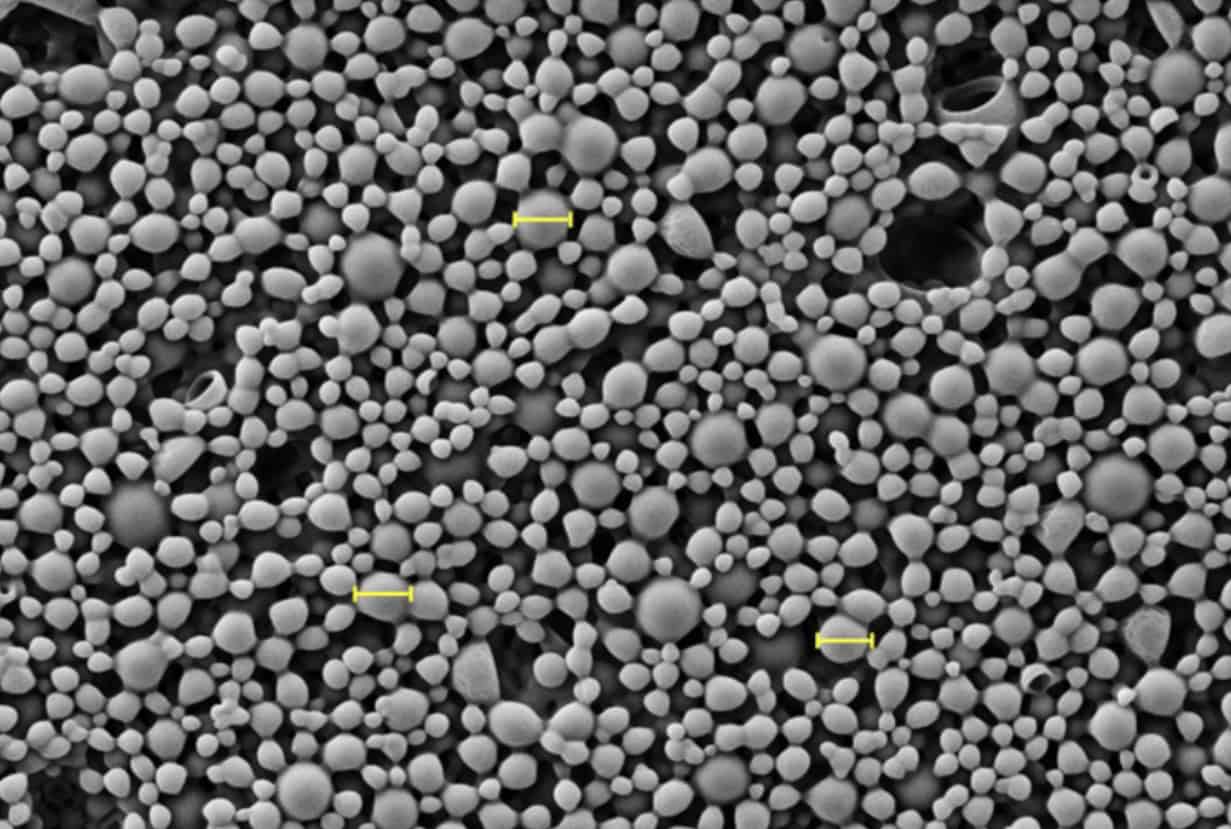
U-M BME research suggests that inflammation, often viewed as harmful in fibrotic disease, may be redirected to help the lung exit a damaging cycle of failed repair.
Pulmonary fibrosis is often described as a disease of scarring. Hannah Viola, a postdoctoral fellow in Biomedical Engineering in the lab of Lonnie Shea, the Steven A. Goldstein Collegiate Professor of Biomedical Engineering at U-M, studies immune-focused nanoparticle therapies for pulmonary fibrosis.
In new research from the University of Michigan Department of Biomedical Engineering, Viola and collaborators studied whether a nanoparticle therapy could help redirect the immune response involved in pulmonary fibrosis. Their findings suggest that nanoparticles delivered through the bloodstream can influence circulating immune cells called monocytes, encouraging them to enter the lung and adopt behaviors associated with resolving fibrosis rather than intensifying it.
“Pulmonary fibrosis is the lung trying to heal from an injury, but failing to succeed,” Viola said. “Because of that, the lung keeps trying to heal, which leads to scarring in the tissue. Over time, the lungs stop working the way they should.”
The work offers a different way of thinking about inflammation, which is often treated as something to suppress in chronic disease.
“Inflammation is not always bad,” Viola said. “We need inflammation to control infection and respond to injuries. I think of inflammation as the first responders—the ambulances and fire trucks that come when there is a problem. The issue is whether that response is happening in the right place, at the right time, and in the right way.”
Pulmonary fibrosis occurs when the body’s normal wound-healing process becomes dysregulated. Instead of repairing an injury and returning to a healthy steady state, the lung remains stuck in a cycle of attempted repair. Scar tissue accumulates, stiffening the lungs and making it increasingly difficult to breathe.
Existing therapies can slow disease progression for some patients, but reversing established lung scarring remains a major challenge.
“Nobody has been able to truly reverse pulmonary fibrosis, because once the scarring happens, it is very difficult to undo,” Viola said. “We do not provide direct evidence that established fibrosis was reversed. What we showed is that we could change the lung environment before extensive scarring occurred, allowing the tissue to exit the fibrotic state without developing the scarring that damages lung function.”
The team delivered nanoparticles intravenously, allowing them to interact with monocytes in the blood. Monocytes are a type of white blood cell that can travel into tissues after injury and help coordinate immune and repair responses. In fibrosis, however, monocytes and other immune cells can contribute to ongoing inflammation and scarring.
That made the study’s results unexpected.
“Normally, having more inflammation in the lung would be expected to make fibrosis worse,” Viola said. “When we added the nanoparticles, we actually increased the number of inflammatory cells in the lungs, but fibrosis decreased. That was surprising.”
The finding points to a more nuanced role for immune cells in fibrotic disease. Rather than simply driving damage, Viola said, immune cells can also help resolve injury—if they receive the right signals.
“In fibrosis, the lung seems to keep repeating the early wound-healing response and never fully reaches the stage where it exits that response,” she said. “The idea is that if we can guide inflammation to perform the correct function, which is to help resolve wound healing, then we may be able to treat fibrosis by redirecting inflammation instead of broadly suppressing it.”
Broad immunosuppression has long been a tempting strategy for inflammatory diseases, but it comes with significant drawbacks. Suppressing the immune system can increase infection risk and slow normal wound healing.
“This work is a step toward thinking differently about inflammation,” Viola said. “Instead of saying, ‘Let’s turn off all inflammation,’ we are asking whether we can influence the type of inflammation we get and make it helpful.”
The researchers found that nanoparticle-treated monocytes migrated into the lung at higher rates and appeared to become more antifibrotic. The precise mechanism remains under investigation, but Viola believes the particles may be encouraging monocytes to shift from an early, aggressive inflammatory state into a later, resolution-oriented state.
She describes these monocyte states as different “personalities.” Some monocytes are fast-acting and highly inflammatory, arriving early after injury to help launch a response. Others appear later and help calm inflammation, clear debris and support tissue repair.
“In a normal healing response, the early inflammatory cells show up first, and then the response transitions into a cleanup and resolution phase,” Viola said. “In fibrosis, that transition does not happen properly. The particles seem to help the tissue progress through the stages of injury and resolution the way it is supposed to.”
That distinction is important, she said, because the therapy does not appear to give immune cells an entirely new function. Instead, it may help cells perform a role they already know how to carry out.
“We are not inventing a new capability for these cells,” Viola said. “We are taking advantage of something the immune system already knows how to do and nudging it to happen at the right time and place.”
The study was conducted in mice, and Viola emphasized that more work is needed before the findings can be translated toward human therapy. “A mouse is not a person,” she said. “The next major question is whether we can achieve a similar effect in human cells.”
Viola is now working to better understand why the nanoparticles have this effect on monocytes and whether the same response occurs in monocytes derived from patients with idiopathic pulmonary fibrosis, or IPF. The team is also exploring whether the approach may apply beyond the lung, including in models of liver fibrosis.
“If this effect is specific to the lung, that tells us one thing about what the particles are doing,” Viola said. “If it works in other tissues, that suggests the particles may be making blood monocytes more generally antifibrotic.”
Beyond pulmonary fibrosis, the research reflects a broader goal: designing therapies that do more than block disease-driving processes. Instead, the team hopes to promote the body’s own anti-disease responses.
“A lot of therapeutics focus on identifying something harmful that disease is doing and inhibiting it,” Viola said. “That can be effective, but it may only be half the picture. We can also ask how to promote the body’s protective response.”
For fibrosis, that means helping the immune system complete the wound-healing program it has already started.
“The body is incredibly capable of healing itself,” Viola said. “Often, the problem is that the response is not happening in the right place, at the right time or in the right way. If we can give cells a nudge toward a function they already have, that could be a powerful therapeutic strategy.”