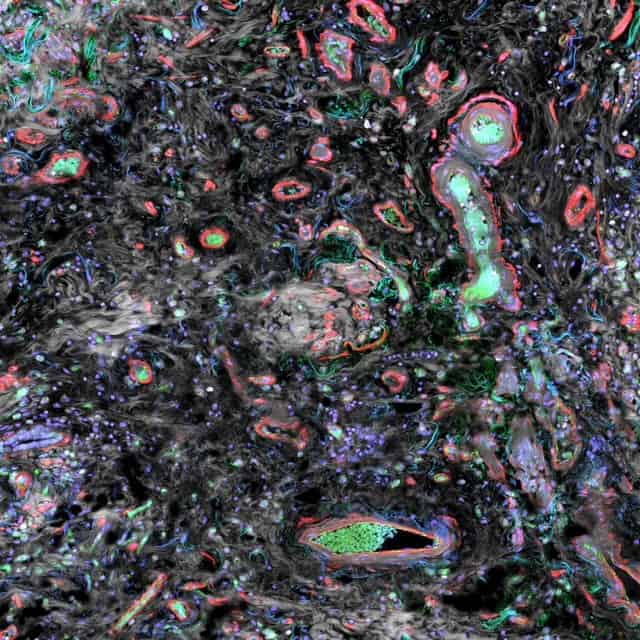
Idiopathic Pulmonary Fibrosis (IPF) is a devastating chronic disease characterized by progressive scarring of the lungs. Available treatments can slow the decline in lung function, but they cannot reverse the damage or restore healthy tissue. Because IPF is often diagnosed only after substantial scarring has occurred, researchers are seeking a better understanding of the cellular events that initiate and perpetuate the disease.
A new study published in Advanced Science, led by Dr. Brendon Baker, Associate Professor of Biomedical Engineering at the University of Michigan, examines a long-understudied participant in this process: the lung’s extensive network of blood vessels.
The Vascular Challenges in Fibrosis
The lung is one of the body’s most highly vascularized organs and endothelial cells—the cells lining the interior of blood vessels—are among its most abundant cell populations. A dense capillary network surrounds the lung’s airspaces, creating the thin interface across which oxygen enters the bloodstream.
Researchers have long recognized that this vascular network changes during lung injury and fibrosis. The nature and significance of those changes, however, remain subjects of debate.
“If you ask one expert, they will say an angiogenic injury response—meaning the growth of new blood vessels—is associated with lung fibrosis,” explains Dr. Baker. “If you ask another, they may say lung fibrosis is accompanied by a loss of vascularization. There has been a lot of confusion about how the vasculature changes, and whether those changes are a result of or a driving factor in fibrosis.”
The study was spearheaded by co-first authors Dr. William Wang, a former BME graduate student in the Baker Lab who led the foundational in vitro studies, and Jingyi Xia, a current BME Ph.D. student who conducted the in vivo research.
Combining Animal Studies with Humanized Models
To investigate how blood vessels respond during the early stages of lung injury, the researchers combined an established animal model with engineered, human-cell-based microphysiological systems
These microphysiological systems are part of a broader class of technologies known as New Approach Methodologies, or NAMs. NAMs include human-derived tissue models, organoids, organ-on-chip platforms, and computational approaches intended to complement—and, where possible, reduce reliance on—animal testing while generating data that may more closely reflect human biology.
“We build microphysiologic models to study disease processes using human cells,” Baker says. “Because these models are simplified and experimentally controlled, they allow us to ask precise mechanistic questions .”
Following experimental lung injury, some endothelial cells near larger blood vessels appeared to separate from the vascular lining and invade the surrounding fibrotic matrix. Because human lung tissue is rarely available during the earliest stages of injury, the combination of engineered human microvessels and animal studies provided a valuable window into processes that may precede advanced fibrosis.
Discovering Aberrant “Lone-Wolf” Endothelial Cells
The team’s microphysiological system consisted of a small device containing fluid-filled channels lined with human endothelial cells. These cells formed living microvessels within a controllable, engineered extracellular matrix—the supporting network fibers surrounding vessels.
By changing the density and organization of this matrix, the researchers could compare microvessels in environments resembling healthy tissue with those in denser, more fibrous environments characteristic of fibrosis.
The team found that endothelial cells sensed and followed matrix fibers, extending outward from the vessel. In dense fibrous environments, some cells adopted a highly invasive and inflammatory phenotype. The researchers termed these cells aberrant tip endothelial cells, or ATECs.
During normal angiogenesis, a leading “tip cell” guides a growing vessel and is followed by connected “stalk cells,” which collectively form a functional, perfusable tube. In the fibrotic models, however, the researchers observed a dysregulated version of this process.
“Instead of organized, multicellular structures, we see individual invading cells,” Baker says. “They are isolated and disconnected from other endothelial cells. The central function of endothelial cells is to form the lining of capillaries and larger blood vessels. Seeing them adopt an isolated, nonperfusable phenotype was very surprising.”
The researchers also identified a potential molecular mechanism underlying this behavior. Adhesion to dense matrix fibers disrupted the cell-cell junctions that normally maintain vascular integrity. This disruption weakened the vessel’s barrier function, increased leakiness, and altered signaling pathways within the endothelial cells. The resulting cells secreted factors capable of influencing inflammation and the behavior of surrounding cells, suggesting a potential route through which vascular dysfunction could contribute to fibrosis.
Shifting Focus: From Halting Scarring to Restoring Health
Further research will be needed to determine how closely ATECs in these experimental models correspond to endothelial-cell states in patients with IPF. Nevertheless, the similarities between the animal studies and engineered human microvessels suggest that abnormal endothelial responses may be an important and previously underappreciated component of fibrotic progression.
“Over the next decade, I think we will develop a much clearer understanding of how these cells contribute to adverse changes in the lung and whether those changes can be targeted therapeutically,” Baker says. “In healthy individuals, injury signals likely prompt endothelial cells to participate in tissue repair. My hypothesis is that aging or repeated injury changes that response, causing these cells to create more problems than they solve.”
The findings encourage researchers to look beyond fibroblasts—the cells most directly responsible for producing scar tissue—and consider how interactions among endothelial, epithelial, immune, and stromal cells shape the course of fibrosis.
Using humanized microphysiological models, the Baker Lab is now investigating whether abnormal endothelial states can be prevented or reversed. Ultimately, understanding how to return disease-associated cells to a healthier state could contribute to therapies that do more than slow the loss of lung function.
“We have been studying fibrosis for decades, yet we haven’t discovered a cure,” Baker says. “One reason may be that we still do not fully understand all the cell types involved or how they interact to drive disease. Research has often focused on only one or two cell types, when in reality the lung contains many distinct populations whose behaviors are tightly interconnected.”