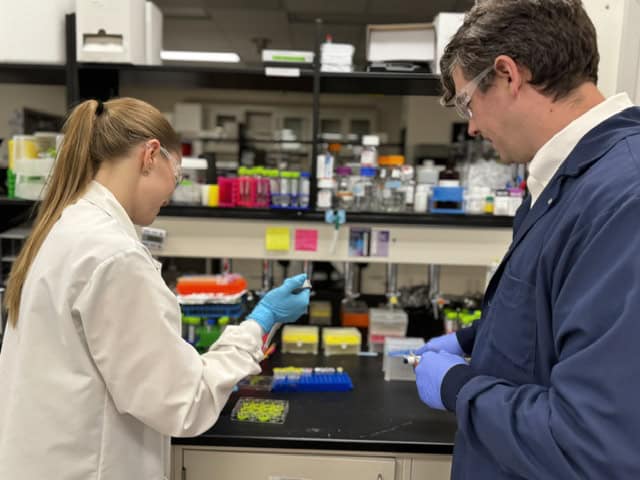
The National Institutes of Health (NIH) has awarded a five-year grant expected to total approximately $2.5 million to U-M researchers, with an aim to engineer precision biomaterials to track, recruit, and study specialized immune cells. The project is a collaborative effort featuring Aaron Morris, Assistant Professor, Biomedical Engineering, and co-investigator James Moon, the J.G. Searle Professor of Pharmaceutical Sciences in the College of Pharmacy, and Professor, Biomedical Engineering and Chemical Engineering in the College of Engineering.
Funded through the National Institute of Allergy and Infectious Diseases (NIAID), these foundational tools will initially be used to monitor and evaluate treatments in multiple sclerosis (MS) models, with long-term potential to transform how clinicians track therapies for other autoimmune conditions, cancers, and vaccines.
Building a Precision Window into the Immune System
The project combines the expertise of the Morris lab with Dr. Moon’s extensive research at the interface of immunology, engineering, and pharmaceutics.
The grant builds heavily upon previous work published by the Morris lab in the Journal of Controlled Release. In that earlier study, led by researcher Sydney Wheeler, the team successfully engineered a system to chemically attach antigens—short peptide sequences—to a synthetic polymer. This allowed them to deliver the antigens into animal models with extreme precision.
In the context of the immune system, antigens act like cellular “wanted posters.” Immune cells recognize these specific sequences to target threats. While standard drug delivery often struggles with exact dosing, the Morris lab discovered that precision is everything.
“That precision loading of the antigen proved to be important,” noted Dr. Morris. “It wasn’t the case that more antigen always equaled more T cells. The response went up and then it came back down, so the ability to do that precisely was critical.”
Meeting the Immune System’s Diverse Players
The grant funding allows the team to expand their material strategy. Different types of immune cells process and recognize antigens in entirely distinct ways. To create a truly comprehensive diagnostic tool, the researchers must adapt their polymers to interface with three major classes of cells:
1. Helper T Cells (CD4+)
These cells coordinate the body’s immune response, essentially helping other cells mature and communicate. The lab’s initial work focused on these cells, which are known drivers in many animal models of autoimmune disease.
2. Cytotoxic “Killer” T Cells (CD8+)
These are the destructive forces of the immune system, designed to eliminate compromised targets.
“If you want a T cell that recognizes and kills a cancer cell, you probably want a cytotoxic T cell,” Dr. Morris explained. “These killer T cells directly kill other cells. They are also very important in autoimmunity, vaccines, and cancer treatment.”
To show antigens to these different T cells, specialized “antigen-presenting cells” act like screens displaying the protein sequences.
“You can think about an antigen-presenting cell as showing a picture of what’s going on to the T cell, and the T cell recognizes that picture,” said Dr. Morris. “The different T cells view different types of screens. Helper T cells only see one type of display, and killer T cells only see another, and they can’t cross over. Because they see different kinds of material, we need to deliver different kinds of antigens to them.”
3. B Cells
Unlike T cells, which only look at short, broken-down fragments of proteins (peptides), B cells recognize fully intact, three-dimensional folded proteins. B cells are responsible for generating antibodies and are major targets in modern medical treatments.
Re-Tracing the Steps: The Value of Foundational Science
A significant portion of the NIH grant will fund basic, mechanistic science. While the team knows that their engineered implants successfully enrich target immune cells at the site of the material, they are still determining exactly how the biological handoff occurs in the tissue.
By running animal studies where specific antigen-presenting cells are systematically depleted, the team can isolate which biological pathways are doing the heavy lifting.
“We have observations of cool phenomena, but we don’t know all the steps in between,” Dr. Morris noted. “We know we put this material in and we get more T cells, but the T cells can’t see that antigen directly on the polymer. There are steps in between happening that we’ve sort of glossed over. This foundational knowledge is important as we continue to build more complex versions of these tools to understand what we’re working with, what parts are important, and what parts might not be.”
From Mouse Models to Personalized Medicine
Once the biological mechanisms are mapped using controlled model antigens, the project will pivot to translationally relevant disease models for multiple sclerosis.
The ultimate goal is to use these cell-recruiting implants as a non-invasive dashboard to monitor whether an autoimmune treatment is working in real time. For example, a common clinical approach to managing aggressive MS is B-cell depletion therapy using clinical drugs such as rituximab or ocrelizumab. By creating an implant that actively recruits and retains B cells, scientists could check the site to see if the drug successfully cleared those cells from the system.
“If we make tools that help us enrich B cells, the hope is we might be able to better monitor therapies like B-cell depletion,” Dr. Morris said. “Eventually, the hope is to be able to monitor these things in patients—monitoring treatments so that you know if a therapy is likely to fail or not in an individual, and you can explore changing the dose or even changing the treatments without waiting for it to fail.”