Paul Jensen Lab’s ‘Robot Scientist’ Earns U-M Empowering Research with AI Award
The award was presented during the MIDAS AI in Research Symposium, highlighting researchers across disciplines—from biological sciences to music—who are integrating AI into their work.
The Paul Jensen Lab has received the Empowering Research with AI Award, recognizing a team-built platform that pairs artificial intelligence with high-throughput robotics to accelerate discovery in microbiology.
The award was presented during the MIDAS AI in Research Symposium, highlighting researchers across disciplines—from biological sciences to music—who are integrating AI into their work.
“The event itself was fascinating because I had the opportunity to hear about extremely innovative and creative things being done all across campus with AI,” said BME Research Faculty Team Member Ben David, who presented the lab’s work at the symposium.
The Jensen Lab’s award-winning work is a project the group calls BacterAI: a self-driving lab for microbiology. “Our team combines AI with laboratory automation to build robot scientists,” David said. “We allow BacterAI to design its own experiments, and it sends the designs over to the lab where a fleet of robots executes the experiments. When the experiments are done, the robots collect the data and hand it back to BacterAI. It tries to make sense of the results to develop a new set of experiments—almost in the way a graduate student would.”
Turning biology into a “game” that AI can learn to play
BacterAI was inspired by reinforcement learning systems that learn through trial and error. “We were inspired by AI agents that learn to play board games on their own,” David explained. “They make a move, receive feedback about the outcome, and through millions of games, they learn to distinguish good moves from bad moves.”
In the Jensen Lab, the “moves” are experimental choices. Their initial biological focus has been the oral microbiome—bacteria that live in the mouth—and fundamental questions about their metabolism. “The questions we were having our system answer were simple biological questions, such as: ‘What nutrients does this bacterium need to grow’?”
BacterAI proposes growth media recipes by removing specific components (for example, a sugar or vitamin) from a broth-like mixture used to culture the bacteria. Laboratory robots then prepare the media and test whether the bacteria grow, returning the outcome as feedback to guide BacterAI’s next “move.”
Shifting the spotlight to BacterAI’s engineering challenges
While AI models often draw attention for their predictive power, David said the Jensen Lab used the symposium to highlight a less visible, but essential, piece: the engineering required to generate high-quality biological data at scale.
“When our lab has presented on BacterAI in the past, we usually focus on the modeling side of the project,” David said. “This time, we wanted to share more about the engineering work our team did to build the robotic pipeline that actually gathers the data in the lab.”
That emphasis reflects a core challenge in microbiology AI: data scarcity at the scale needed to train and validate powerful models. “In our field, one of the big challenges is the lack of large datasets for AI,” David said. “We don’t have a lot of existing data we can draw on in the way ChatGPT can take in the entire internet as part of its training.”
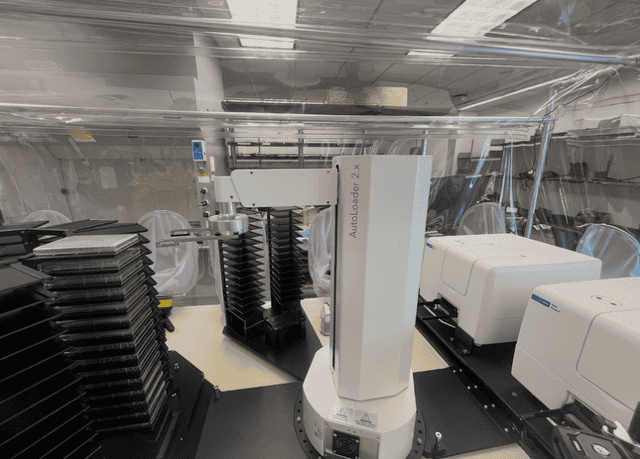
To address that gap, the Jensen Lab built a robotic system capable of performing experiments in enormous numbers. “We had to find a way to collect our own data at scale,” David said. “That’s why we built a robotic platform that conducts thousands of experiments a day on these microbes.”
In his presentation, David detailed the end-to-end workflow—from an AI-suggested experimental design to automated reagent preparation, robotic liquid handling, incubation, measurement, and returning the results back to the agent. “This entire pipeline is almost like a factory,” he said. “I framed it as a ‘How it’s made’—a day in the life of these experiments.”
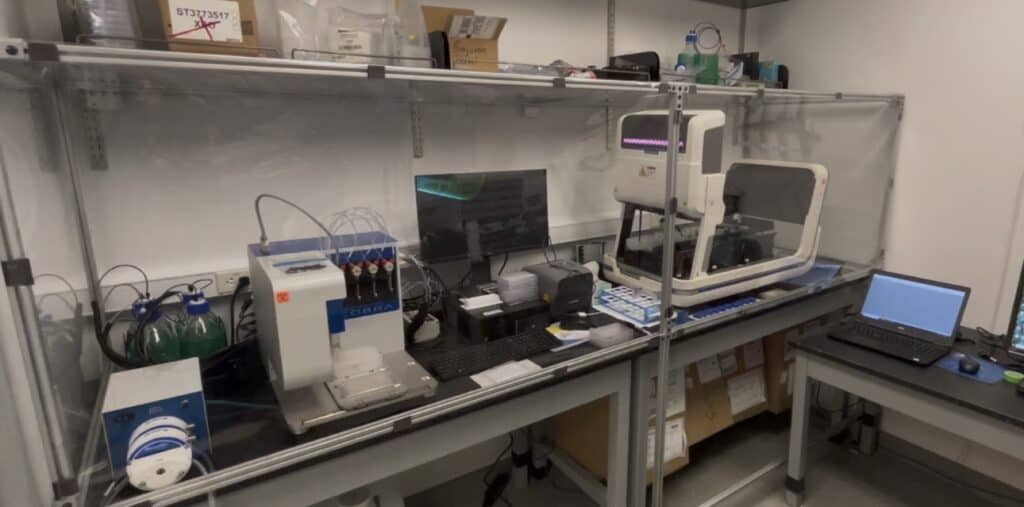
A fleet of robots
“The robots come in all different shapes and sizes,” David said. “The first half of the process is setting up the cultures.” For small-volume cultures, the lab uses instruments that dispense remarkably tiny amounts into each well of a plate. “They can dispense volumes that are less than a microliter—less than a millionth of a liter, and they can visit hundreds of wells per minute,” David said. “Every well might have a different amount of each reagent, so to have a human set this up would take hours. We can really speed the process up with the robots.”
To capture richer biology than a single end-point measurement, robotic arms also automate time-course growth monitoring. “Every 15 minutes or so, a plate comes out, the arm grabs it, and puts it into the measurement device,” David said. “That allows us to see not just how much the bacteria grew over 24 hours, but how it got there.”
Planning experiments for robots, without humans
A major portion of the team’s work is not only running robots, but also translating an abstract experimental idea into an executable robotic protocol—without requiring a human automation engineer to handcraft instructions.
“One of the things I did as part of this project is write software that takes experimental designs and turns them into instructions for the robots,” David said. “The state of the art is to have very talented automation engineers write out protocols, but existing tools weren’t flexible enough for a system to plan on its own.”
The goal is a fully autonomous loop—from design to planning to execution—where people aren’t trapped as the bottleneck. “How do you take a very abstract experimental design and turn that into instructions for robots without having a human do any of it?” David said. “The whole point is that a human shouldn’t need to be involved in monitoring the robot’s actions, or in planning or execution.”
Along the way, the team has also had to solve quality control issues specific to automated systems. “When a human conducts an experiment, we make mistakes, but we can usually tell when we’ve made a mistake,” David said. “If a human isn’t supervising a robot, it can be hard to detect small mistakes—such as a clogged nozzle that isn’t dispensing reagent correctly.”
What automation makes possible
Even as the platform grows, David emphasized that automation is shifting—rather than eliminating—the role of scientists. “Paradoxically, the more automation we’ve employed, the more time we spend doing mundane tasks, such as watching robots to make sure they don’t drop plates, or grabbing items from the fridge to put onto a robot,” he said. “We’re not doing the very technical tasks anymore while preparing the experiments.”
At the same time, automation enables researchers to explore questions that would otherwise be out of reach. “This has allowed us to gather data at a scale that would be completely infeasible without these robots,” David said. “We can design much more ambitious experiments, and address larger challenges.”
Looking ahead, David anticipates new roles emerging around advanced lab automation. “There will be a growing type of job—a lab automation technician,” he said—someone who can oversee platforms and solve engineering challenges specific to laboratory sciences. And, he added, few researchers will miss the most repetitive manual tasks: “I don’t think that if you asked a biologist, they would say pipetting is their favorite part about being a scientist.”
A team award
David also underscored that this award reflects years of collective effort across the Jensen Lab. “One important thing to emphasize with this award is how large the team was, and how much collaboration there has been from nearly every member of our lab—past and present,” he said. “I was the one who presented at the symposium, but I did only a fraction of the work that went into all of this. It was very much a team effort, and a team award.”