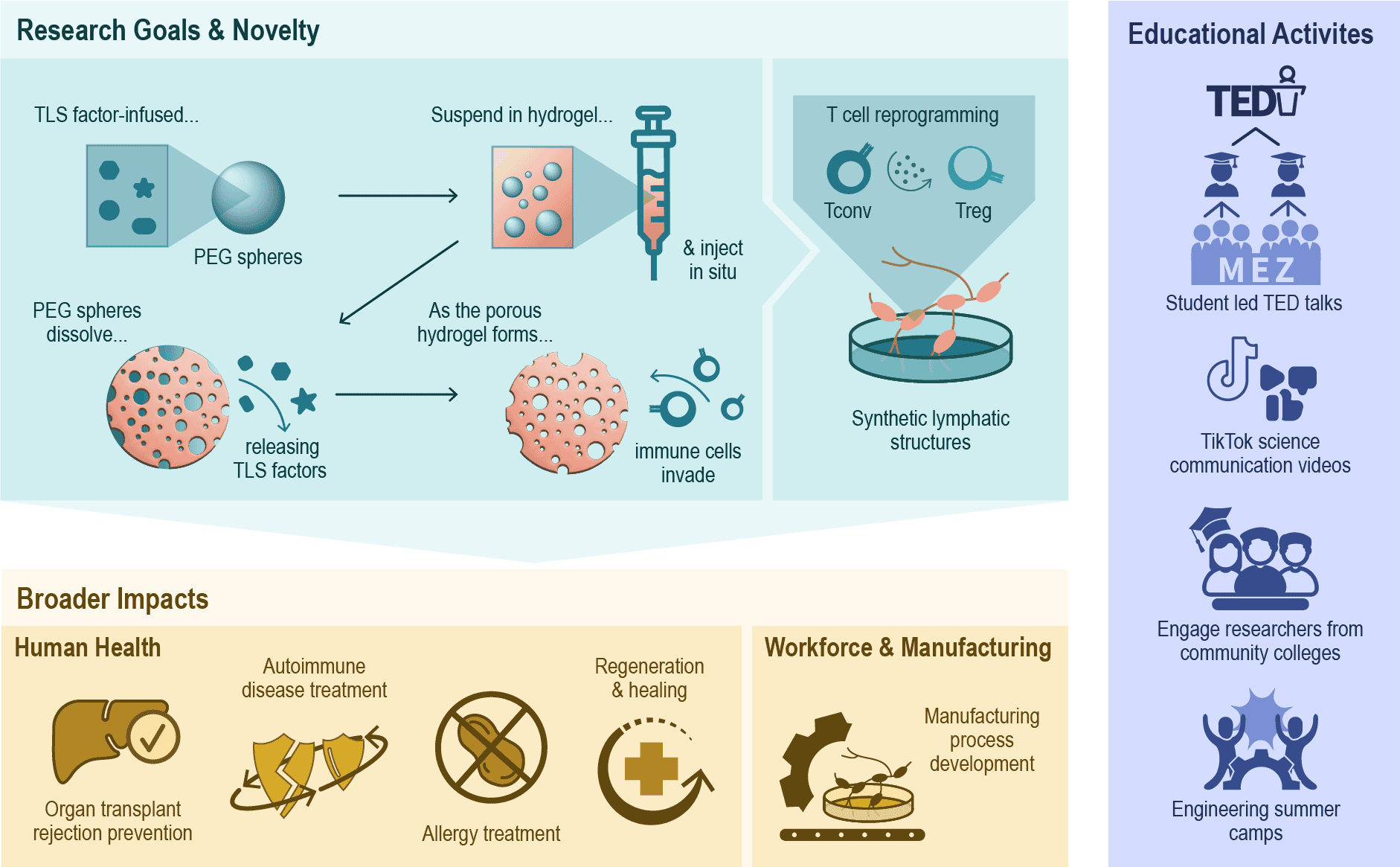
University of Michigan Biomedical Engineering Assistant Professor Aaron Morris has received a Faculty Early Career Development (CAREER) Award from the National Science Foundation to advance new strategies for immune cell therapies by recreating key features of lymphoid tissues outside the body.
The NSF Faculty Early Career Development Program (CAREER) Award is a Foundation-wide activity that offers the NSF’s most prestigious awards supporting early-career faculty who have the potential to serve as academic role models in research and education—and to lead advances in the mission of their department or organization. According to the program’s submission guidelines, CAREER activities should build a firm foundation for a lifetime of leadership in integrating education and research.
Addressing a key bottleneck: specificity, scale, and stability
Dr. Morris’s research focuses on T cells, including regulatory T cells (Tregs)—a specialized population that can dampen harmful inflammation. Tregs are being explored as potential therapies for autoimmune and other inflammatory diseases, but a central obstacle remains: producing enough of the right cells, with the right function, that remain stable over time.
“Regulatory T cells are an attractive therapy, particularly for conditions like autoimmune disease,” Dr. Morris said. “One of the things they do is help prevent dysregulated immune responses—especially to our own tissues. You’re delivering the off switch, basically. You could turn down autoimmunity.”
Treg-based therapies are already being tested in human clinical trials for autoimmune disorders and other inflammatory conditions. According to Dr. Morris, early reports suggest that delivering Tregs is “very safe,” but whether the approach will be reliably effective is still an open question. The efficacy is still kind of the question mark,” he said.
One likely reason is a cell source problem: the therapeutic benefit may depend on antigen-specific Tregs—cells tuned to the particular tissue or molecule involved in a patient’s disease—but those cells are rare and difficult to isolate at scale.
“Regulatory cells are just like other T cells—they’re antigen-specific,” Dr. Morris explained. “It’s difficult to get enough antigen-specific regulatory T cells.”
As a workaround, many studies expand and deliver polyclonal Tregs—cells with mixed specificities—because they are easier to obtain. But polyclonal populations may not provide the same targeted impact in inflamed tissues, potentially limiting efficacy.
Reprogramming inflammatory T cells—without risking reversal
Dr. Morris’s CAREER award will also explore a promising but challenging idea: converting conventional, inflammation-driving T cells into regulatory T cells.
“One way around that is if you could take conventional T cells—the ones that cause the inflammation—and reprogram them into regulatory T cells,” he said.
In the body, this type of conversion can happen naturally as part of “peripheral tolerance,” a process that helps prevent autoimmune reactions. “Our conventional T cells can be reprogrammed into regulatory T cells. It happens all the time,” Dr. Morris said.
But when researchers attempt similar reprogramming in vitro, the resulting cells often fail a crucial test: stability. “In vitro, they’re not stable,” Dr. Morris said. “There’s the potential that they revert from being regulatory cells back to the conventional ones.”
In an autoimmune setting, that reversal could do harm. “It wouldn’t even be an ineffective treatment,” Dr. Morris said. “It could make the disease worse.”
Engineering lymph node-like environments to uncover missing signals
The central question behind Dr. Morris’s NSF CAREER Award is why reprogrammed regulatory T cells can be stable in vivo, but unstable when generated in vitro—and what signals are missing in standard lab culture methods.
“In vivo, they have complex 3D tissues with complex architecture and stiffnesses and gradients of things,” Dr. Morris said. “And then in vitro, we’re basically putting these things on plastic and hoping that it’ll be the same. But a lymph node is not hard two-dimensional plastic. It’s a squishy texture.”
To tackle this gap, Dr. Morris’s lab will use biomaterials to create engineered in vitro models that better reproduce lymphoid tissue microenvironments.
“This grant is about engineering these tissues—models of these tissues,” Dr. Morris said. “We’re calling them tertiary lymphoid structures in vitro as a tool to investigate this and figure out exactly what signals are necessary to promote stable reprogramming.”
While the long-term vision includes enabling new therapeutic pipelines, Dr. Morris emphasized that the CAREER project is designed to establish foundational understanding. “This one is relatively basic science focused,” he said—aimed at “understanding what signals are necessary to stably reprogram conventional T cells into regulatory ones in vitro.”
CAREER education component: building communication skills through a student symposium
In addition to the research plan, Dr. Morris’s CAREER Award includes an education initiative centered on scientific communication—mirroring, in a human context, the importance of signaling and interaction in immune tissues.
“The CAREER Award also has another component, which is education focused,” he said. “This award program is divided into a science component and an education component.”
Dr. Morris is developing a scientific communication program for high school students who are participating in existing University of Michigan summer programs. The effort will culminate in a “TED Talk-inspired” summer symposium, where students will practice presenting complex ideas clearly and effectively.
“As we’re developing our skills and learning effective communication with each other, learning to communicate complex ideas in a distilled way is important,” Dr. Morris said.
The goal, he added, is to bring the same intention to mentoring that guides his lab’s research: “The overall goals are nurturing the cells and nurturing the students.”