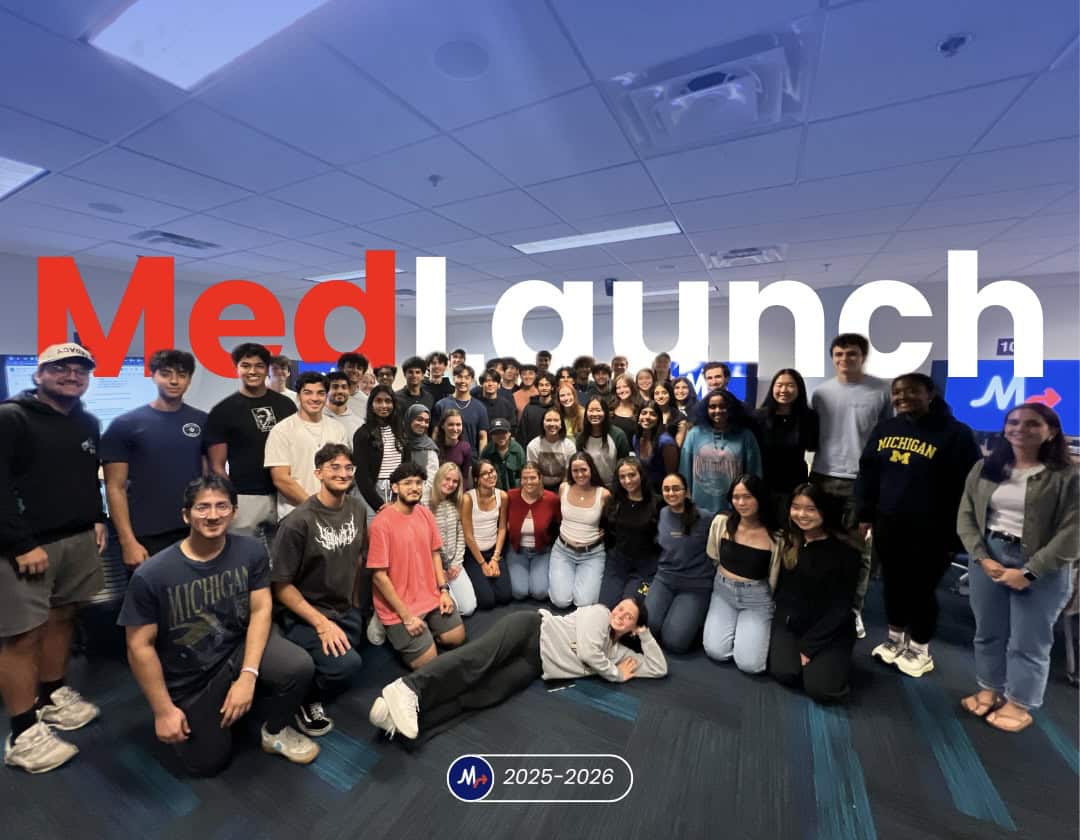
On weeknights and weekends, while much of campus powers down, MedLaunch is often just getting started. This University of Michigan student organization—now in its seventh year—brings together students who are passionate about biomedical innovation and entrepreneurship to develop assistive technologies with local community partners with health challenges.
That commitment is demonstrated in the group’s schedule: MedLaunch meets twice a week on Wednesdays and Sundays, with additional work happening within each project team as deadlines and prototyping demands ramp up. “We meet twice a week,” said Hane Eun, a senior and MedLaunch’s president. “Anything else that’s needed happens team-by-team, depending on the specifics of the project.”
MedLaunch operates as a collection of project teams, each assigned a community partner in the greater Ann Arbor region and guided by a yearlong design process grounded in frequent end-user feedback. Teams meet with community partners in person as often as possible, ensuring the work stays aligned with real needs, not assumptions. “We encourage teams to have as many in-person meetings as they can,” Eun said. “It keeps community partners updated on progress, and it helps teams respond quickly to changes in what the partner needs from the design.”
Throughout the year, this partner-centered approach is reinforced by a deliberate engineering structure: planning, prototyping, testing—and plenty of iteration. A key milestone is MedLaunch’s design reviews, where industry professionals provide external critiques to strengthen safety, usability, and feasibility. “We invite industry professionals to critique the prototypes and designs,” Eun said. “Our goal is to get feedback from outside sources, not just from students and peers.” The process culminates in a final showcase in April, where teams present what they built and explain the background on how it came to fruition.
Six teams, six real-world problems
This year, MedLaunch fielded six project teams, each tackling a different challenge with a different mix of skills—ranging from computer science, machine learning and AI, robotics, sewing, CAD, and graphic design. The projects span both hardware and software, reflecting MedLaunch’s expansion into tools that can scale impact.
Among the projects described by Caroline Dean, a senior in biomedical engineering and MedLaunch’s finance chair, are devices and applications designed to meet highly specific needs: a mouthguard-style stick to support a child with quadriplegia; an accessible shower-sitting device for people with lower-limb loss; a web application that serves as a virtual library of physical therapy exercises for clinicians and patients; a vest to support an amputee soccer goalkeeper; and a stabilization device for pots and pans for a community partner who had a stroke.
The partners behind these projects come from a blend of outreach and referrals—community connections built over years of work. “We’ll have past project teams recommend us, and in the summer the executive board meets and reaches out to several groups,” Dean said. “We also use community resources, other student organizations, and word of mouth.”
Engineering with a purpose
For many members, the most meaningful difference between MedLaunch and other engineering experiences is the direct relationship with the person for whom they’re designing.
“For me, it’s the perfect way to give back and have a direct impact on someone,” said Safir Rashid, a junior. “A lot of engineering can feel like you’re vaguely solving a problem for a broad population. In MedLaunch, you work with one person. You meet with them in person, see what they like, and if they don’t like something, you improve it. That direct interaction is the most valuable part.”
Maddy Chong, a third-year student, was drawn to that same one-to-one design model as her interests bridged engineering and healthcare. “MedLaunch appealed to me because you work with a single community partner, so you can tailor the project and design to one person’s needs,” Chong said. “That crossover between engineering and healthcare can be hard to find in undergrad. I also gained valuable experience learning what it’s like to work on a team and to be able directly to see the impact you can have.”
That impact is often felt most strongly in the homes, practices, and athletic spaces where community partners live their daily lives. Breanna Gallegos, a senior in biomedical engineering, said joining MedLaunch was rooted in a desire to support communities that are often overlooked. “Going into BME and healthcare, it was important to me that I helped underrepresented communities,” Gallegos said. “People with disabilities are a largely underrepresented community. When I went to FestiFall to learn about student organizations, MedLaunch stood out to me for the impact it has, plus everyone was so welcoming.”
Working closely with partners made the mission tangible. “On the projects I’ve worked on, our community partners were both mothers,” Gallegos said. “Getting to go to their homes, meet their families, and see the day-to-day challenges they face made the impact feel real. It’s also meaningful to think about how these ideas could grow to a larger scale.”
A place to learn and mentor
MedLaunch is open to students from any background, and its membership reflects that—from engineering and LSA to Stamps, those considering premedical tracks, and beyond. Eun, for instance, studies in LSA and is preparing for dental school. The team’s diversity of interests and perspectives is central to how teams function and how students develop effective ways to handle engineering challenges.
Dean joined MedLaunch as a first-year student seeking hands-on experience and mentorship. Four years later, she credits the organization with shaping both technical skills and the ability to support others. “I joined because I didn’t know much about engineering yet, and this was a way to learn new skills,” Dean said. “There’s a lot of mentorship—upperclassmen help younger students learn things like 3D printing, SolidWorks, and how to build devices.”
Now, she sees her role as carrying that mentorship forward. “As a senior, I’ve taken away communication skills and the ability to teach others,” Dean said. “Working with non-engineers who are interested in design has helped me grow, and having an impact on people here in Ann Arbor has been a great experience.”
Filling gaps the marketplace often misses
Several students emphasized that MedLaunch addresses a reality that traditional product pipelines can overlook: many essential accessibility needs don’t attract investment, even when the need is urgent.
Maria Sun, a sophomore, joined because she saw MedLaunch as a way to close the distance between what exists and what people actually need. “Accessibility is important because there are so many barriers to addressing disability,” Sun said. “There can be financial barriers and innovation barriers, and sometimes the product just doesn’t exist yet. Doing this work to fill those gaps is important.”
Philip Tesic, a sophomore, echoed that theme—while also pointing to the organization’s collaborative culture. “MedLaunch embraces an interdisciplinary approach,” Tesic said. “We bring together students interested in engineering, healthcare, and design. Members can learn skills over a yearlong process while helping someone in the community and making a lasting impact.”
That model, he added, helps address a structural mismatch between need and profit. “In industry, innovation often follows financial incentives,” he noted. “When you’re working with an individual community partner, or a small, underrepresented cohort, there isn’t always funding, despite a very real need. As students, we aren’t motivated by profit—we’re motivated by learning and using our skills to improve someone’s life. We can fill a gap that doesn’t always get filled in the commercial world.”
Making a difference in the community
For Eun, MedLaunch became transformative precisely because his initial reasons for joining were practical. “When I first joined, I thought it would be a great way to learn skills and build experience,” he said. “But the takeaways became much bigger than that.”
He pointed to his first project—designing a specialized toothbrush for a community partner with hand tremors—as a turning point. “It wasn’t perfect,” Eun said. “But it helped our community partner maintain better oral hygiene. Later, I realized it also affected her self-confidence and independence. That changed the way I viewed these projects and the motivation to do them.”
That same mindshift is reflected in members whose academic paths have evolved through MedLaunch. Elizabeth Thornton, a junior in mechanical engineering, joined as a student exploring biomedical engineering and stayed for the organization’s human-centered focus. “MedLaunch aligned with what I wanted at Michigan because you work with one person the entire time,” Thornton said. “There’s a real benefit to listening to specific concerns, and it changes your perspective on what you think would be best.”
Now a project manager, Thornton leads a team designing a vest for a community partner who is a goalkeeper on an amputee soccer team who previously taped her arms to her body during play to avoid penalties. “She told us that the process is hot and uncomfortable,” Thornton said. “You’re running around with adhesive on your body—it’s not comfortable. We’re making a vest to use instead.”
Thornton credits MedLaunch with helping her see how broadly human-centered design can apply. “I switched to mechanical engineering because of this club,” she said. “I’m going into an automotive safety internship this summer, and it still feels connected. MedLaunch helped me realize I can carry this mindset into different fields.”
Looking ahead: growth, education, and new partners
As MedLaunch prepares for the upcoming academic year, the team expects its project slate to evolve based on community partner availability and member capacity. “We’re not sure exactly how many projects we’ll take on next year,” Tesic said. “It depends on how many community partners we can connect with and how many applicants can fully commit. But we’re always looking to grow and make our projects better.”
That includes expanding educational outreach—both for members and the broader public. Tesic said the team hopes to develop more educational materials that can be shared through social media and other channels.
MedLaunch is also eager to deepen its network of support beyond campus. Alumni are encouraged to contribute by connecting the organization with community partners and by serving as mentors in design reviews or accessibility audits. “We’re always open to alumni providing input to teams and helping us connect with people in the community,” Tesic said.
And for students looking for a way to pair hands-on design with meaningful local impact, MedLaunch wants them to know there’s a place at the table—no matter their major. “We’re always looking for new members who align with our vision,” Tesic said. “We’re open to people applying in the fall and joining a yearlong project team.”
In MedLaunch, the work is technical—CAD models, prototypes, testing plans—but the motivation is personal: listening carefully, iterating responsibly, and showing up consistently for someone who will feel the difference every day.