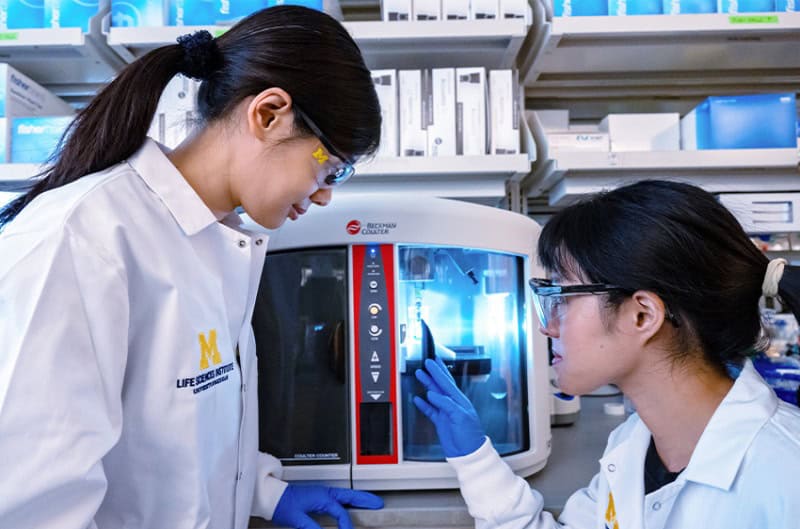
University of Michigan Biomedical Engineering Assistant Professor Connie Wu has received an NSF CAREER Award to develop ultrasensitive protein measurement tools designed to capture more of the information embedded in the human proteome—particularly proteins linked to disease that exist at extremely low levels and are often missed by conventional assays. Dr. Wu also is a Research Assistant Professor, Life Sciences Institute (LSI), and an Assistant Professor, Pharmaceutical Sciences.
To set the context for this research award, Dr. Wu noted that her group focuses on “ultrasensitive detection of proteins and other biomolecules,” typically to identify biomarkers in blood or other biofluids for diagnostic applications. In this CAREER project, the team aims to improve on several aspects of its ultra-sensitive protein detection tools.
A central challenge is that many existing protein tests are limited in sensitivity and in the number of targets they can measure at once. “Many disease-relevant proteins are present at very low concentrations in blood or other biofluids below the detection limits of conventional methods, so ultrasensitive measurement tools are needed to be able to detect such proteins reliably and to save valuable clinical or biological sample volumes,” Dr. Wu noted. For complex diseases—and across different individuals—“just measuring a couple different proteins is not going to be enough to have enough sensitivity or specificity for detecting a certain disease.” Even in basic biology research, she said, investigators often want broader profiles but face limited sample volumes and resources. The goal, she said, is to build assays that “can really maximize the biological or clinical information you can obtain.”
The CAREER project builds on a recently developed single-molecule protein detection approach that enables measurements at concentrations far below the limits of standard methods. From that foundation, the research will pursue two complementary technical thrusts:
- Expand multiplexing while eliminating false signals. Dr. Wu’s team will establish design principles for a multiplex digital immunoassay platform engineered to avoid cross-reactivity, a common source of false positives when many proteins are measured simultaneously. Dr. Wu described this direction as overcoming key obstacles in ultrasensitive protein measurement tools in “multiplexing, which is simultaneously being able to profile or detect many different proteins at once.”
- Measure protein function alongside abundance. Many tools quantify how much protein is present, but not whether it is active. Dr. Wu emphasized that the project will extend beyond concentration measurements to capture “their function,” adapting ultrasensitive detection to profile enzymatic activity, particularly focusing on proteases. The work integrates DNA barcoding and activity-based detection with a high-throughput single-molecule digital immunoassay platform to enable multiparametric protease activity profiling.
Across both aims, accessibility is a design requirement, not an afterthought. Dr. Wu said that a key objective is to create methods that many labs can adopt, with no specialized instrumentation and no complex workflows, so that research and clinical laboratories can measure low-abundance proteins more routinely using common equipment. The project is supported for five years.
Training, outreach, and diagnostics literacy
The CAREER award also includes an education and outreach program centered on improving diagnostics literacy and expanding hands-on learning opportunities. Dr. Wu’s plans include working with local K–12 schools through hands-on workshops to build public awareness of the importance of diagnostics and basic diagnostic principles. She pointed to lessons reinforced by the COVID-19 pandemic, where early detection can support public health response: “If you’re able to detect early, obviously then you can better contain the problem,” she said.
“A key part is our lab’s involvement in immersive summer research programs,” Dr. Wu noted. “Our lab has actively participated in several programs through the LSI (Perrigo and Aspirnaut Fellows programs) and Michigan Medicine (BioMed Focus) in the past few summers already. We have hosted undergraduate and high school students from these programs, which aim to provide immersive hands-on research experiences to students across Michigan, particularly to those who may have fewer opportunities or resources to be exposed to STEM research early in their educational experiences.”
Dr. Wu also plans to develop publicly accessible short videos—potentially released as a regular series—covering both practical and societal aspects of diagnostics. Topics could range from “why is diagnostics important in terms of public health” to explainers such as “how do those qPCR tests work for COVID,” she said.
At the graduate level, Wu is launching a new elective focused on biomolecular engineering for diagnostics/biosensing, along with drug delivery. She described the course as journal-club and proposal-writing oriented, designed to help students identify unmet clinical needs, evaluate the technology landscape, and “design a technological solution and write a proposal,” emphasizing skills in scientific communication and problem solving.
By advancing ultrasensitive, multiplexed, and activity-aware protein measurement platforms—and pairing them with education and outreach—Dr. Wu’s CAREER research aims to accelerate biomarker discovery, strengthen the future biotechnology workforce, and improve readiness for future public health challenges.