University of Michigan Biomedical Engineering (BME) Assistant Professor Maria Coronel has received a prestigious National Science Foundation (NSF) CAREER Award to advance a new class of “smart” biomaterials designed to track immune activity inside wounds in real time—and, separately, to expand access to hands-on science learning through an educational video game platform.
“This NSF CAREER award is particularly meaningful because it supports not just the research we are trying to do, but also the educational aspect of the work—not just locally, but also in terms of outreach,” Dr. Coronel said. The Faculty Early Career Development Program is a Foundation-wide activity that offers the National Science Foundation’s most prestigious awards in support of early-career faculty who have the potential to serve as academic role models in research and education and to lead advances in the mission of their department or organization. Activities pursued by early-career faculty should build a firm foundation for a lifetime of leadership in integrating education and research, according to the award’s submission guidelines.
Understanding why some wounds heal—and others don’t
Chronic wounds are a major clinical challenge, affecting many patient populations, yet, as Dr. Coronel notes, the underlying biology often remains unclear.
“The biological question we are trying to address with this research is simple,” she said. “There are wounds that heal very well, and there are wounds that don’t heal at all and become chronic wounds that are hard to treat clinically. There is a lack of biological understanding as to why that happens.”
Today, wound care often relies on reacting after problems become visible. “The method in which we currently treat wounds is very reactive,” Dr. Coronel said. “The practice is to wait until a wound is infected—showing symptoms either locally or systemically—before intervening. There is nothing actively monitoring the wound trajectory to inform whether it is progressing toward healing or non-healing.”
Dr. Coronel’s project aims to examine this process with a material that can help clinicians and researchers watch biology unfold over time. “We’re proposing the use of a biomaterial that enables proactive monitoring,” she said. “We will track the wound changes we see over time to inform our decision-making.”
Rather than functioning only as a therapeutic, Dr. Coronel sees this method as a platform that can guide care by revealing what’s happening inside the wound environment. “This material acts not just as a therapeutic, but as a smart material that can help dictate the outcome by providing information about what is happening biologically within the wound,” she said.
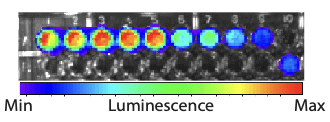
A bioluminescent sensor platform: GELITE
This research builds on a technology that has a provisional patent filed through the University of Michigan: GELITE—a name that alludes to “gels” and “light.”
“We use bioluminescence sensors,” Dr. Coronel explained. “We have a protein that we split in half. When it’s apart, it doesn’t produce bioluminescence, but when it comes together, it emits a light signal.” By linking the split-protein components to biological “reporters,” the team can design sensors that illuminate when specific signals are present.
Those sensors are integrated with Dr. Coronel’s microgel platform—micron-scale gels that can immobilize on a material surface to improve spatial control and enable “multiplexing,” or detecting multiple signals at once. “Biology has many different signals interacting,” she said. “Outcomes don’t come down to a single activation signal—they are revealed in combinatory signals.”
Dr. Coronel’s team aims to track wound biology over the course of healing, which is often about two weeks in uncomplicated cases. Because the smart material is envisioned as a dressing, it could be replaced on a normal wound-care schedule.
Game-based learning to broaden access to science
Dr. Coronel is equally energized by the CAREER award’s education component. Since joining Michigan, she has been involved with FEAST (Faculty, Engineering, Art Student Teams), an initiative that encourages collaboration among students across disciplines.
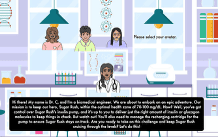
Through FEAST, Dr. Coronel has helped students from biomedical and chemical engineering, as well as graphic design and communications, build a “play-and-learn” video game that introduces learners to a virtual lab environment. This can provide outreach to younger students who may not have access to research labs or science camps. “We’re thinking about rural communities within Michigan,” she said, “and students who are in city-like environments but have rural infrastructure when you’re thinking about how schools are designed.”
The team has already beta tested the game in local schools, and Dr. Coronel hopes the award will help expand that reach.