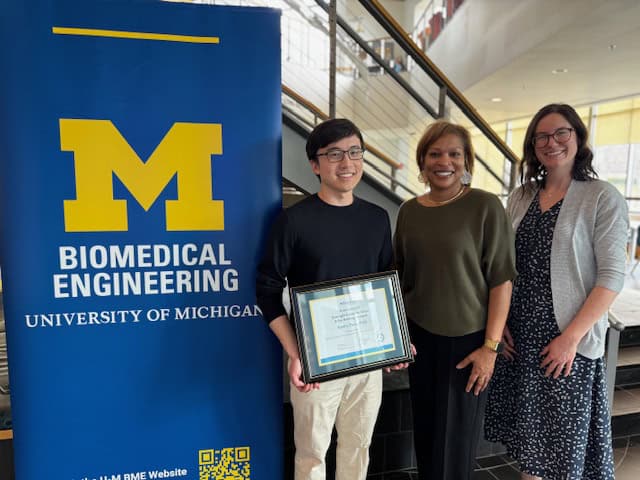
U-M BME’s Kevin C. Zhou, Assistant Professor, Biomedical Engineering, and Assistant Professor (affiliate), EECS – Electrical and Computer Engineering, is launching a pioneering project backed by a $15,000 pilot grant from Eversight.
In collaboration with Dr. Nambi Nallasamy, MD, Assistant Professor, Ophthalmology and Visual Sciences, at the Kellogg Eye Center, Dr. Zhou aims to revolutionize how clinicians and scientists characterize and treat diseases of the anterior segment of the eye—critical for vision and eye health.
Eversight, a nonprofit with a mission to restore sight and reduce blindness, advances its work through eye banking, research funding, and community outreach. Eversight’s Eye and Vision Research seed grants—up to $15,000—help researchers develop new ideas, launch pilot projects, gather preliminary data, and lay the groundwork for future applications to larger agencies, including the National Institutes of Health (NIH).
“We decided this was a great opportunity,” Dr. Zhou said, noting that one of his central goals is to develop high-speed 3D imaging methods for ophthalmic applications. Existing ophthalmic imaging approaches often struggle with motion artifacts, especially when capturing 3D images in live patients whose eyes tend to move unpredictably during exams. Enhanced imaging could inform surgeries such as the placement of artificial lenses—procedures that demand precision but are currently limited by slow and imprecise technology.
Dr. Nallasamy will contribute expertise on the surgical applications of improved eye imaging. “I’m really excited about developing devices that can achieve higher 3D imaging speeds and overcome the limitations of current tools,” Dr. Zhou said.
The project will evolve from calibration on model eyes to testing on donor human eyes provided by Eversight’s eye bank, with a goal of eventually incorporating healthy volunteers, and ultimately patients. This systematic approach allows the team to rigorously validate their techniques and compare them to existing imaging standards.
While modest in size, the grant represents critical seed funding. “It will help us generate preliminary data for larger, more competitive grants, such as those from the NIH,” Zhou said. The project is designed as a one-year pilot, with aims to move toward clinical studies within two to three years.
Ebony Johnson, Eversight’s Senior Partner Relations Director, emphasized the significance of the award: “Dr. Zhou’s work is directly aligned with the mission of Eversight—to restore sight and prevent blindness. The grant winners were determined by an independent panel of ophthalmologists, researchers and scientists overseen by Eversight’s Research Committee Chair Dr. Jonathan Lass; Dr. Onkar Sawant, Vice President of Research & Development, and Diane Hollingsworth, President/CEO at Eversight.”
Read the Eversight Eye & Vision Research Grants Blog for more information.