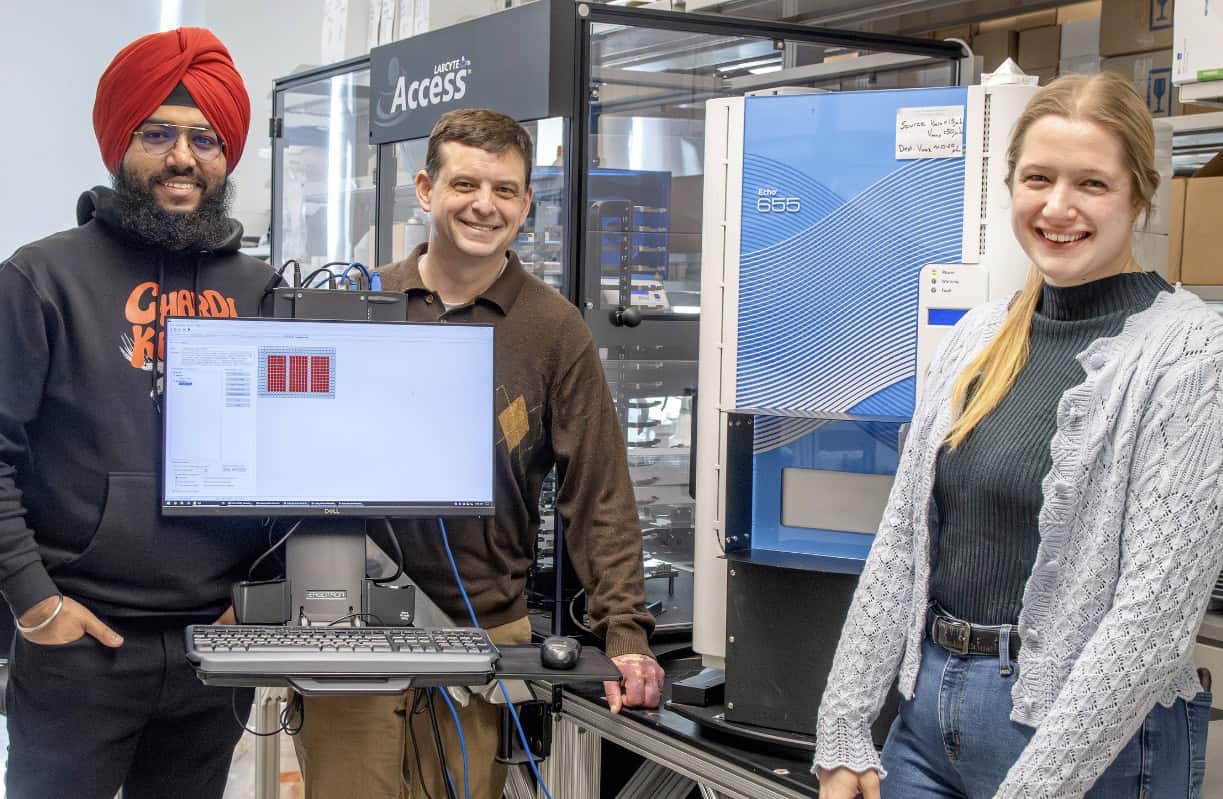
Antibiotic resistance remains one of the greatest global health threats, projected to claim 10 million lives annually by 2050 unless new solutions emerge. Addressing this urgent challenge, a cross-disciplinary team at the U-M Biomedical Engineering (BME) has developed an innovative machine learning model that not only predicts which drug combinations can best combat resistant pathogens, but also flags those most likely to produce harmful side effects.
The research, led by Sriram Chandrasekaran, Associate Professor, Biomedical Engineering, and Ph.D. student Harikat Singh Arora, pioneers a custom AI model that predicts not only the efficacy of drug combinations against key pathogens, but also their risk of toxic side effects, addressing a major obstacle in advancing new therapies. The research benefited from U-M’s drug discovery resources, the U-M Coulter Translational Research Partnership Program, and the NSF I-Corps program, which encouraged engagement with pharmaceutical industry stakeholders.
“We’ve spent years developing machine learning models to find new drugs or optimal combinations for infections,” said Dr. Chandrasekaran. “But what’s unique here is the extra mile that Harikat took by engineering a model that looks at both potency and safety. It can actually rank combinations based on effectiveness and the potential for side effects, so scientists can prioritize candidates that are both safe and powerful.”
The research, conducted in partnership with the Michigan Drug Discovery Core and Komodo Health, centered on two major bacterial pathogens: E. coli and M. tuberculosis. Using the Michigan Drug Discovery Core facility and experimental assays devised by team members, Aaron Robida and Katherine Lev, they validated the AI model’s predictions in the lab. The research relied on anonymized health records from Komodo Health, which holds extensive patient data. The use of real-world evidence brought a clinical perspective to lab findings—demonstrating that drug pairing predicted by AI led to safer outcomes for patients.
Notably, the AI flagged combinations—including one marrying the FDA-approved antibiotic vancomycin (often limited by kidney toxicity) with another agent—not only boosted effectiveness, but also reduced toxicity. “When we looked at health records for people who had received these combinations, we found that kidney side effects were significantly lower for patients taking this combination than for patients taking vancomycin alone,” Dr. Chandrasakaran said. “It was a full circle: from model, to bench, and then to real-world patient data. It’s pretty heartwarming for us to see science translate all the way.”
But the innovation doesn’t stop at prediction. Addressing long-standing criticism about “black box” AI, the team ensured their model is interpretable. “We developed new methodologies to ensure mechanistic interpretation,” Arora noted. “It shows not just which drug combinations are promising, but also which metabolic pathways or molecular mechanisms are driving potency and toxicity. That means scientists can actually see why something works or doesn’t, and engineer safer drugs based on those insights.”
One recurring mechanism identified was the nucleotide pathway, crucial in both effectiveness and side effects. The team perturbed this pathway in the lab and confirmed the model’s predictions, cementing their approach as both predictive and explanatory.
The project was inspired in part by the COVID-19 pandemic, which highlighted the broader threat of antibiotic resistance. “COVID claimed around 7 million lives, but if unchecked, antibiotic resistance could claim 10 million annually by 2050,” said Arora. “Pharmaceutical companies often avoid developing new antibiotics because this business model is not seen as profitable. So we thought, can academic researchers take the lead by combining existing drugs in safer, more impactful ways?”
The research benefited from U-M’s drug discovery resources and the NSF I-Corps program, which encouraged engagement with pharmaceutical industry stakeholders. Arora credits this experience for shaping his thesis proposal. “Industry told us their top worry was unknown toxicity in AI-predicted drug combinations, so we built our methodology to directly address that,” he said.
The study’s interdisciplinary nature, spanning machine learning, experimental microbiology, toxicology, and clinical data analysis, brought together researchers across campus and beyond. “It was very exciting to see anonymized healthcare data used in such a novel fashion to validate AI-generated hypothesis. We look forward to discovering more promising combination therapies through this approach”, said Dr. Ramraj Velmurugan of Komodo Health, and a coauthor in this study.
Looking ahead, the team sees potential to expand their approach beyond human health. “This model can work for animal health, too,” noted Arora. “It’s disease-agnostic—a platform that could transform how we think about drug safety in a holistic way.” This promising intersection of AI, biology, and clinical data not only offers new hope for treating infections, but also sets a precedent for interpretable and translational machine learning in medicine.
For more information, please see the preprint link.