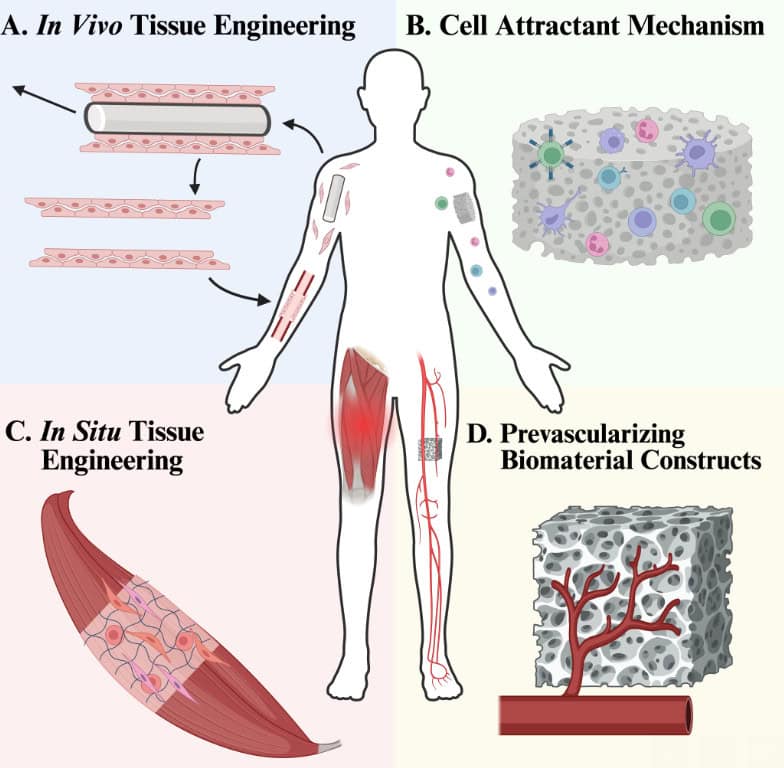
A new review article published in npj Biomedical Innovations led by U-M Biomedical Engineering doctoral candidate Mary Dickenson and her PI Aaron Morris, Assistant Professor of Biomedical Engineering, in collaboration with Robert Oakes, Assistant Professor at the University of Delaware, highlights a significant shift in how scientists view the body’s foreign body response. The article summarizes recent research and discusses how the immune reaction triggered by implanted materials—which has historically been considered a barrier to medical device success—can instead be leveraged for positive biomedical outcomes.
“The foreign body response occurs anytime we put foreign materials into the body,” Dickenson explained. “Our body mounts an inflammatory reaction around these materials, trying to degrade or remove them. Your body generally doesn’t like foreign objects, so this response has typically been thought of as a negative thing that we should try to minimize or eliminate.”
However, Dickenson emphasized that the field is now exploring new possibilities. “In recent years, including in our own research, people have started to see the immune response as something we can use to our advantage, rather than working against the body’s natural processes.”
The Morris Lab focuses on harnessing this response, rather than suppressing it. “Much of our work is about leveraging this inflammatory reaction to deliberately recruit immune cells to a targeted location, so we can use those cells to improve patient outcomes,” she said.
The review article examines this evolving perspective. “I reviewed the literature to study what approaches are out there,” Dickenson said, “and we discuss how the foreign body response works, as well as how people have historically tried to minimize it. More recently, researchers have found ways to make this response useful, which reframes a traditionally negative process into a positive tool for biomedical engineering.” Rather than treating the foreign body response as purely detrimental, Dickenson sees opportunities for innovation.
The team’s next steps involve applying these concepts to autoimmune diseases—a key focus of their lab. “We’re especially interested in autoimmune diseases, which are typically difficult to monitor and diagnose minimally invasively,” Dickenson said. “In my own work with multiple sclerosis, for example, getting information from the central nervous system is extremely challenging and usually requires invasive procedures. Our idea is to use this cell-attracting mechanism—elicited by implanted materials—to bring immune cells to a scaffold, so we can gain insight into what’s happening throughout the body’s immune system from a single, less invasive site.” This approach could transform disease monitoring, creating immune “checkpoints” for sampling and diagnostics.
Dickenson concluded with a broader message for the research community: “I think it’s important to reconsider anything that’s traditionally seen as negative. Rather than immediately trying to get rid of a response, there’s value in looking at it from another perspective and finding ways to use it to our advantage. Instead of fighting the body’s natural defenses, sometimes we can work with them. Keeping an open mind and reframing our approach can lead to new and advantageous solutions.” The research highlights a new frontier in biomedical engineering, one where clinical success may come from collaborating with—not combating—the body’s own systems.