BME Celebrates 20 Years of Coulter Translational Research Partnership Program Success Stories
Pioneering Neuroma Prevention to Advanced Prosthetic Control
6–9 minutes

Pioneering Neuroma Prevention to Advanced Prosthetic Control
BME’s Coulter Translational Research Partnership Program has played a foundational role in launching landmark innovations for amputee care through the work of multiple engineers and clinicians, playing a key role in supporting research to shape worldwide standards for neuroma prevention and enhanced limb control.
This story–one of several spotlighting the Coulter Program’s impact during its 20th anniversary year–features an interview with Paul Cederna, the Robert Oneal Professor of Plastic Surgery, and, Professor, Biomedical Engineering, and his collaborator, Tod Borton, CEO Blue Arbor Technologies. Their efforts have led to two major advances: the development of regenerative peripheral nerve interfaces (RPNIs), which have become a worldwide approach to the prevention of neuroma pain and phantom limb pain, and the creation of new technologies for intuitive, high fidelity prosthetic limb control—now being commercialized by Blue Arbor Technologies.
Cederna and Borton, along with Thomas Marten, Managing Director, Coulter Program, recently discussed the history, impact, challenges, and team philosophies that have nurtured these breakthroughs.
Launching a Multidisciplinary Effort
The origins of this breakthrough trace to 2007, when Dr. Cederna was approached with a U.S. Army Multidisciplinary University Research Initiatives (MURI) grant opportunity by Daryl Kipke, then a U-M Professor, Biomedical Engineering, sparking this collaboration among neural probe and peripheral nerve experts at the university.
“This work really began in that year,” said Dr. Cederna. “We wrote the initial proposal with David Martin of Material Science and Brent Gillespie of Mechanical Engineering, and together we received our first $4.5M grant, and that is when we started our research on developing a way to interface with the peripheral nervous system. We were able to combine our expertise in peripheral nerves, neural probes, material science, and mechanical engineering to begin the development of a novel way to interface with the peripheral nerves for control of prosthetic devices. Since that time, I have developed an amazing network of research colleagues across the University of Michigan, all with different areas of expertise, who have contributed to the foundational research. Among the collaborators: Cindy Chestek, Professor, Biomedical Engineering, Electrical Engineering and Computer Science and Robotics and Neurosurgery, Brent Gillespie, Professor, Mechanical Engineering and Robotics, David Martin in Material Science, Deanna Gates, Professor, Movement Science, Biomedical Engineering and Robotics, and director of the Rehabilitation Biomechanics Laboratory (RBL) in Kinesiology, along with many other researchers. Over the course of 17 years, and with nearly $60 million in grants and over 200 manuscripts, we tackled two key problems.”
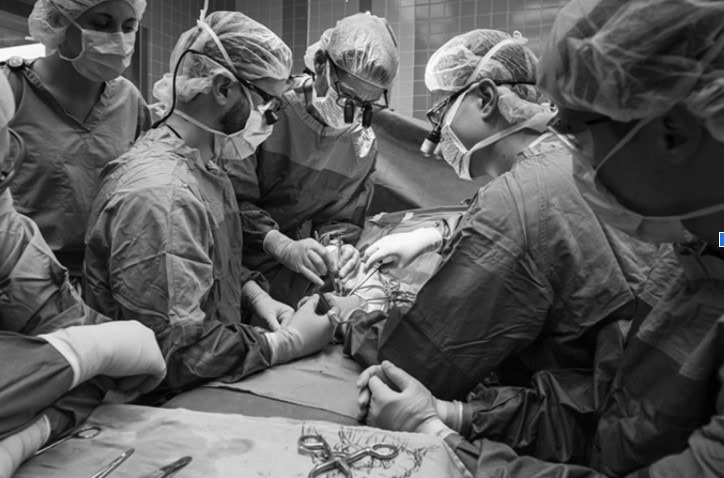
Dr. Cederna continued: “The first was preventing and treating neuromas—painful nerve growths after amputation. Our Regenerative Peripheral Nerve Interface (RPNI) procedure not only created a way to interface nerves with electrodes for prosthetic control, but we unexpectedly discovered it prevented neuroma formation. This changed amputation care, and now RPNIs are performed worldwide to prevent neuroma pain and phantom limb pain.”
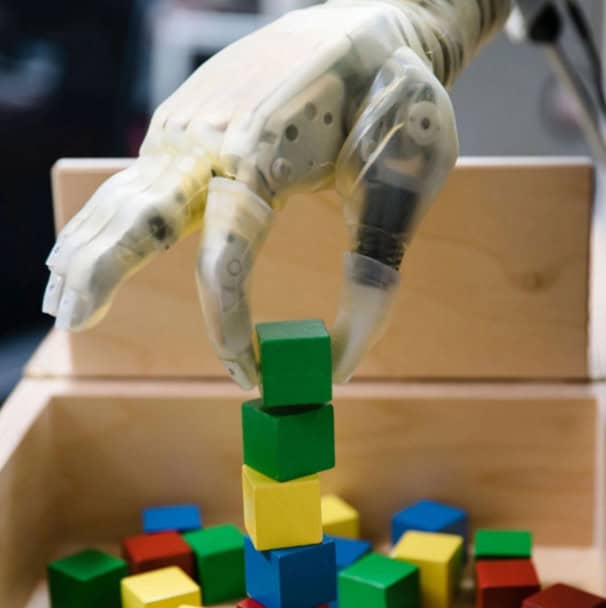
The second innovation related directly to prosthetic function. “Through further development, we created interfaces and algorithms that allow people naturalistic, fine motor control—discrete finger and wrist movements along with sensory feedback from the upper and lower limbs,” Dr. Cederna noted. “We’ve demonstrated control far beyond what current commercial prostheses provide.”
From Lab to Market: Commercial Translation
As the research matured, translating these scientific advances into practical devices became the next challenge. Tod Borton, CEO of Blue Arbor Technologies, entered the picture to lead commercialization.
“My involvement began three years ago, when Paul’s group was ready to translate extensive foundational science into the commercial world,” Borton explained. “As I learned about the team’s clinical success—both in eliminating neuroma pain and enabling sophisticated prosthetic control—I saw the potential. My role has been taking these scientific pillars and turning them into practical devices, navigating regulatory, funding, and operational hurdles.”
Coulter’s Coordinating Role and Support
BME’s Coulter Program was instrumental throughout this journey, facilitating connections and resources vital to the project’s progression and serving as an early launch pad for the collaboration. Thomas Marten, Managing Director for the BME Coulter Program, emphasized the importance of bridging engineers, clinicians, and business expertise.
“Coulter’s role is to unite engineers and clinicians and drive research to focus on real patient impact,” Marten noted. “Paul’s work exemplifies this, with its two-pronged breakthrough. Coulter was instrumental over the years—not only funding prototype and proof-of-concept work, but bringing in business expertise and facilitating connections to move both the pain prevention and control advances forward.”
Dr. Cederna highlighted the challenges of company creation and commercial translation. “Establishing a business wasn’t in my original skill set,” he noted. “Coulter, especially Tom Marten and the board, provided direction and they were instrumental in helping to guide, mentor, and support us during our early phases of company formation and commercialization. They connected us to Fast Forward Medical Innovation and Innovation Partnerships ,who helped us secure nine patents. We also received support from the University of Michigan beyond the support we had already received from the National Institutes of Health (NIH) and Department of Defense (DOD),” he said. “The transition to commercial product required navigating regulatory, quality, and business terrain, and Coulter was crucial in helping us leverage U-M’s resources.”
Dr. Cederna connected with the Coulter Program in the early stages of research, when he first saw the announcement. “I thought that was perfect for us, combining engineering with medicine, so we perfectly fit into that space,” he said.
Borton elaborated, “For a startup, the biggest hurdle is always funding and moving quickly from a research device to a regulated product. Coulter and U-M resources enabled us to build a viable product, set up regulatory strategy, and design clinical trials. The pre-seed funding we raised of $4 million was possible only due to the infrastructure and connections initially enabled by U-M and Coulter.”
Patient Impact and Ongoing Advances
For patients, these innovations are already delivering dramatic improvements. “For pain prevention, RPNIs are now performed globally,” Dr. Cederna reiterated. “Hundreds of thousands of amputees no longer develop neuroma pain and phantom limb pain. In advanced control, we’re seeing people perform individual finger and wrist movements, regain lower limb function, and even sense their prosthetic hand and foot. Our upcoming Blue Arbor Technology RESTORE ESU System will be implanted in Vienna, Austria, in December. Early 2026 will see trials at U-M—both aspects, focusing on pain prevention and prosthetic control—will reach more patients soon.”
The global impact of these advancements is immense. Millions worldwide may benefit. There are 1.7 million Americans with limb loss, and 25 million patients in Asia alone. “The numbers are staggering, so there are many people we can help,” said Dr. Cederna.
Much of the early work in recording and interpreting peripheral nerve signals was a result of the collaboration between Drs. Cederna and Chestek in Biomedical Engineering. “Interpreting all of the machine learning algorithms and AI that is used to interpret signals so we know what the motor intent is, and then delivering those control signals to the prosthesis was all done by Cindy Chestek’s team,” said Dr. Cederna.
Marten reflected on the program’s role in sustaining scientific impact. “It’s transformative—moving from bench to a standard of care and a commercial pathway. Coulter’s value is supporting these translation and scale phases, ensuring the science becomes routine in clinical practice and reaches global patients.”
Advice for Researchers: Focus on Team Building and Resilience
The magnitude of this work requires resilient, adaptable teams capable of overcoming obstacles and adjusting course as needed.
“Big impact needs big teams,” Dr. Cederna said. “Success comes from recognizing strengths, recruiting for your gaps, and always celebrating together. Resilience is essential. When something doesn’t work, we adjust rapidly—sometimes, winners need to quit a failing strategy in order to succeed. Our group spans engineering, medical science, research and business, and each collaboration and pivot strengthens us.”
The product evolution at Blue Arbor exemplifies this adaptability. “Product development requires deep belief and humility,” Borton added. “You must be ready to pivot, challenge assumptions, learn from failures, and keep patient needs central. Egos must be set aside.” Borton described how the team changed course for patient safety and regulatory success after debating their initial device design. “Team resilience is critical, and Coulter’s external perspective helps keep us agile.”
Marten added that the lessons learned from adaptation should be institutionalized for future translational projects. “Blue Arbor sets an example within Coulter—document what works, and value adaptive decision making,” he noted.
U-M’s Translational Ecosystem Serves as a Foundation for Innovation
“Collaboration across U-M is our foundation for scaling and real patient impact. Recognition and resources fuel our growth,” said Borton.
Marten added, “Blue Arbor is a model project for Coulter—where research, infrastructure, team science, and adaptation drive both new standards of care and commercial innovation.”