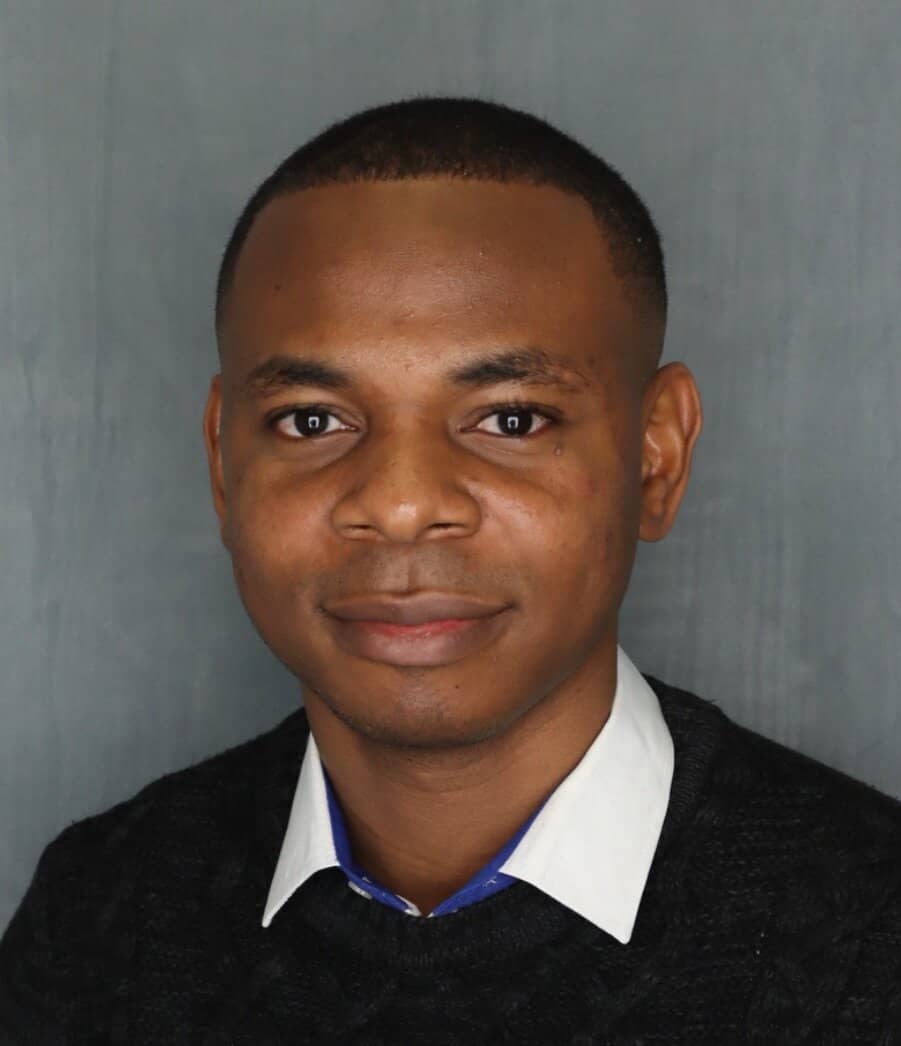
Collins Chimezie Receives Rackham International Fellowship
Award enables expanded focus on targeting bacterial toxins through probiotics, with the goal of reducing colorectal cancer and inflammatory bowel disease risk.
2–3 minutes

Award enables expanded focus on targeting bacterial toxins through probiotics, with the goal of reducing colorectal cancer and inflammatory bowel disease risk.
Collins Chimezie, a Ph.D. Candidate in the lab of Jiahe Li, Assistant Professor, Biomedical Engineering, has been selected to receive the Rackham International Fellowship,a competitive award supporting outstanding global scientific talent. Chimezie’s research centers on harnessing probiotics and natural compounds to target bacterial toxins implicated in colorectal cancer and inflammatory bowel disease (IBD).
Journey to Michigan and the Fellowship
“It wasn’t easy to come to Michigan,” Chimezie recalls. Originally a chemistry Ph.D. student at the University of Tennessee, Chimezie’s academic path veered when his intended advisor left that program. Determined to find broader interdisciplinary opportunities, he applied to several universities and was ultimately drawn to U-M’s Chemical Biology program for its wide-reaching collaborations in biomedical engineering, medicinal chemistry, and life sciences.
“I wanted a place where I could access collaboration and fellowships to support my career pathway,” he said. “When I looked at U-M, I saw a community where research is really interdisciplinary, and where I could work with people from so many fields. That’s why I chose Michigan.”
Pioneering Cancer Prevention Research
Now working in Dr. Li’s laboratory, Chimezie’s research confronts one of the leading causes of cancer deaths: colorectal cancer. Unlike most labs focused on curing cancer once it has appeared, Chimezie’s team investigates risk factors that predispose patients to cancer in the first place—especially the role of genotoxins and other harmful substances secreted by bacteria like E. coli and other Enterobacteria.
“Our lab’s approach targets the toxins that set the stage for disease, using probiotics and natural product inhibitors,” he said. “The idea is to prevent cancer and inflammatory bowel disease before they develop, shifting the paradigm from cure to prevention.”
His work aims not only to develop new therapies, but also to make a significant impact on public health. “Colorectal cancer and IBD are big problems,” Chimezie notes. “By focusing on the bacterial risk factors, we hope to improve the lives of millions.”Preliminary data from Chimezie’s research contributed to an internal grant from Michigan Drug Discovery earlier this summer, and more recently a grant application that received an exceptional score at the National Cancer Institute this past week.
How the Fellowship Will Help
The Rackham International Fellowship provides vital funding support for Chimezie’s Ph.D. journey, including a stipend for the coming semester—allowing him the financial freedom to dedicate himself fully to research.
“This award gives me encouragement to commit more time and work harder in my research,” he said. “With this support, I can dive deeper into my experiments—not only to publish papers, but to make a real impact on people’s health.”
Chimezie sees the fellowship as pivotal for advancing his work at U-M. “It propels me forward. I want my research to contribute to cancer prevention—to focus on risks that are often overlooked, like bacterial toxins, and find ways to counter them before disease starts.”
Looking Ahead
Chimezie shares a message for future researchers: “Find what truly motivates you, and use every opportunity to pursue impactful projects,” he said. “My journey wasn’t straightforward, but this award is proof that perseverance pays off—and that Michigan is an amazing place to build your scientific career.”