When most people hear “MRI,” they picture images revealing the structure of our brains. But what if we could use MRI to peek inside the tiniest spaces—seeing not just the tissues, but how fluids actually move at the microscopic level?
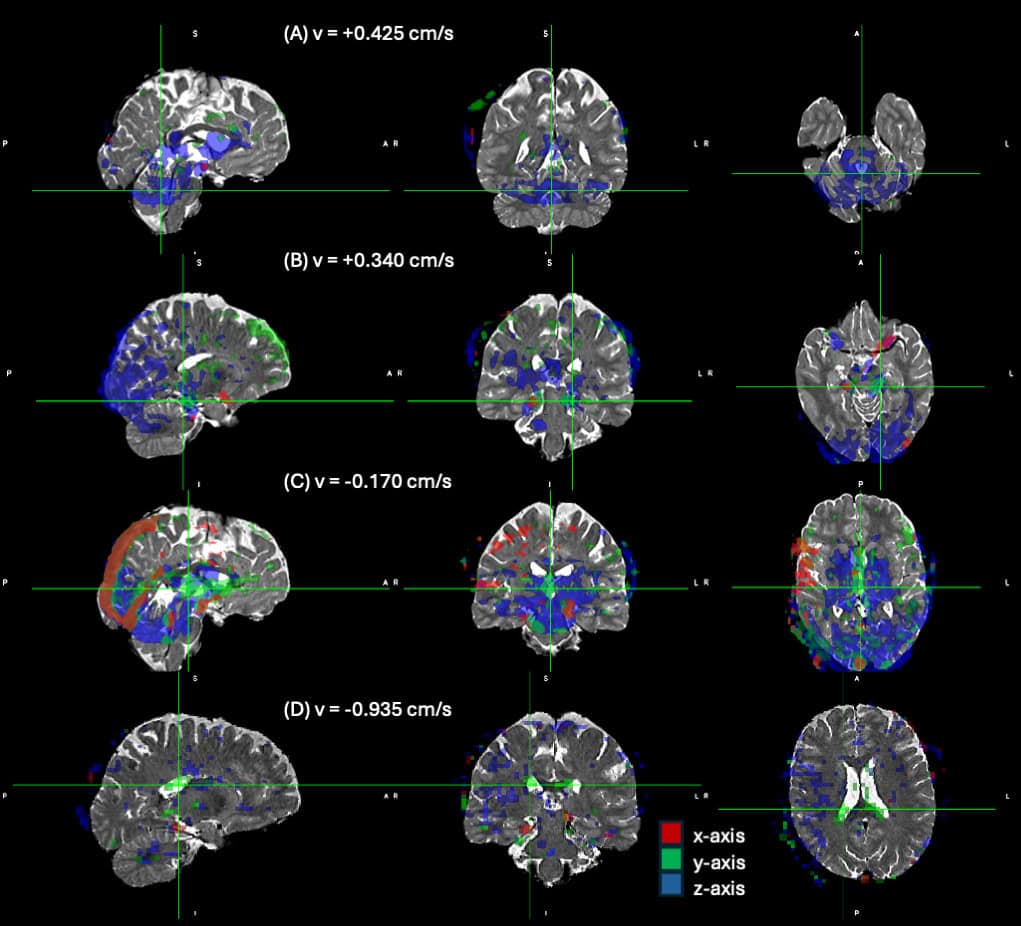
That’s the ambitious goal of new research from Luis Hernandez-Garcia, Research Professor, Biomedical Engineering and Radiology, and his team. Their latest study introduces an innovative MRI technique—Velocity Spectrum Imaging (VSI)—that maps how water is moving inside each voxel, or three-dimensional pixel, of an MRI scan. The implications for understanding the brain’s waste-clearing system and a host of neurological diseases are significant.
From Pixels to Fluid Flows: A Simplified Explanation
“We’ve developed a tool to be able to measure what fraction of water is moving at a specific velocity and in a specific direction inside each pixel of an image,” explained Dr. Hernandez-Garcia. While MRI doesn’t reach the scale of single molecules, this new method can “give you a spectrum—a distribution of what’s moving in each direction, and at what speed, for every little pixel.”
How does it work? In VSI, the MRI scanner is programmed to use special motion-sensitizing gradients—sort of like “wind gauges” for water molecules. These gradients are varied (by adjusting their “first moment” in physics parlance), and a series of images is acquired. Each image is “prepared” with a pulse to encode how fast water is moving. Just as MRI can develop an anatomical picture using many slices and settings, here the data is transformed to reveal which water molecules are moving, in what directions, and how quickly. For a long time, we have been able to measure diffusion in a similar way. Now we can measure convective flow velocity distributions at the microscopic level as well.
Importantly, this technique is non-invasive and requires no tracer injections: “You just put someone on an MRI scanner and you get these images.” said Dr. Hernandez-Garcia.
Why Does Tracking Water Matter? The Glymphatic System Connection
Most of the water in our brains isn’t just standing still; it’s circulating in complex patterns. Having a full velocity profile could be a game-changer for research into the glymphatic system, the brain’s recently discovered waste-clearing mechanism. “While this glymphatic system has always existed, we didn’t really know about it until about 20 years ago,” explained Dr. Hernandez-Garcia. “Now we know that movement of water—not just in blood, but between the cells—clears out metabolic waste. When it’s impaired, you start building up amyloid and other proteins that can kill neurons. That’s when you see Alzheimer’s and similar disorders.”
VSI has the potential to help scientists visualize these subtle water movements, possibly linking them to disease and offering new ways to monitor therapies. “If somebody develops a method or therapy for Alzheimer’s, we could see the therapy in action by watching how water moves and how the brain clears waste,” said Dr. Hernandez-Garcia.
A Proof-of-Concept with Room to Grow
While promising, VSI is still in its proof-of-concept stage. Data collection takes time, and further improvements are needed before the method can measure the ultra-slow flows found in tiny perivascular spaces—sites thought to be crucial for glymphatic clearance. “The paper’s sort of proof of concept,” noted Dr. Hernandez-Garcia. “The data are not very clean yet, and it takes a long time to collect the measurements. But I have many ideas about how to make it faster and better.”
Dr. Hernandez-Garcia sees great potential for collaboration: “Anybody who’s looking at how fluids move through tissue—maybe in a microfluids lab or another department—this might be useful to them. I’m hoping that sharing this work will lead to new partnerships, new studies, and new advances.”
Where Could this Lead?
One day, this research could assist in validating mathematical models of fluid movement in biology and medicine, monitoring disease progression or treatment effects in neurodegenerative disorders, and in studying fluid exchange in other tissues, potentially informing cancer, stroke, or kidney research. Dr. Hernandez-Garcia concluded, “It has the potential to be another tool to monitor and to use as a biomarker for water exchange and water movement—in the brain and beyond.”