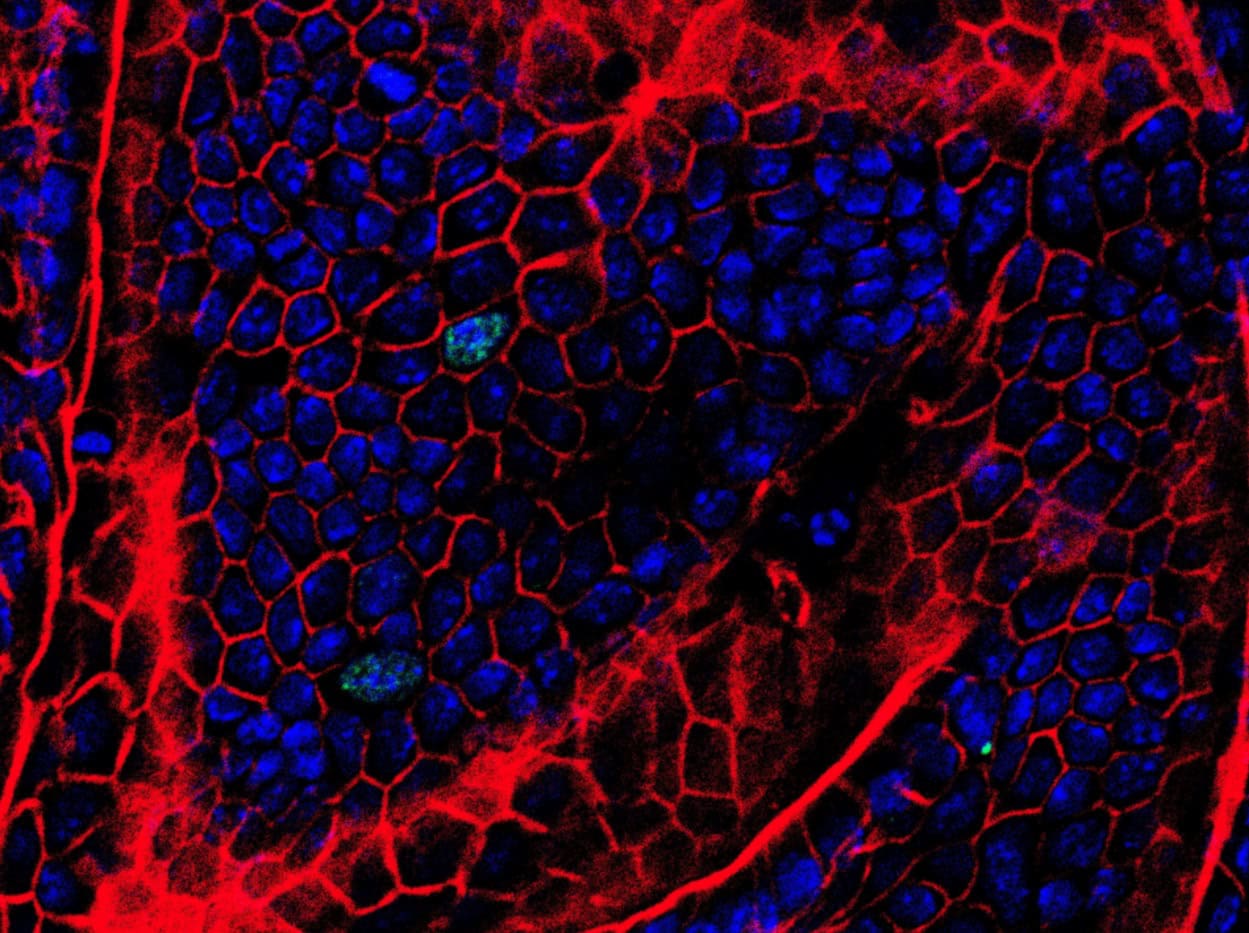
A new study from U-M BME’s Jiahe Li Lab opens the door to a promising frontier in cancer prevention. Their pioneering research, published in Nature Microbiology, tackles the alarming rise of early-onset colon cancer, a trend now seen in patients under age 50. Dr. Li’s team has developed an engineered probiotic designed to neutralize genotoxic threats in the gut, shifting the focus from treatment to prevention in colon cancer research.
Microbial Risk Factors in Early-Onset Colon Cancer
“Colon cancer is increasingly diagnosed in younger adults, even teenagers,” noted Dr. Li, BME Assistant Professor, and the corresponding author. “If you develop colon cancer before age 50, it’s considered early onset. The rate is going up, and we’re learning that it’s not only genetic or lifestyle factors, but also environmental exposures like microplastics and, crucially, bacterial genotoxins.”
One genotoxin, colibactin, is produced by certain strains of E. coli and has been linked to DNA damage in colon cells, possibly aggravated by industrial environmental changes. Dr. Li explained, “These bacteria can be transmitted both horizontally,through environment, water, or food,and vertically, from mother to child. That imprinting in the microbiome during the first 10 years of life is critical. Mutations accumulate early, and may set the stage for cancer decades later as reported by a Nature article published earlier this year.”
A First-in-Class Probiotic Prevention Approach
Current treatments for colon cancer prioritize intervention after diagnosis, but the Li Lab’s work charts a new course: “There are no FDA-approved therapeutics targeting these genome toxins,” Dr. Li said. “We call this the first-in-class approach. The idea is to engineer commensal, or beneficial, bacteria to deliver antitoxin proteins in the gut,” said Dr. Li.
“This provides protection right in the gut lumen,the inner lining of the colon,acting as a preventative shield against DNA-damaging bacteria,” he added. “Cancer prevention hasn’t been a hot research area, but it’s becoming increasingly important for public health. If we can prevent those early mutations, we could save millions of lives and reduce healthcare costs.”
Mechanism and Promise: Two-Pronged Protection
Shaobo Yang, a former Ph.D. student in the Li Lab and 1st-author, elaborated: “The microbiota can introduce harmful gene functions that elevate cancer risk. Our engineered probiotics not only neutralize the genotoxins but also help outcompete the harmful bacteria, lowering their abundance below the threshold required to induce DNA damage and mutation.”
Zongqi Wang, a third year Ph.D. candidate in the Li Lab said: “We first found that our engineered probiotics reduced pks+ bacteria-induced tumors in ApcMin/+ mice at Northeastern University. After relocating to University of Michigan, we repeated the experiment and confirmed the same antitumor effect across independent animal facilities. This consistency highlights the robustness and high translational potential of engineered probiotics for colorectal cancer prevention.”
The team’s mouse studies demonstrate that their approach reduces both DNA damage and the population of genotoxic E. coli, although further ecological mechanisms are still under investigation.
“Eventually, we hope this technology could be deployed much like a vaccine,” Dr. Li explained. “If administered early in life, akin to the way polio or HPV vaccines are administered and work, we could reshape the microbiome and protect against cancer decades before it emerges.”
Six Years of Perseverance
Dr. Li reflected on the project’s long journey: “This work took six years, starting in my first year as an assistant professor. There were pauses during the pandemic, lab relocation, and challenges in perfecting the delivery mechanism for the antitoxin. The perseverance of everyone involved has been incredible.”
Yang added, “I joined the lab in 2021; a number of challenges, including COVID, delayed the research, but our commitment has always been there.”
Looking Forward
The publication, “Surface expression of antitoxin on engineered bacteria neutralises genotoxic colibactin in the gut,” highlights the power of synthetic biology not just for therapeutic innovation, but for cancer prevention. As Dr. Li said, “This could be transformative if applied widely.”
Acknowledgements
We want to thank our collaborators and former and current trainees from Dana-Farber Cancer Institute, Northeastern University, the Rogel Cancer Center at the University of Michigan and Massachusetts Institute of Technology. This work was funded by CDMRP PRCRP Idea Award (W81XWH-21-1-0324), startup fund from Northeastern University and UM, Swim Across America Young Investigator Award, the NIH Office of the Director (DP2GM154019), and National Cancer Institute (R01CA299955 and R01CA303150).