M-HEAL: A Student Organization Driving Context-Driven Health Innovation for Global Impact
Founded nearly two decades ago and now home to 12 active project teams, M-HEAL fosters partnerships that cross disciplines and borders.
4–5 minutes

Founded nearly two decades ago and now home to 12 active project teams, M-HEAL fosters partnerships that cross disciplines and borders.
Major advances in global health start with a simple principle: design solutions hand-in-hand with the communities they’re meant to serve. This philosophy powers M-HEAL (Michigan Health Engineered for All Lives)—a student-led, multidisciplinary organization supported by BME and dedicated to tackling pressing health challenges around the world.
Applying Context-Driven Design in Global Health
Founded nearly two decades ago and now home to 12 active project teams, M-HEAL fosters partnerships that cross disciplines and borders. With members from the College of Engineering, LSA, the School of Public Health, and beyond, its collective mission is to advance medical technology for under-resourced settings. Guided by context-driven health innovation, M-HEAL emphasizes what M-HEAL President and The Initiative project team co-lead Sivani Manimaran calls “sustainable, in-context work—solutions tailored through partnership and continuous feedback with local healthcare providers.” Manimaran and fellow M-HEAL Vice President of External Affairs and The Initiative co-lead Joanne Jung provided background on M-HEAL’s broad scope, as well as the specific Initiative team they oversee.
Project Variety and Organizational Reach
M-HEAL’s umbrella spans teams addressing maternal health, diagnostic devices, and public health challenges both internationally and within the United States. The student population is truly multidisciplinary: “About 45% of our 265 members are in Engineering (with 63% of those in BME) and about 44% are in LSA, with others from business and public health,” said Jung. The group’s open recruitment and mentorship model mean students from any major and year can join, and many, even without prior technical experience, grow into leadership positions.
“We don’t require experience for any of the sub-teams,” added Manimaran. “We look for passion—it’s what sustains involvement and leadership in our mission.”
Recognition and Knowledge Sharing
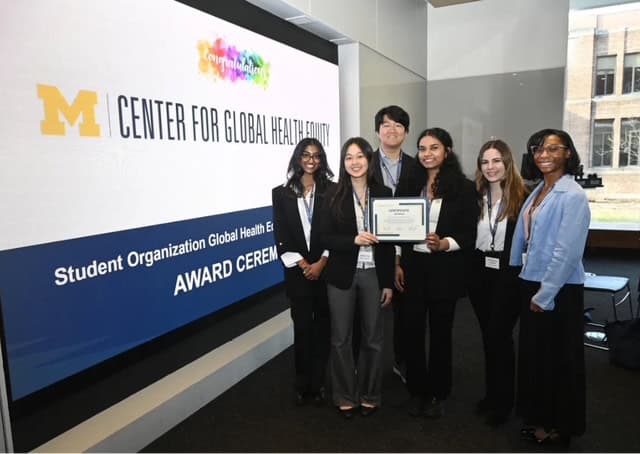
The Initiative’s efforts have achieved campus recognition, most recently winning first place at the Center for Global Health Equity’s (CGHE) 2025 Student Organization Pitch Competition. Students are also working with the CGHE and C-SED (Center for Socially Engaged Design) to develop campus workshops on sustainable global health partnerships. The Initiative’s work has inspired spin-off efforts, including NeoNest Global, a nonprofit with the goal of broader commercialization and impact for the innovations seeded within M-HEAL.
The Initiative Team’s Work on Infant Warming in Ghana
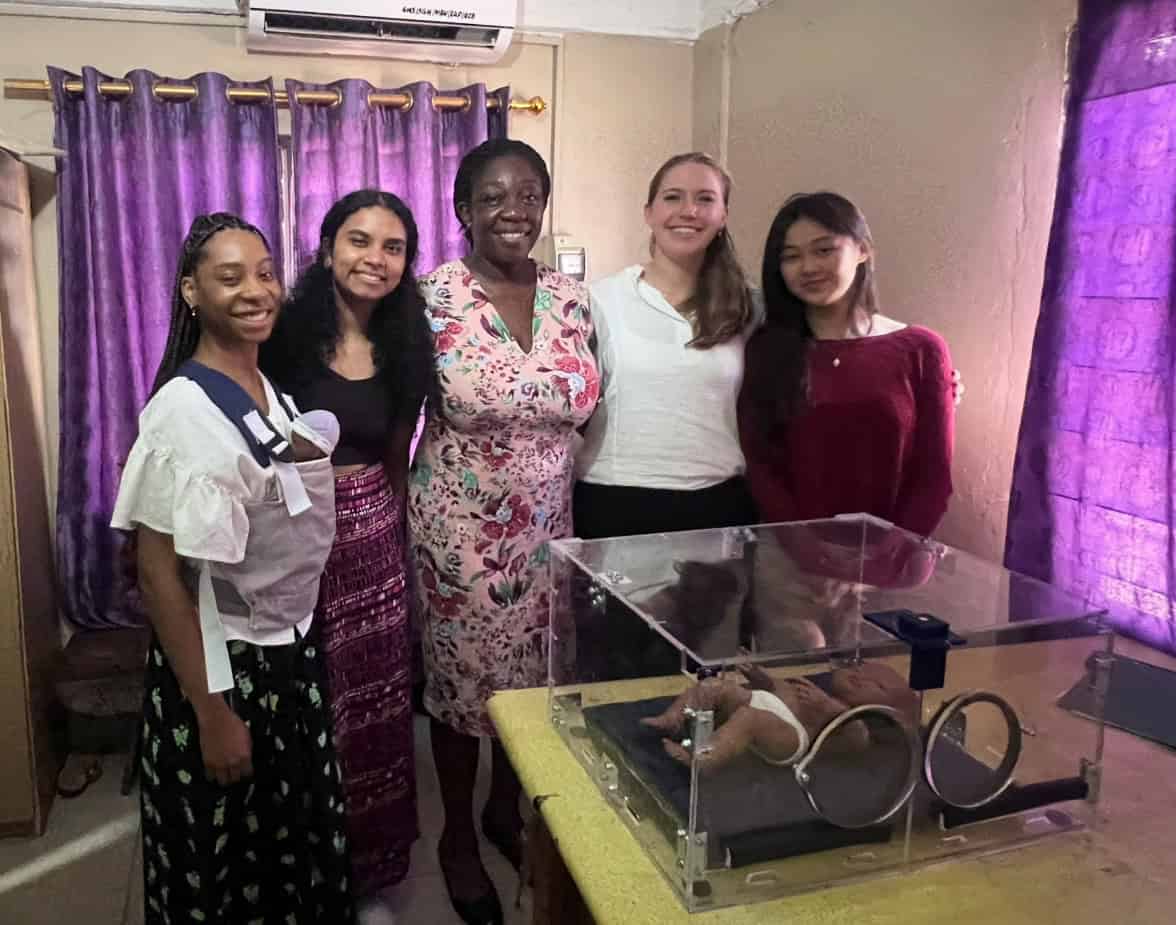
A standout example among M-HEAL’s portfolio is The Initiative’s ongoing work in Kumasi, Ghana, supporting one of the region’s busiest, resource-stretched mother-baby units at Suntreso Government Hospital. The team co-develops solutions with Dr. Joyce Bening and Dr. Ashura Bakari, two pediatricians working in neonatal health.
Based on extensive needs assessments, The Initiative has advanced two prototypes designed to address infant hypothermia, a leading risk for newborns in low-resource hospitals: an affordable, sustainable infant incubator and a kangaroo mother care (KMC) carrier.
The team observed that, due to equipment shortages, critical infants frequently shared donated Radiant Warmers, often leading to an increased risk of infection, inadequate temperature control, and few methods of repair. “We realized there was great value for the infant incubator in providing warmth during transport—especially between the birthing unit and NICU, which aren’t adjacent,” explained Manimaran. “So we designed for that transport-specific need.”
The Initiative’s solutions include both electrical and chemical heating elements, enabling flexibility where reliable power is not always available. Sizing, portability, cleanability, and compatibility with other treatments (such as CPAP and phototherapy) have been optimized through collaboration and repeated testing. “Our materials are chosen so the incubator can withstand cleaning with bleach, and access ports for CPAP and IV lines facilitate comprehensive care,” noted Jung.
The KMC carrier aims to relieve the burden often placed solely on mothers for continuous skin-to-skin care. “For the KMC carrier, we saw that mothers often carry the burden of providing constant warming, sometimes with uncomfortable, load-bearing knots,” Manimaran said. “Our design allows other family members to participate, while aligning with local cultural practices.”
The KMC device aesthetic design is also adapted for the local culture, with vibrant, local market-sourced fabrics and padding for comfort and support. “We wanted something that was beautiful, functional, and easy to transfer between caregivers,” said Jung.
Evolutionary Development and Collaborative Culture
Device development in M-HEAL is evolutionary and community-driven. The Initiative typically progresses through several significant prototype iterations each year, each shaped by feedback from local clinicians and test users—often with preliminary work tested using mannequins before any clinical trials. “Every decision is made with our community partner,” says Manimaran. “We have regular monthly feedback meetings to ensure our work matches their needs.”
Travel to partner sites in Ghana has been pivotal for refining design. “Seeing the clinical environment firsthand really informs our progress and accelerates our understanding and ability to innovate,” Jung added.
A Culture of Lasting Impact
Through its strong emphasis on community partnership, socially engaged design, and hands-on learning, M-HEAL provides its members with a real-world platform to effect change. “Prioritizing other people’s needs in a prototype, and seeing the impact, is a once-in-a-lifetime opportunity,” Jung said.
For students, whether interested in engineering, global health, design, or business, M-HEAL offers more than just extracurricular involvement—it offers inspiration. “Join for your passion,” says Manimaran. “You’ll help impact stories that span continents, and grow as a leader along the way.”
M-HEAL welcomes new members each semester. To learn more about current projects, join, or partner, visit mheal.engin.umich.edu.