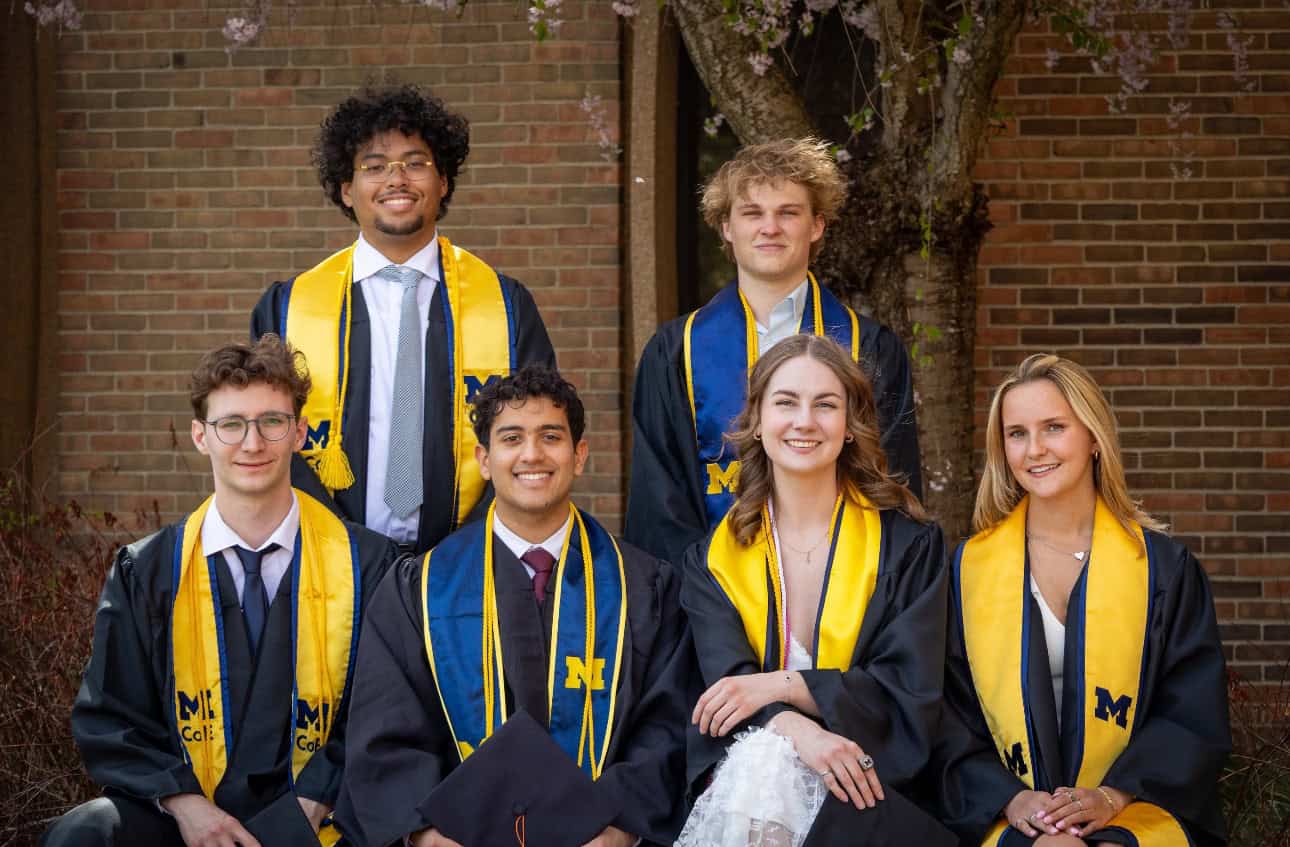
U-M BME’s Team SafeSpike Takes Top Honors in 2025 NIH DEBUT Challenge
Team SafeSpike’s Journey to National Recognition for Innovative Needle Safety Device
5–8 minutes

Team SafeSpike’s Journey to National Recognition for Innovative Needle Safety Device
When the August 25 email arrived sharing the news, U-M BME alum Kian Weihrauch and his teammates could hardly believe it. Their design, SafeSpike—a device ingeniously engineered to prevent needle stick injuries—had won the highly competitive $15,000 HIV/AIDS Prize in the National Institutes of Health’s prestigious Design by Biomedical Undergraduate Teams (DEBUT) Challenge.
“We were honestly shocked,” said Weihrauch. “We only had a semester to ideate and build our prototype, while many teams had a full year. We knew the problem was significant, but never expected to stand out at the national level.”
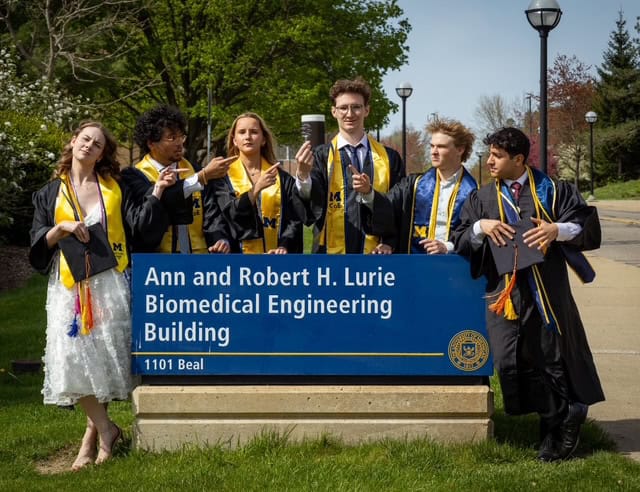
This year’s NIH DEBUT Challenge set a new record, drawing 123 entries from 67 universities and 534 students across 24 states. The University of Michigan’s team, which included Weihrauch, Merrilees Craig, Liam Smith, Nicholas Chan, Sarah Horst, and Saif Alesawy, seized the spotlight with their innovative response to a simple but pervasive need. The team’s faculty sponsor was Dr. Melissa Wrobel.
Identifying a Universal Risk: Gathering Input from Stakeholders
The inspiration for SafeSpike was deeply grounded in the team’s own experiences and conversations with stakeholders, including friends, family, and healthcare professionals. “Almost everyone who’s handled hypodermic needles—whether nurses, doctors, or home caregivers—has stories about accidental sticks,” explained Craig. “The administrative burden involved with the cost and time of follow-up testing, and the very real risk of transmission of HIV, hepatitis, or other bloodborne illnesses, is something that touches so many.”
The senior design class is led by Dr. Wrobel, who works in collaboration with a teaching team of Sam Jensen, M.F.A., Zahra Nourmohammadi, Ph.D., and other faculty. Jensen is a Lecturer III in Technical Communication who served as the team’s Documentation Manager. Nourmohammadi is a Research Specialist and Lab Manager in the Otolaryngology department of Michigan Medicine, who worked as Lecturer I in BME, to serve as this design team’s Engineering Manager. In this role, she met with the team regularly and reviewed their technical work. The course is designed to motivate students to address authentic clinical needs. Class capstone requirements encouraged each group to think big, but also to take concrete steps towards tangible, practical solutions. As part of their process, the SafeSpike team interviewed a diverse set of stakeholders: not just medical professionals, but patients, home caregivers, hospital administrators, and Michigan Occupational Safety and Health Administration (MIOSHA) officials.
As Dr. Wrobel explained, “BME450 is our department’s single-semester capstone course. The goal is to ‘cap off’ students’ Michigan experience by bringing together all the skills they have acquired, and allowing teams to pick a biomedical problem they’re passionate about. The opportunity to choose their own project—and to find real stakeholders to inform their work—fosters excitement and motivation.”
The instructional team encouraged students to examine biomedical engineering challenges in novel ways. “The teaching team of our senior design class encouraged us to think big and think outside of the box,” added Horst. “One group was designing something to help with pacemakers, and another group was doing something to help soon-to-be mothers with at-home diagnosis of preeclampsia. There was a very wide variety of topics. We ultimately ended up choosing this topic because it affects so many people, and we were able to approach it from that direction.”
“The problem is universal,” added Chan. “We discovered that not only clinicians, but also people giving injections at home, face significant risks—and often with much less training than professionals.”
Designing for Impact: From Brainstorm to Prototype
At the heart of SafeSpike is a spherical, spiral spring mechanism designed to shield the needle tip throughout injection—dramatically reducing risk, especially in unpredictable scenarios such as pediatric injections, care for patients with Alzheimer’s, or individuals overcoming substance use disorders.
“What sets SafeSpike apart is how intuitive it is—two steps and you’re protected,” explained Craig. “No professional training necessary. We wanted it to work just as well for a parent at home as for a nurse in a hospital. I think that our design ended up being pretty intuitive. It’s two steps–You screw it into the syringe, and then the needle is on top of that. You don’t have to have a degree or have training, and it’s still able to offer you support and reduce the risk of needle stick injuries occurring.”
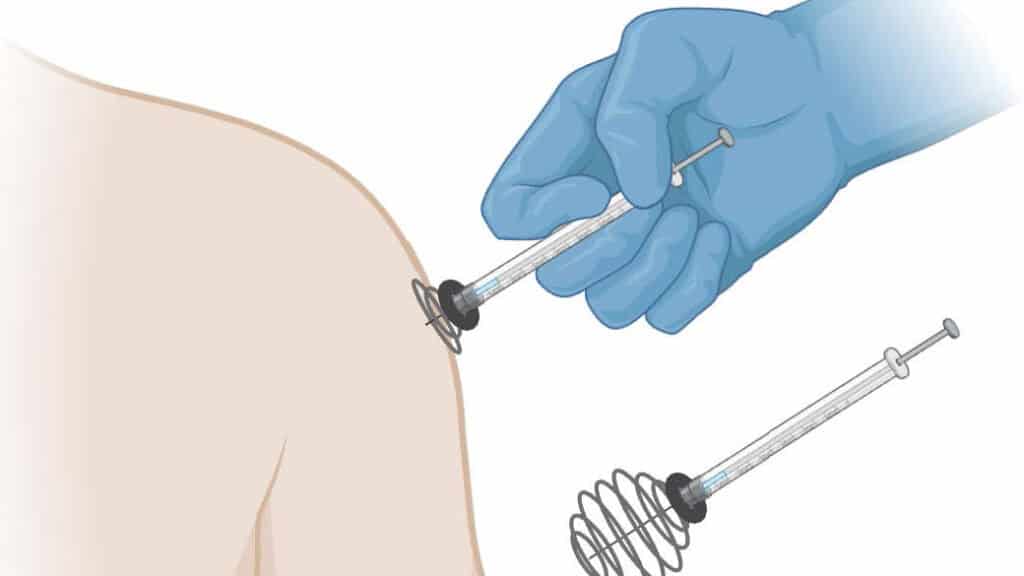
The team’s rigorous prototyping and testing process played a critical role. “We conducted hands-on tests with classmates, injecting gel to simulate real use and even built in ‘shake tests’ to mimic nervous or resistant patients,” remembers Weihrauch. “Every time someone’s hand slipped or twitched, it reinforced why safety was so vital.”
The team’s iterative process led to user-friendly, re-usable, and easy-to-sanitize prototypes that not only filled a clinical need, but also showed strong potential for wide adoption and market feasibility.
Excellence Recognized
Judges for the DEBUT Challenge—jointly sponsored by the NIH’s National Institute of Biomedical Imaging and Bioengineering (NIBIB) and VentureWell—look for innovative, clinically relevant, and feasible solutions.
Dr. Wrobel noted, “The DEBUT Challenge is unique—judges include biomedical faculty and also venture capitalists, so there’s an emphasis on not just innovative design, but the ability to bring something to market. SafeSpike’s elegance and simplicity, combined with thoughtful user research, made it stand out.”
SafeSpike fit the Challenge criteria: a meaningful problem, demonstration of analytical and design skills, effective teamwork, and a working prototype. “The team’s ability to deliver real test results with a functional device in just one semester set SafeSpike apart,” added Smith.
Notably, the SafeSpike team didn’t stop at engineering: they delved into the product’s market potential, patent research, and manufacturing cost analysis. “We made sure to check existing patents, ensuring our design’s novelty, and calculated our production costs to make sure SafeSpike could be realistically implemented,” said Chan.
The $15,000 NIH Office of AIDS Research prize will be divided equally among the team members, who will officially be recognized at the Biomedical Engineering Society’s (BMES) 2025 meeting in San Diego. There, they will also participate in NIH-led workshops on how to develop innovative prototypes for real-world clinical use.
A Lasting Michigan Legacy—and Looking Ahead
Though each team member has since graduated and started new adventures—including graduate school at MIT and U-M, law school at Michigan State, industry roles at Stryker and Coinbase, and applications to dental school—the team remains eager to keep in touch and keep SafeSpike moving forward. “We’re scattered around the country now, but we’re still exploring patent options, and we will see what support NIH can offer,” said Smith.
Craig added: “We wouldn’t have reached this level without the incredible guidance from our instructors. Dr. Wrobel’s encouragement to submit to national awards inspired us to push beyond what we thought possible in a semester. It’s a testament to the strength of U-M’s BME program.”
Dr. Wrobel’s advice for future students echoes the course’s philosophy. “You have to make sure you’re solving the problem your users are really facing,” she said. “More ‘complicated’ doesn’t necessarily mean more successful—focus on user needs and consider the full lifecycle from product development to end use.”
She added: “Trust the process. This team didn’t know on day one what they’d ultimately create. There were so many iterations, failures, and improvements along the way. Stay open to feedback, and keep refining your design—you’ll end up with something better than you ever expected.”
As the team looks to the future—whether that includes a patent, new rounds of prototype testing, or maybe even commercial partnership—Team SafeSpike exemplifies the ethos of Michigan Engineering: bold ideas, teamwork, and real-world impact.
Watch the video Team SafeSpike entered in the competition and meet all of the winners in the 2025 NIH DEBUT Challenge.