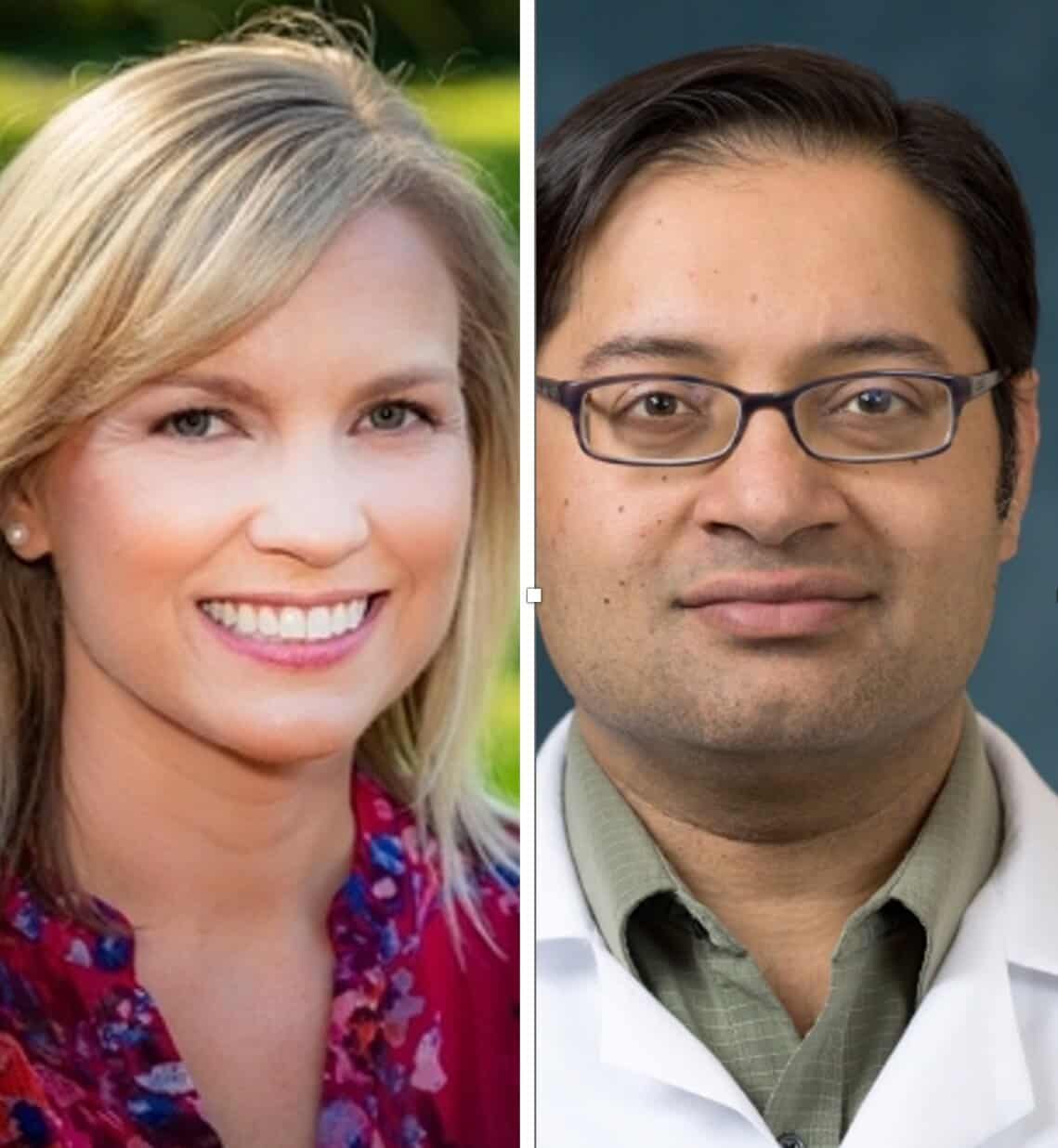
From decoding the microbial changes that shape lung health, to harnessing wearable tech to improve cancer care, U-M BME researchers are at the forefront of tackling some of society’s biggest challenges. In the latest round of U-M’s Bold Challenges Boost grants, BME core faculty Kelly Arnold, Associate Professor, and associate faculty Muneesh Tewari, Ray and Ruth Anderson-Laurence M. Sprague Memorial Research Professor and professor of internal medicine and biomedical engineering, underscore the department’s reputation as a center of collaborative innovation.
The Bold Challenges Initiative, now in its third cohort, funds early-stage, boundary-pushing research teams with up to $75,000 and personalized workshops, accelerating projects with the potential for large-scale impact. With recipients spanning nine U-M colleges and units, the program’s latest roster offers a snapshot of the foundational role that BME expertise is to future-shaping collaborations.
“These researchers are seeking to solve some of the world’s most difficult challenges and create innovations that will benefit individuals and society as a whole,” said Arthur Lupia, vice president for research and innovation. “Our university is uniquely positioned to tackle complex problems that require interdisciplinary solutions. Programs like Boost help researchers launch the projects that lead to world-changing discoveries.”
Cracking the Microbiome-Lung Connection: Kelly Arnold’s Partnership in Precision Respiratory Health
Associate Professor Kelly Arnold, who is recognized for her work in computational modeling of complex biological systems, is a force behind the Boost-funded project, Decoding the Role of Microbial Dynamics for Precision Respiratory Health. Dr. Arnold’s team is deciphering how changes in the respiratory microbiome—critical communities of bacteria, fungi, and viruses—impact lung disease susceptibility and progression.
Dr. Tewari’s area of focus is Harnessing Mind-Body Interactions Using Wearable Technologies and Data Science to Improve Cancer Outcomes. He will work with a cross-campus team aiming to unlock the therapeutic power of mind-body interactions for cancer patients, leveraging wearable technologies and advanced data science.
“At U-M BME, our mission is to translate science and engineering into solutions for challenges in medicine and the life sciences,” said Mary-Ann Mycek, William and Valerie Hall Department Chair and Professor, Biomedical Engineering. “The Bold Challenges Boost grants awarded to our faculty highlight our commitment to collaborative innovation and demonstrate how we’re driving real-world impact on society’s most complex health issues.”
Applications for the initiative’s next cohort open in spring 2026, and the department looks forward to seeing how BME researchers will continue to drive change—across campus, and far beyond.For more on U-M’s Bold Challenges Initiative and the list of 2025-2026 Boost teams, visit the University Record article.