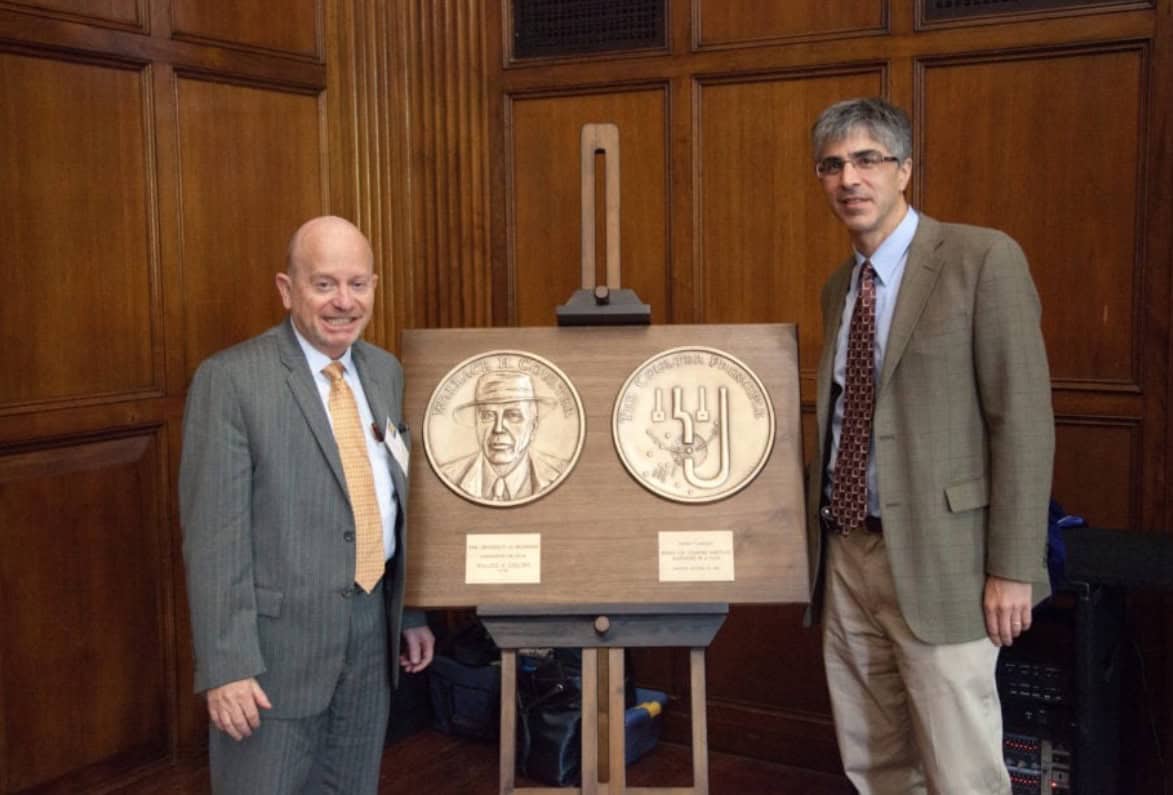
In 2005, U-M took a bold step into uncharted territory when it was one of 10 initial universities to receive funds to launch its Coulter Translational Research Partnership Program—a step that would not only redefine the Biomedical Engineering (BME) Department, but also continue U-M’s global reputation in translating innovations “from bench to bedside.” Now, on the cusp of the program’s 20th anniversary, BME’s faculty, staff and alumni look back on the transformative power of the Coulter Foundation—and forward to a future shaped by its ongoing legacy. The program, which was established with a $20M endowment, supports the translation of promising technologies within research laboratories that are progressing towards commercial development and clinical practice.
A New Era: From Publishing Papers to Impacting Patients
The 1990s focus on “translational research” challenged academia to think beyond basic science, urging them to deliver products that would directly impact human health. That goal became reality at U-M with an initial $5-million grant from the Wallace H. Coulter Foundation in 2005. The support wasn’t just financial: research teams consisting of both engineers and clinicians were coached through commercial development from the earliest stages. The impact was immediate and measurable—in the first five years, 19 projects were funded, spawning four startups and drawing $25 million in follow-on support.
“It allowed me to marry my two loves, industry and academics,” said former BME Chair Dr. Matthew O’Donnell, in a January 2018 BME website article. Dr. O’Donnell had been Chair at the time of the 2005 award announcement. “Especially for our junior faculty, to be exposed to a world where you don’t just write papers; you put out a device…that people will actually use in the clinic.”
An Inside Perspective: Doug Noll Remembers
Few have witnessed the evolution of U-M’s Coulter program more closely than BME Professor and former Chair, Doug Noll, who was interim Chair when the first research projects were launched in 2006. As he reflected, “We were starting from no program, basically. The Office of Tech Transfer, what Innovation Partnerships was called at that point in time, had a number of programs, but nothing focused on our department.”
Dr. Noll emphasized the unique clinician-engineer partnership at the heart of Coulter’s formula. “That was by design, from the Coulter Foundation,” he said. “They believed that this was the magic formula, and I think it did serve us quite well.”
While the program was in its infancy, Dr. Noll said that many in the department gradually realized the program was not a traditional grant, and that it needed to have a different structural foundation than traditional research support that had faculty and graduate students focused purely on research and writing papers.
Instead, the program revealed that critical activities—such as market analysis, regulatory pathways, and intellectual property work—were often the “missing pieces that are necessary to commercialize” innovations. “These are things that the students may be interested in, but they’re not the things that you typically do in a Ph.D. program, where you’re focused on scientific innovations,” Dr. Noll added. “We evolved the program collaboratively with the Foundation, and the department and the Foundation were learning together as we moved forward.”
A Catalyst for Department Growth
The significance of the Coulter Translational Research Partnership Program for a young U-M BME department cannot be overstated, according to Dr. Noll. “We were a small department at that time (in 2005),” he recalled. “There were about 10 or 11 primary faculty in the department. We were looking to grow, and the college wanted us to grow, so this was important for us. Externally it gave us a lot of visibility among other esteemed institutions—but it was also important internally within the university and the College of Engineering because it gave our department recognition that we could be a key contributor in this field.”
“At that point in time, we were mostly a graduate education focused department,” Dr. Noll added. “We were just starting the undergraduate program, but it was still pretty small, and we were trying to grow it. For us, Coulter was a big deal, because this was a high-profile victory for us.”
The Coulter program’s success helped fuel a $10-million endowment from the foundation in 2011—matched by $5 million from U-M’s College of Engineering and $5 million from the Medical School for a $20-million fund. “By the time this endowment was awarded, we had received formal approval within the university to become a joint department,” said Dr. Noll, highlighting how Coulter not only anchored relationships between engineering and medicine, paved the way for other translational research programs at U-M, and returned the focus to the breadth and depth of biomedical engineering’s role in the university and the profession.
Highlighting the departmental and institutional growth, Dr. Noll acknowledged, “The Coulter Translational Research Partnership Program certainly was an important factor when drawing us into the medical school.” Becoming a joint department integrated our department chair into the medical school chair’s meetings and strategic planning activities, to allow for more regular interactions with medical school departments and faculty. It literally gave us a seat at the table. I think receiving the Coulter program support really helped us strengthen connections between Engineering and the Medical School.”
Lessons Learned: Crossing the “Valley of Death”
For Dr. Noll, the essence of the Coulter Translational Research Partnership Program’s legacy is its commitment to translation, across all areas of the breadth of BME. “The phrase ‘Valley of Death’ is where people come up with innovations, but can’t coordinate the critical pieces necessary to commercialize them,” he said. “Unfortunately, many great ideas that are hatched in university laboratories often fizzle out for lack of being able to cross that valley. Translation of technology should help faculty maintain the focus on the end goal of all of what we do–which is to improve the health of people in the world.”
Over time, the Coulter program adopted a more sophisticated selection process, weighing projects’ probability of commercial and clinical impact. “There’s just no question,” Dr. Noll reflected, “that initially, we were excited by interesting science that was a long way from translation.”
“I was always surprised at how many pieces—the market, the intellectual property, the regulatory aspects and financing, the business model… how many things needed to come together in order to make something come to fruition,” Dr. Noll said. “It’s a lot more than just having one clever idea.”
Measurable Impact on Patient Care
A benefit to teams going through the Coulter process is working with the Coulter Program Director, the Oversight Committee, Innovation Partnerships and other external partners to guide teams as they develop proposals and research plans. According to Tom Marten, Managing Director of the Coulter Program, “The whole idea is to leverage Coulter funding to demonstrate incremental value and enable follow-on-funding from other sources within the university or as new company spinouts with grants and investor financing to continue development.”
In two decades, Coulter-funded projects at U-M have led to 20 exits–defined as licensing the intellectual property rights to existing revenue generating companies or to startups who raise angel or venture capital financing (metrics that were defined by the Coulter Foundation and part of the Endowment Agreement). BME’s Coulter program has also resulted in 6 FDA approvals, more than $650 million in external investment, and a range of technologies now benefitting patients—including standouts such as the spin-off company, HistoSonics, which further developed and commercialized the non-thermal focused ultrasound for non-invasive precision surgery known as histotripsy.
“The most famous one that comes out of our program is HistoSonics, which has done extremely well,” Dr. Noll said. “Charles Cain (a now-deceased faculty member in whose lab Histotripsy was discovered and developed) had said that he didn’t know if this would have happened, or at least not as fast as it had, if the program had not supported some critical studies.”
Importantly, Coulter’s influence didn’t end with BME. Because of the project team structure that requires an engineer and a clinician, colleagues throughout the College of Engineering and the Medical School collaborate, bolstering the impact and reach of the program.
Looking to the Future
“The Coulter Program was really the first to recognize the potential for academia to spinout medical technology concepts that could move toward impacting patient care,” said Jonathan Fay, Clinical Associate Professor of Practice, Biomedical Engineering and Associate Chair for Translational Research. “The key was bringing in frameworks from industry on how to de-risk projects early from a technological, market, and business points of view. The Coulter program has been a thought leader in university-based innovation. In 2005, many viewed university licensing and startups as a distraction. Now in 2025, playing an active role in creating societal and economic impact from our research discoveries is considered a central part of our mission. Experiences with the Coulter Program have been instrumental in informing what additional issues or gaps needed to be addressed to bridge from research to impact. The Michigan program in particular has been very innovative in exploring different models and stretching the boundaries of what can be done within the university. It really is an exciting time for medical innovation. Our knowledge of genetics, biologically based therapies, and neurology are combining with powerful technologies like AI, microrobotics, and neuro-prosethics. Programs like Coulter are so important for building the culture of doing great science that matters.”
As the BME Department’s Coulter Translational Research Partnership Program reaches its 20-year mark, Dr. Noll is proud of what it has achieved. “I think that Coulter has had an impact, both in terms of impact on faculty and how they think about their work, but also in terms of the startups and the technologies that have been licensed and have now resulted in FDA-approved products that are having a positive effect on patients’ lives.”
“For two decades, the BME Department’s Coulter Translational Research Partnership program has been a cornerstone of biomedical innovation and clinical translation, not only for faculty in the BME Department, but also for researchers across the University of Michigan – in the College of Engineering, the Medical School, Dentistry, Pharmacy, and so on,” noted Mary-Ann Mycek, the WIlliam and Valerie Hall Department Chair, Biomedical Engineering, and Professor, Biomedical Engineering. “We empower interdisciplinary teams of researchers to transform biomedical discoveries into real-world solutions. Our program’s enduring impact is reflected not only in remarkable technologies that revolutionize clinical care, but also in fostering a culture of collaboration and entrepreneurship in biomedical engineering that benefits our students and faculty locally, as well as patients and communities worldwide.”
One example of a Coulter project with global reach is HistoSonics: On August 7, the company announced a management-led majority stake acquisition by a syndicate of globally recognized private and public investors. This acquisition values the company at approximately $2.25 billion, positioning it for accelerated growth of the Edison System across new clinical indications and global markets, enabling histotripsy to treat more patients. (Please read details about the HistoSonics announcement on page XX of this magazine.)
Dr. Noll’s final reflection summarizes the core of Coulter’s story at U-M: “Translation of technology should help faculty keep in their mind on the end goal of all that we do–which is to improve the health of people in the world.”
For more on the legacy and future of the U-M Coulter Translational Research Partnership Program, visit this webpage.
Some quotes and background details originally appeared in a 2018 BME department story.