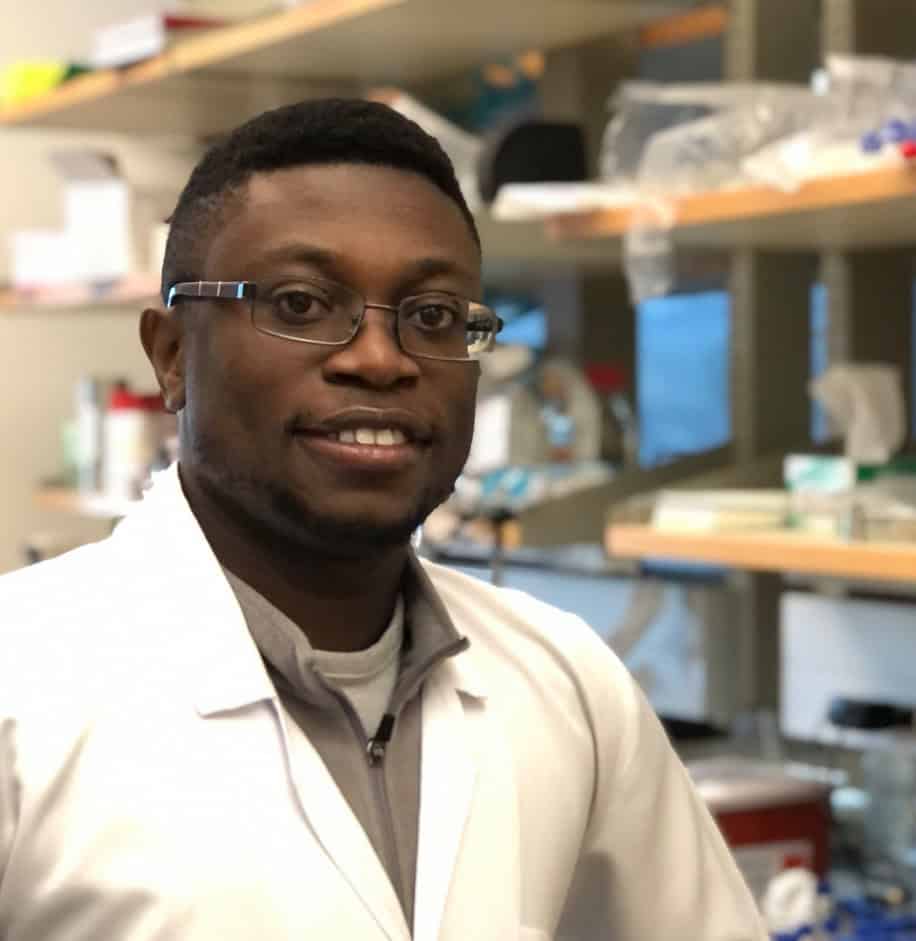
Welcoming Chima Maduka to BME
Dr. Maduka’s research aims to uncover insights into the role of immune cell metabolism in driving disease progression, such as in heart failure post-myocardial infarction.
3–5 minutes

Dr. Maduka’s research aims to uncover insights into the role of immune cell metabolism in driving disease progression, such as in heart failure post-myocardial infarction.
U-M BME welcomes Chima Maduka, DVM, Ph.D., to our faculty as an Assistant Professor. Dr. Maduka joins us from the University of Colorado—Boulder, where, as an American Heart Association postdoctoral fellow, he developed biomaterial platforms for drug delivery after a heart attack (myocardial infarction).
Dr. Maduka’s journey to Michigan is rooted in diverse, interdisciplinary academic pursuits. He earned his Doctor of Veterinary Medicine (DVM) with Distinction from the University of Maiduguri in Nigeria, followed by an M.S. and Ph.D. from nearby Michigan State University, where he introduced a tissue engineering paradigm, revealing how immunometabolism fundamentally drives adverse, chronic inflammation from biomaterials and how this can be leveraged for pro-regenerative outcomes.
“I’m truly thrilled to join the BME community at Michigan,” Dr. Maduka said. “It’s a phenomenal opportunity to extend interdisciplinary research and innovation at the intersection of immunometabolism, drug delivery and chronic inflammatory diseases, especially the different phenotypes of heart failure. At Michigan, I’m excited to leverage existing partnerships and build new collaborative networks to push the boundaries of our understanding of heart failure and other chronic conditions.”
Dr. Maduka’s research aims to uncover insights into the role of immune cell metabolism in driving disease progression, such as in heart failure post-myocardial infarction. “My research will focus on understanding and treating the immunometabolic basis of chronic diseases,” he said. “By investigating heart failure after myocardial infarction, we will understand the role of immune cell metabolism in driving this syndrome, and then transition to engineering biomaterials to locally deliver drugs that interrupt disease progression, ultimately to heal and regenerate diseased tissues.”
“My research will primarily focus on heart failure, but joining U-M BME opens doors to expand these methodologies to chronic conditions such as vascular and immune pathologies, cancer, obesity and diabetes,” Dr. Maduka added. “Michigan’s vast array of expertise offers huge collaborative opportunities across various specialties, both within BME and beyond—such as in Materials Science, Cardiology, and Cardiac Surgery—allowing for the clinical translation of basic science advances from our group.”
Dr. Maduka had become interested in this topic while working on the role of immune cell metabolism in driving chronic inflammation resulting from the implantation of biomaterials in the body. “When various biomaterials are applied in the body for different applications—such as orthopedic and cardiovascular uses, or in drug delivery for various regenerative purposes—some of these biomaterials elicit an immune response, often called a host response. This inflammatory response can then impair or prevent the biomaterials from actually functioning. I was very interested in understanding how we can halt or control this process. Or better still, how we can actually leverage this process to drive a pro-regenerative response to produce better outcomes in patients.”
Dr. Maduka’s ties to Michigan run deep; during his doctoral studies at Michigan State, he collaborated with several U-M researchers, reinforcing the strength and impact of interdisciplinary research synergy. “I have history with Michigan,” he noted. “During my Ph.D., I collaborated with faculty members here, including Dr. Kurt Hankenson, DVM, Ph.D., Henry Ruppenthal Family Professor of Orthopaedic Surgery and Associate Chair for Research, and Dr. Peter Scott, Paul L. Carson Collegiate Professor in Radiology, who were both instrumental in shaping my academic path. Joining this visionary community as a Michigan Program for Advancing Cultural Transformation (M-PACT) scholar, which is devoted to inclusive excellence across the biomedical and health sciences, feels like coming home.”
In addition to his research and mentorship, Dr. Maduka is passionate about teaching and giving back through service. “I am truly excited to teach biomaterials and tissue engineering,” he said. “I recognize that the next generation of biomedical engineers and researchers will have to excel in highly interdisciplinary teams, as they develop biomedical technologies, often alongside clinicians. My unique clinical background will be leveraged to provide students with essential exposure to such engineer-clinician interactions, inspiring them toward excellence.”
Dr. Maduka’s vision aligns perfectly with U-M BME’s commitment to bridging engineering and medicine, fostering an interdisciplinary approach to tackling grand scientific challenges. “The biggest questions in science cannot be answered by one person or one discipline,” Dr. Maduka said. “It really involves bridging gaps and building these very interdisciplinary strengths, which were the things that resonated with me and attracted me to Michigan. I am definitely thrilled to be here and to be part of the BME community, to contribute to the growth and to the vision that already exists, and to be part of something this meaningful, this impactful, and to contribute to the diverse strengths of the broader community. I like to think of BME like a really big family, where we can support one another and can all grow together and win together.”