BME Summer Workshops @ Michigan Highlight the ‘Future of Neurotechnology’
The event also featured a new session: a student-focused hackathon, which encouraged hands-on collaboration and rapid prototyping developed around neurotechnology-themed challenges.
This year’s BME Summer Workshops @ Michigan focused on the “Future of Neurotechnology,” bringing together leading researchers, clinicians, and students to discuss emerging tools and approaches shaping the future of brain research and innovation. This two-day immersive workshop explored the frontiers of neurotechnology, where innovative engineering meets transformative neuroscience by highlighting transformative developments in researchers’ understanding of brain connectivity, decoding, and modulation, focusing on advancing the promise of precision neuromodulation, brain-machine interfaces, and data-driven neurological therapies.
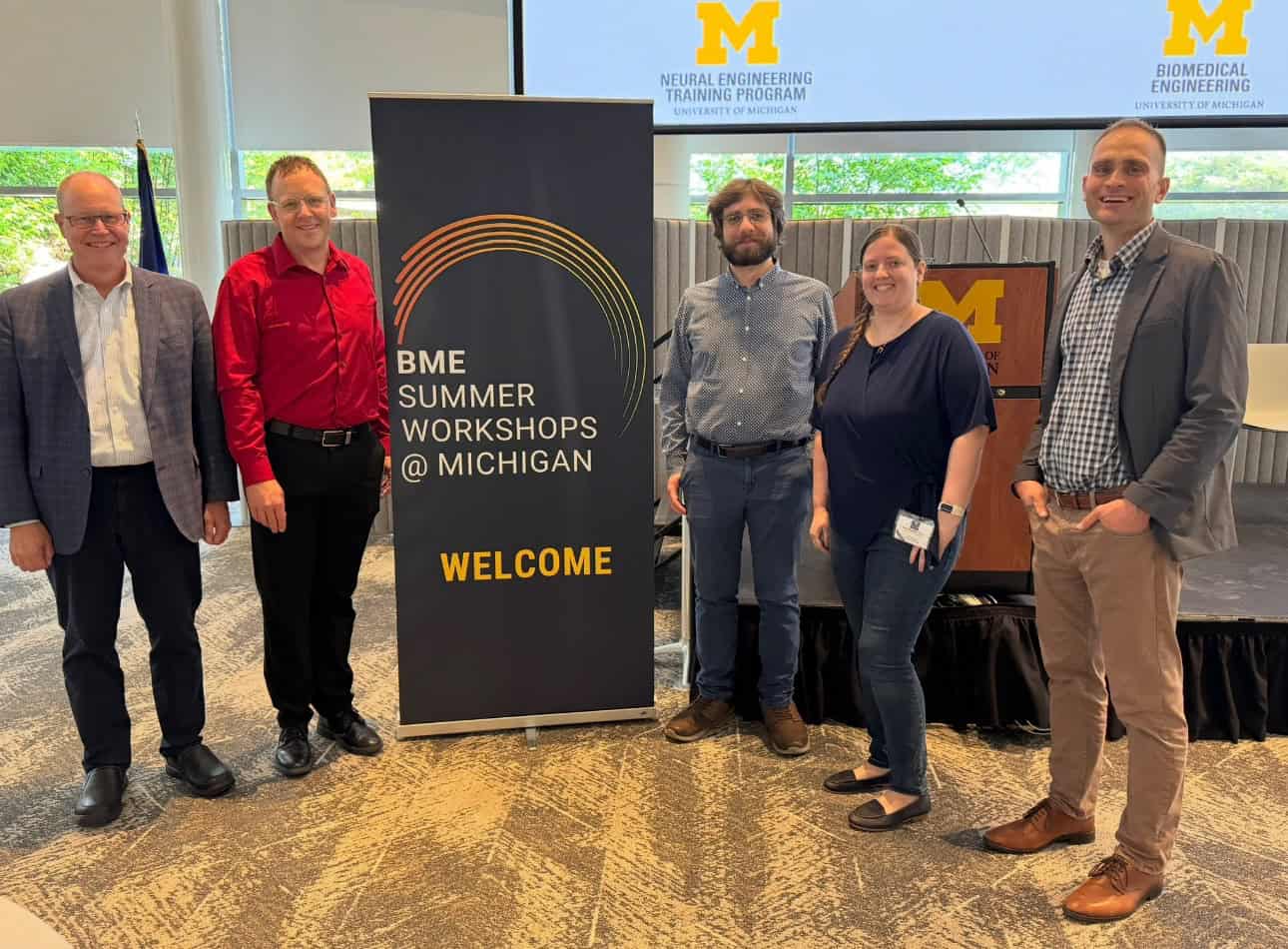
Anne Draelos, Assistant Professor, Biomedical Engineering, and Computational Medicine & Bioinformatics; Enrico Opri, Assistant Professor, Biomedical Engineering and Neurology, and Matthew Willsey, M.D., Ph.D., Assistant Professor, Neurosurgery and Biomedical Engineering, were the faculty leaders of this year’s sessions.
“BME summer workshops offer a valuable forum for exploring rapidly evolving research areas with significant societal implications,” Dr. Draelos said. “Neurotechnology is a prime example, and we benefited enormously from discussing future possibilities across differing viewpoints.”
“This workshop was a great journey on the current and future perspectives on neurotechnology, and reminded me how powerful it is when engineers, neuroscientists, and clinicians at all stages come together around a shared vision,” Dr. Opri said.
“I truly enjoyed gaining insights from leading BCI researchers and felt energized by the enthusiasm of students who attended,” Dr. Willsey added.
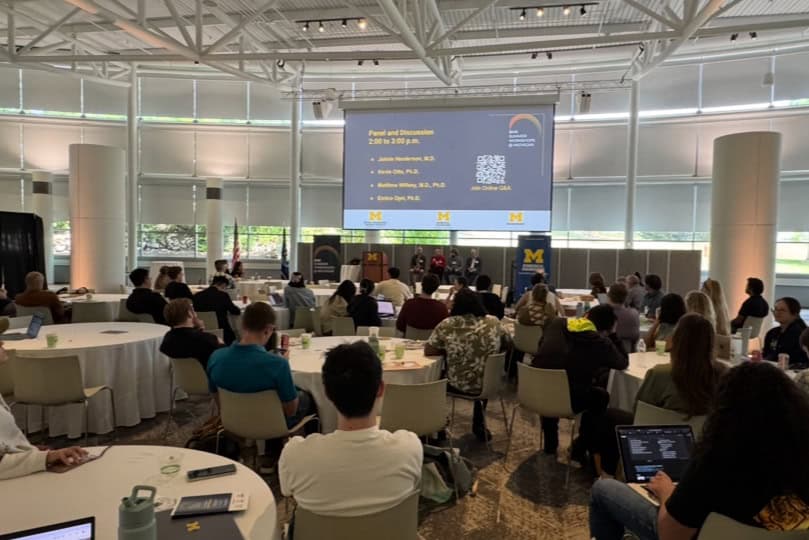
Featuring four focused scientific sessions on Neural Interfaces, Neuroprosthetic Applications, Computational Approaches, and Network Dynamics and Neuromodulation, the event includedmultiple panel discussions on Pioneering the Future of Brain Innovation, with highlights on envisioning the next decade of brain research. Attendees enjoyed an interactive poster session, sponsored by the Neural Engineering Training Program (NETP), which showcased ongoing work from trainees and faculty. It was led by NETP Trainees Emily Bence, MS, and Chinwendu Nwokeabia, MS. This year’s student winners were Jake Joseph, Liam Matthews andJacky Tian.
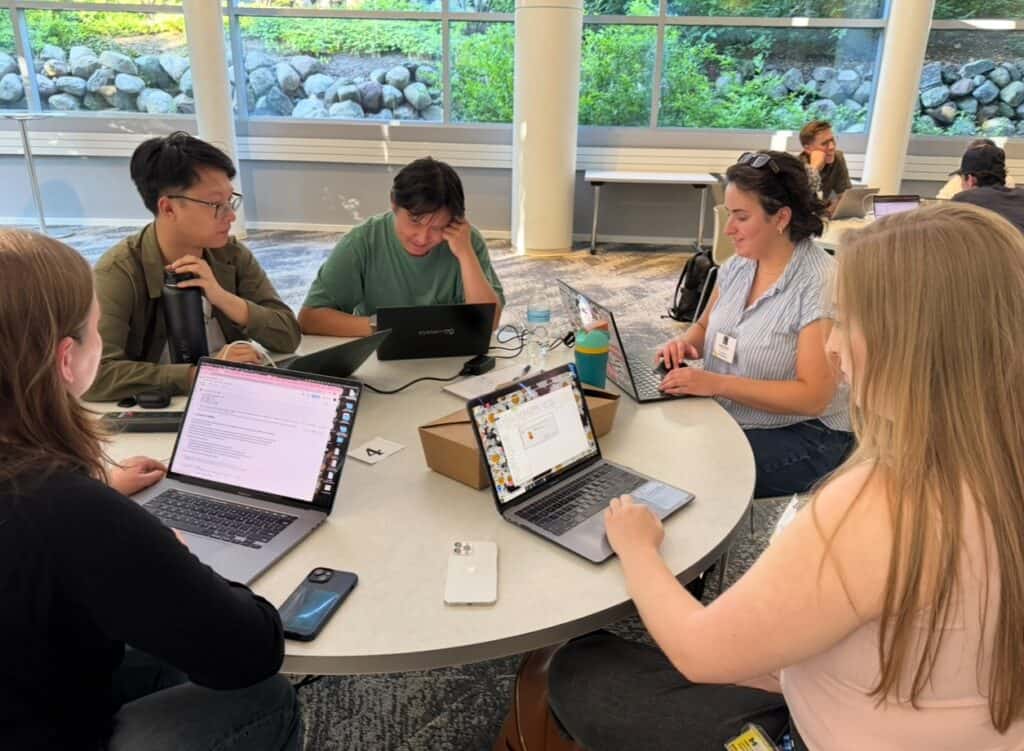
The event also featured a new session: a student-focused hackathon, which encouraged hands-on collaboration and rapid prototyping developed around neurotechnology-themed challenges. Students gathered into teams and worked to solve a research question of their choosing based on the data they were given. “This is the first time we did this activity as part of the workshop,” said Anjali Shankar, MS Research Associate, Hackathon Event Organizer. “All we provided were two data sets and helpful starter code, but the rest was up to them. We were just honestly excited to see what the students came up with,” she added. Judges scored teams on several criteria, including scientific impact, effort and execution, and communication. This year’s winners were Owen MacKenzie, Liam Matthews, Prateek Pinchi and Lucy Liu.
“For those who have less experience, the hackathon was a great opportunity for students to be empowered to try new things that may or may not work in practice,” said Dr. Draelos. “We want students to possibly use Generative AI when coding, and this might be their first exposure to it in a casual way.”
“It’s important for these students to enjoy bonding and to have a networking opportunity with science as the foundation for that,” added Dr. Opri. “The collaboration with people from different backgrounds in an informal forum allows participants to feel less bound by conventional expectations, so students are more likely to try new things that go beyond their comfort zone. That’s how discoveries are made.”
“It’s been a really amazing conference with great speakers,” said graduate student MacKenzie, “Having the hackathon, too, was a great addition because it allowed us to practice implementing some of the ideas firsthand that we discussed during the other parts of the session.”“I think it’s a wonderful way for the community to come together because you’re normally very busy doing your own thing, and very rarely do we get to see other people’s work, so it’s great for PIs, graduate students and everyone to come together have conversations about our research,” added BME graduate student Zan Huang.